
The global multiple orifice flow control valve market is witnessing steady growth as industries increasingly prioritize efficiency, safety, and automation in fluid-handling systems. Multiple orifice flow control valves are engineered to precisely regulate fluid flow by splitting a single flow stream into multiple orifices, which reduces pressure fluctuations, minimizes cavitation, and ensures stable downstream operation. These valves are widely utilized across oil & gas, chemical, petrochemical, water treatment, and power generation sectors, where accurate flow control is critical for operational efficiency and regulatory compliance.
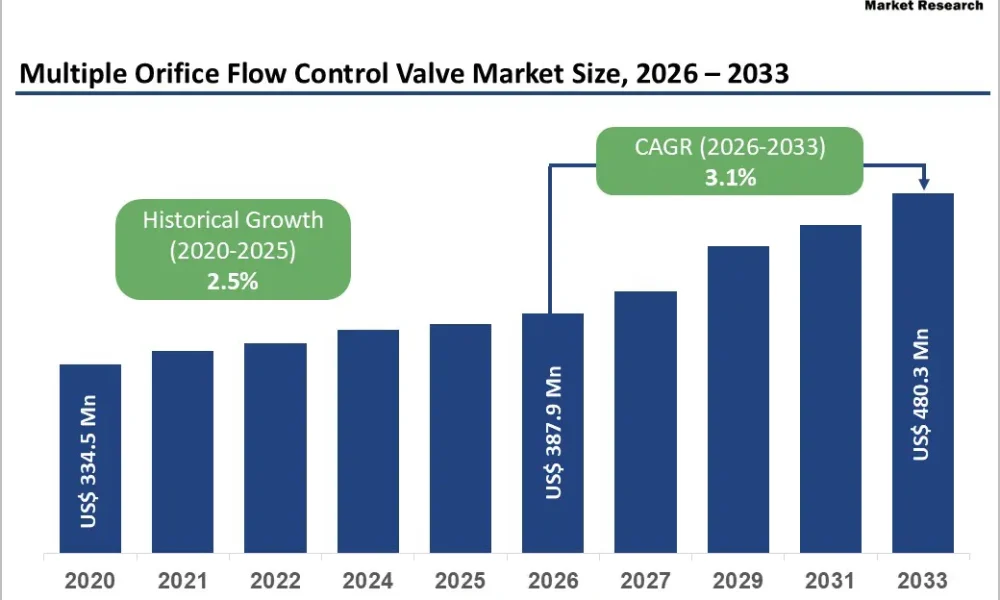
The market is projected to grow from US$ 387.9 million in 2026 to US$ 480.3 million by 2033, registering a CAGR of 3.1% during the forecast period. The globe’s oil and gas sector remains the leading end-user segment due to the extensive use of multiple orifice valves in upstream, midstream, and downstream operations for pressure management and energy-efficient flow distribution. North America leads geographically, supported by strong infrastructure investments, stringent safety and emissions regulations, and early adoption of smart manufacturing and automation initiatives in chemical and petrochemical industries.
Key Highlights from the Report
• The global multiple orifice flow control valve market is projected to reach US$ 480.3 million by 2033.
• Oil and gas remains the largest end-user segment, driven by pressure-control needs.
• North America dominates due to infrastructure investments and regulatory compliance.
• Adoption of automated and smart valve systems is increasing across chemical and petrochemical sectors.
• Multiple orifice valves are preferred for their superior pressure drop and flow management capabilities.
• Energy efficiency and operational safety requirements are key growth drivers.
𝐆𝐞𝐭 𝐚 𝐒𝐚𝐦𝐩𝐥𝐞 𝐏𝐃𝐅 𝐁𝐫𝐨𝐜𝐡𝐮𝐫𝐞 𝐨𝐟 𝐭𝐡𝐞 𝐑𝐞𝐩𝐨𝐫𝐭: https://www.persistencemarketresearch.com/samples/28399
Market Segmentation
The multiple orifice flow control valve market is segmented based on valve type, application, and end-user industry to accommodate diverse operational requirements.
By valve type, the market is classified into globe valves, ball valves, and other specialized valves. Globe valves are widely adopted due to their precise flow control, reliability under high-pressure conditions, and versatility in industrial applications. Ball valves are gaining popularity in automated systems for their quick shut-off capabilities and reduced maintenance needs. Specialized MOFCVs, including custom multi-orifice designs, serve niche industrial applications requiring unique flow distribution and pressure control characteristics.
By end-user industry, MOFCVs are utilized in oil & gas, chemical & petrochemical, water & wastewater treatment, power generation, and other process industries. Oil and gas leads due to extensive use in pipelines, refineries, and natural gas processing plants. Chemical and petrochemical facilities increasingly deploy MOFCVs to manage aggressive fluids and maintain compliance with strict safety and emission standards. Water and wastewater treatment plants rely on multi-orifice valves to maintain stable flow rates, prevent pipe erosion, and optimize pump efficiency. Power generation facilities, particularly thermal and nuclear plants, implement MOFCVs in feedwater, condensate, and cooling systems to achieve precise pressure and flow regulation.
By application, the market is divided into pressure reduction, flow control, and safety/shutdown systems. Pressure reduction remains the leading application, with multi-orifice design minimizing pressure drops and mitigating cavitation, thereby enhancing system reliability. Flow control applications are increasingly automated, particularly in chemical, petrochemical, and water treatment plants, to maintain constant operational conditions. Safety and shutdown systems utilize MOFCVs for critical operations where precise valve performance is essential to prevent accidents or equipment damage.
Regional Insights
North America maintains market dominance due to robust investment in oil and gas infrastructure, advanced chemical and petrochemical facilities, and early adoption of automated valve systems. Regulatory pressures for emissions reduction and operational safety are compelling industrial operators to upgrade fluid-handling systems with MOFCVs.
Europe follows closely, supported by stringent environmental regulations and growing investments in process automation. Countries such as Germany, France, and the U.K. are investing in energy-efficient industrial systems and advanced chemical processing technologies, boosting demand for multiple orifice valves.
Asia-Pacific is emerging as a high-growth region, driven by rapid industrialization, expansion of oil refineries and petrochemical plants, and increasing adoption of automated process equipment. Nations like China, India, and Japan are prioritizing efficiency and safety in fluid-handling infrastructure, creating significant opportunities for MOFCV manufacturers.
Middle East & Africa show moderate growth due to continuous investment in oil & gas infrastructure and desalination projects. Latin America is witnessing emerging demand from chemical and energy sectors, with focus on modernizing industrial facilities and improving process reliability.
𝐆𝐞𝐭 𝐚 𝐂𝐮𝐬𝐭𝐨𝐦𝐢𝐳𝐞𝐝 𝐌𝐚𝐫𝐤𝐞𝐭 𝐕𝐢𝐞𝐰 𝐢𝐧 𝐎𝐧𝐞 𝐂𝐥𝐢𝐜𝐤 : https://www.persistencemarketresearch.com/request-customization/28399
Market Drivers
The MOFCV market is primarily driven by the need for energy-efficient flow control, stringent safety and emission regulations, and the adoption of automated valve systems. Industrial sectors such as oil & gas, chemical, and petrochemical increasingly require precise pressure and flow management to optimize operational efficiency, reduce energy consumption, and ensure compliance with regulatory standards. Additionally, smart manufacturing initiatives are compelling industries to integrate advanced multi-orifice valves into automated control systems, facilitating real-time monitoring, enhanced process safety, and reduced operational costs.
Market Restraints
Market growth is restrained by high capital investment requirements, complex installation processes, and specialized maintenance needs. Multi-orifice flow control valves often require skilled technicians for installation, calibration, and maintenance, which can increase operational costs and deter adoption among small and medium-sized enterprises. Additionally, compatibility challenges with existing legacy systems in industrial facilities may slow the integration of MOFCVs in certain regions.
Market Opportunities
Opportunities exist in the development of smart MOFCVs, IoT-enabled valves, and customized designs for specialized industrial applications. Increasing demand for digital monitoring and predictive maintenance creates avenues for smart valve adoption, particularly in automated chemical, petrochemical, and water treatment plants. Emerging markets in Asia-Pacific and the Middle East offer significant growth potential, with new oil & gas infrastructure and industrial expansion driving demand for high-performance flow control solutions. Manufacturers focusing on energy-efficient, durable, and automated MOFCVs are well-positioned to capitalize on evolving industrial requirements.
𝐂𝐥𝐢𝐜𝐤 𝐭𝐨 𝐏𝐮𝐫𝐜𝐡𝐚𝐬𝐞 𝐭𝐡𝐞 𝐅𝐮𝐥𝐥 𝐑𝐞𝐩𝐨𝐫𝐭 & 𝐒𝐭𝐚𝐫𝐭 𝐄𝐱𝐩𝐥𝐨𝐫𝐢𝐧𝐠 : https://www.persistencemarketresearch.com/checkout/28399
Company Insights
Key players in the MOFCV market are focusing on innovation, automation compatibility, and regional expansion. Leading companies include:
• Emerson Electric Co.
• Flowserve Corporation
• IMI Critical Engineering
• Danfoss A/S
• Crane Co.
• KSB SE & Co. KGaA
• Velan Inc.
• Metso Outotec Corporation
• Schubert & Salzer Control Systems
• Weir Group PLC
Recent developments underscore technological progress and strategic growth. Emerson Electric Co. launched a new range of smart MOFCVs with integrated digital controls for petrochemical and water treatment applications, enhancing operational efficiency and predictive maintenance. Flowserve Corporation expanded its production facility in Asia-Pacific to meet rising demand for automated multi-orifice valves, reducing lead times and strengthening regional support services.
Conclusion
The global multiple orifice flow control valve market is projected to grow from US$ 387.9 million in 2026 to US$ 480.3 million by 2033, at a CAGR of 3.1%. Growth is primarily driven by investments in oil & gas infrastructure, adoption of energy-efficient flow control solutions, and increasing automation across chemical, petrochemical, and water treatment industries.
Motorized, automated, and smart MOFCVs dominate the market due to their superior performance, reliability, and compliance with stringent safety and emissions standards. North America leads the market, while Asia-Pacific presents significant growth potential. Manufacturers focusing on smart, IoT-enabled, and customized valve solutions are well-positioned to capture emerging opportunities, drive operational efficiency, and support sustainable industrial processes globally through 2033.




