
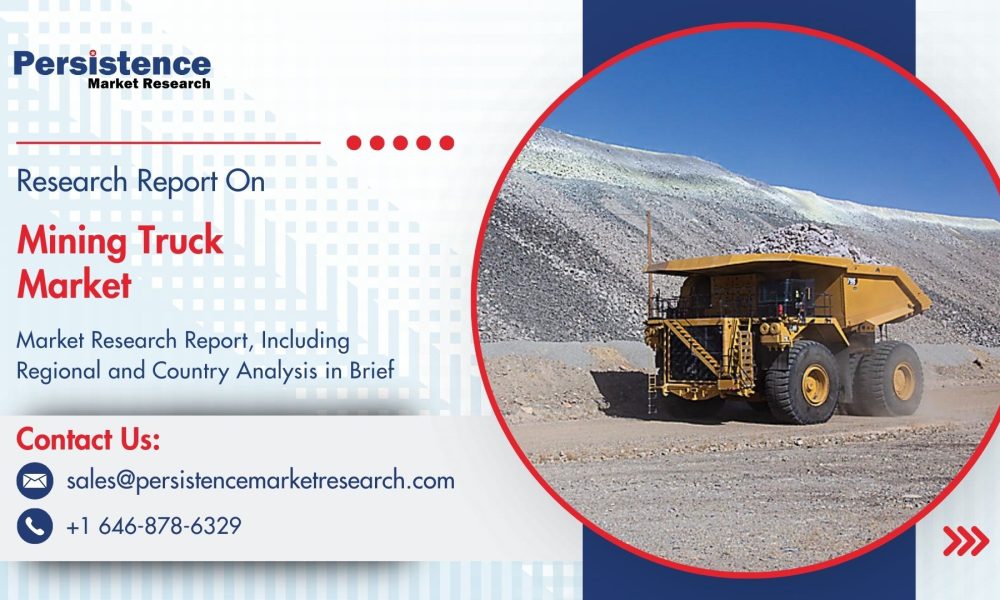
Introduction: Driving Efficiency in the Mining Sector
The mining industry has long relied on heavy-duty machinery to achieve operational efficiency, and mining trucks are central to this ecosystem. These massive vehicles are designed to transport large volumes of minerals, ores, and overburden across challenging terrains. Over the years, advancements in technology, growing demand for minerals, and rising investments in mining operations have significantly influenced the mining truck market. As the industry continues to embrace automation, electrification, and sustainability, mining trucks are evolving into highly sophisticated machines that are not only efficient but also environmentally friendly.
Market Overview: Size, Growth, and Projections
The mining truck market is witnessing steady growth, backed by rising demand for raw materials in construction, energy, and manufacturing sectors. According to a detailed report by Persistence Market Research, the global mining truck market is expected to reach a value of US$22.2 billion by the end of 2024. Over the forecast period from 2024 to 2031, the market is projected to expand at a CAGR of 5.5%, ultimately reaching US$32.3 billion by 2031. Interestingly, the industry recorded a CAGR of 4.7% during the historical period of 2019 to 2023, underscoring how innovation and growing mining activities are accelerating demand.
Get a Sample PDF Brochure of the Report (Use Corporate Email ID for a Quick Response): https://www.persistencemarketresearch.com/samples/34711
What is Driving the Demand for Mining Trucks Worldwide?
The global demand for mining trucks is primarily driven by the growing extraction of minerals and metals needed for construction, renewable energy, and industrial applications. The surge in infrastructure development projects, particularly in emerging economies, has significantly increased the requirement for iron ore, coal, copper, and rare earth elements. Additionally, the rise of sustainable mining practices and the adoption of autonomous and electric mining trucks are fueling market expansion. The integration of smart technologies such as IoT and AI in mining trucks ensures better safety, efficiency, and productivity, further solidifying their role in modern mining operations.
Key Growth Drivers: Factors Powering Market Expansion
Several factors are contributing to the robust growth of the mining truck market. Firstly, global infrastructure projects and urbanization have increased the demand for raw materials, directly boosting mining activities. Secondly, the energy transition and the growing focus on renewable energy sources require critical minerals such as lithium, cobalt, and nickel—leading to expanded mining operations.
In addition, the development of autonomous and electric mining trucks is reshaping the industry. Manufacturers are investing heavily in research and development to produce trucks that reduce operational costs, improve safety, and lower environmental impact. Lastly, government policies that support mining investments and industrial development are further accelerating market growth.
Technological Advancements: The Rise of Automation and Electrification
Mining trucks are becoming more advanced with the integration of cutting-edge technologies. Automation is a key trend, with major mining companies deploying autonomous haulage systems (AHS) that allow trucks to operate without human intervention. This reduces risks, enhances efficiency, and lowers operational costs.
Electrification is another crucial advancement. Electric and hybrid mining trucks are gaining traction as the industry seeks to reduce emissions and improve sustainability. These trucks are equipped with advanced battery technologies and energy-efficient drivetrains, making them viable alternatives to traditional diesel-powered trucks. Furthermore, the use of telematics and IoT-enabled solutions provides real-time monitoring, predictive maintenance, and optimized fuel management.
Segmentation Insights: Types and Applications of Mining Trucks
The mining truck market can be segmented by type, capacity, and application. By type, rigid dump trucks dominate due to their ability to handle heavy loads in large mining operations. Articulated dump trucks, on the other hand, are popular in smaller operations and sites with uneven terrains.
Capacity-wise, trucks are categorized into less than 100 tons, 100–200 tons, and above 200 tons. While smaller trucks cater to medium-scale mining operations, larger trucks are extensively used in large-scale mines for transporting bulk loads. In terms of application, coal mining, iron ore mining, and metal mining remain the largest consumers of mining trucks, with increasing demand from rare earth and non-metallic mineral mining.
Regional Analysis: Market Hotspots Across the Globe
Regionally, Asia Pacific holds a dominant position in the mining truck market due to the high demand for coal, iron ore, and other minerals in countries like China, India, and Australia. These nations are investing heavily in mining infrastructure and adopting advanced machinery to boost efficiency.
North America is also a significant market, with strong adoption of autonomous mining trucks in the United States and Canada. Europe, while smaller in comparison, is experiencing steady growth driven by demand for sustainable mining practices and rare earth exploration. Latin America and Africa are emerging as lucrative markets, with large-scale mining projects and foreign investments driving demand for high-capacity trucks.
Challenges: Barriers to Market Growth
Despite its positive outlook, the mining truck market faces several challenges. High capital investment required for purchasing and maintaining mining trucks remains a major barrier for smaller mining companies. Additionally, fluctuating commodity prices often affect mining activities, leading to uncertainty in truck demand.
Environmental concerns associated with emissions from diesel-powered trucks also pose a challenge, although the rise of electric trucks is gradually addressing this issue. Furthermore, supply chain disruptions, skilled labor shortages, and high maintenance costs can hinder widespread adoption.
Future Outlook: Opportunities on the Horizon
The future of the mining truck market is promising, with innovations expected to redefine the industry landscape. The adoption of artificial intelligence, machine learning, and advanced analytics will enhance decision-making, predictive maintenance, and overall operational efficiency.
Moreover, the increasing shift toward green mining practices will drive demand for electric and hybrid trucks. Governments and mining companies alike are investing in cleaner technologies to align with global sustainability goals. The growing demand for critical minerals required for electric vehicles, batteries, and renewable energy projects will also sustain long-term growth in mining truck demand.
Conclusion: A Market Steered by Innovation and Demand
The mining truck market stands as a vital component of the global mining industry, supporting large-scale extraction and transportation of minerals essential for modern economies. With the market projected to grow from US$22.2 billion in 2024 to US$32.3 billion by 2031 at a CAGR of 5.5%, the industry is poised for steady expansion. Historical growth at 4.7% between 2019 and 2023 highlights its resilience even amid fluctuating market conditions.
As technology, sustainability, and infrastructure development converge, mining trucks will continue to evolve, becoming safer, smarter, and more efficient. The market’s future lies not just in meeting the demands of today’s mining operations but also in shaping a sustainable and technologically advanced tomorrow.
Explore the Latest Trending Research Reports:




