
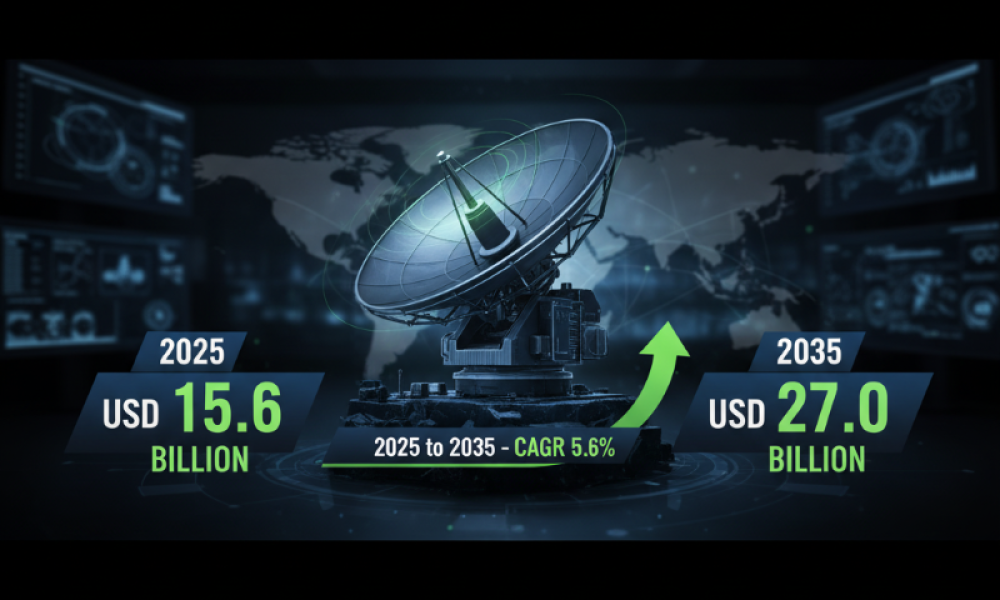
The global military radar market is projected to expand significantly from USD 15.6 billion in 2025 to USD 27.0 billion by 2035, marking a steady compound annual growth rate (CAGR) of 5.6%. As defense budgets grow and geopolitical tensions rise, the demand for advanced radar systems has surged across the land, air, and naval platforms, propelling this market’s strong growth trajectory.
Unlock detailed analytics – Request your personalized report now! https://www.futuremarketinsights.com/reports/sample/rep-gb-25729
Growth Drivers: Increasing Defense Budgets and Technological Advancements
The global military radar industry is strongly influenced by defense modernization programs, technological innovations, and the ever-increasing need for advanced surveillance capabilities. The military radar market is bolstered by growing investments in next-generation radar systems, including phased array, active electronically scanned array (AESA), and software-defined radar systems. These technologies are expected to enhance operational efficiency, threat detection accuracy, and battlefield situational awareness, driving the global market’s expansion.
Regionally, the Largest Growth Areas
Regional defense modernization efforts are a major contributor to the growth of the military radar market. North America, particularly the United States, continues to lead the market, driven by ongoing defense procurement initiatives and multi-domain radar integration across air, land, and sea platforms. Meanwhile, the Asia-Pacific region, especially China and India, is expected to show substantial growth due to increasing defense budgets, border security needs, and an emphasis on indigenous radar development. Europe, with its strategic defense alliances and NATO commitments, is also investing heavily in radar system upgrades and modernization.
Key Market Segments
Within the military radar market, antennas are projected to account for 38.6% of total revenue by 2025, followed by the Doppler waveform segment, which is expected to hold 53.8% of the market share. The dominance of the Doppler waveform is driven by its ability to offer precise velocity detection, reliable tracking of moving objects, and superior target discrimination, particularly in airborne applications and missile guidance systems.
Software-defined radars are also gaining significant traction due to their flexibility, multi-mission capability, and ease of upgradeability. By 2025, software-defined radar systems are expected to capture 53.7% of total market revenue. Their adaptability to emerging threats and integration with advanced algorithms make them highly attractive for defense agencies looking for long-term, sustainable solutions.
Competitive Landscape: Key Players and Strategic Differentiation
The military radar market is highly competitive, with leading players such as Aselsan A.S., BAE Systems, Israel Aerospace Industries Ltd. (IAI), L3Harris Technologies, Inc., Leonardo S.p.A., Lockheed Martin Corporation, Northrop Grumman Corporation, Raytheon Technologies Corporation, and Thales Group. These companies are focused on delivering modular, scalable radar systems that are interoperable across various platforms, including air, sea, and land.
Innovations in radar technology, particularly in AESA and phased array systems, are providing manufacturers with opportunities to differentiate themselves in the market. Collaboration with defense agencies and technology transfer agreements are essential strategies for enhancing market presence. Additionally, partnerships with global defense contractors ensure the rapid integration of new technologies, enabling these players to meet the evolving demands of modern defense operations.
Key Trends Shaping the Military Radar Market
One of the most significant trends in the military radar market is the growing emphasis on multi-domain integration. As modern military operations require interoperability between various branches of the armed forces, radar systems must seamlessly integrate with missile defense, electronic warfare, and surveillance platforms. This integration not only improves decision-making but also enhances overall operational efficiency.
Another key trend is the rise of export opportunities, as countries with advanced radar capabilities supply systems to allied nations. This is particularly important in emerging economies investing heavily in border security, coastal surveillance, and defense infrastructure. Global defense collaborations, coupled with offset agreements and joint production programs, are expected to drive international market growth, expanding the reach of radar manufacturers beyond their domestic borders.
Download Brochure for Full Insights: https://www.futuremarketinsights.com/reports/brochure/rep-gb-25729
Market Outlook
Despite periodic fluctuations, the military radar market is expected to maintain consistent growth throughout the forecast period. Rising geopolitical tensions, coupled with the necessity for enhanced defense systems to counter evolving threats such as hypersonic missiles and unmanned aerial vehicles (UAVs), are expected to sustain demand for radar technologies across all domains. Moreover, advancements in radar signal processing, artificial intelligence, and machine learning will continue to drive the evolution of radar capabilities, ensuring that military forces are equipped to handle future threats.
As defense modernization initiatives unfold worldwide, the military radar market is poised to see substantial growth, providing manufacturers with new opportunities for innovation and revenue. With a resilient growth trajectory and increasing global defense investments, the military radar market is set to become a cornerstone of next-generation defense capabilities.
About Future Market Insights (FMI)
Future Market Insights, Inc. (ESOMAR certified, recipient of the Stevie Award, and a member of the Greater New York Chamber of Commerce) offers profound insights into the driving factors that are boosting demand in the market. FMI stands as the leading global provider of market intelligence, advisory services, consulting, and events for the Packaging, Food and Beverage, Consumer Technology, Healthcare, Industrial, and Chemicals markets. With a vast team of over 400 analysts worldwide, FMI provides global, regional, and local expertise on diverse domains and industry trends across more than 110 countries.



