
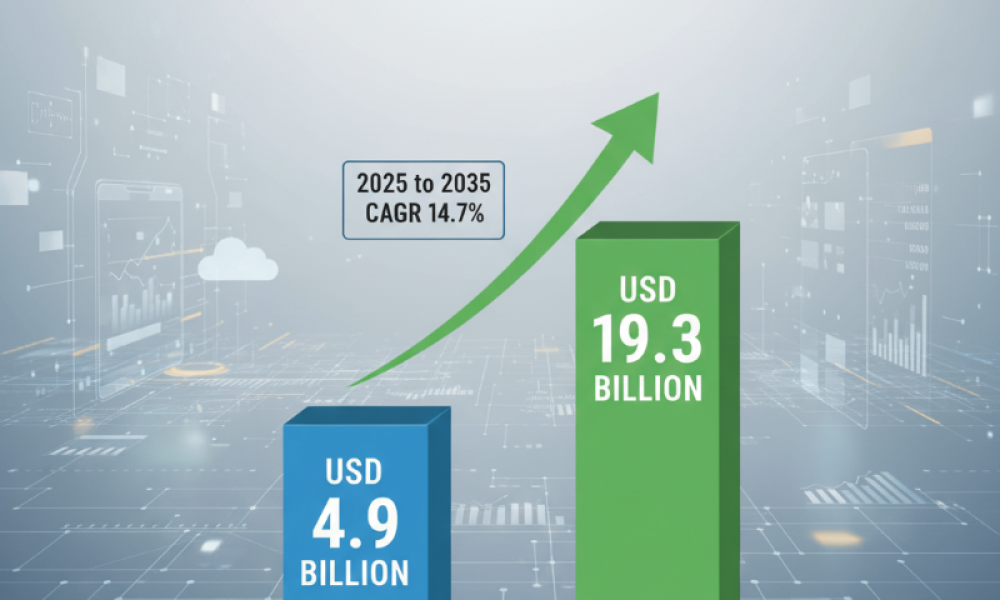
The Banking as a Service (BaaS) Platform Market is on track to witness significant expansion, with projections indicating a growth from USD 4.9 billion in 2025 to USD 19.3 billion by 2035. This substantial growth represents a compound annual growth rate (CAGR) of 14.7%, driven by a surge in digital banking solutions, embedded finance, and the growing shift towards open banking ecosystems. The market’s rapid evolution signals a transformative shift in how financial services are being delivered, with BaaS platforms offering unparalleled flexibility, cost efficiency, and scalability to a variety of enterprises.
Unlock detailed analytics – Request your personalized report now! https://www.futuremarketinsights.com/reports/sample/rep-gb-13992
The BaaS platform market has seen increased adoption from a diverse set of players, from traditional banks to fintech startups. BaaS platforms allow non-financial entities to integrate financial services like payment processing, digital wallets, and credit facilities into their offerings, without the need to establish traditional banking infrastructures. This agility has made BaaS solutions critical in the digital transformation of financial services worldwide.
Key Drivers of Market Growth
Several factors are propelling the market’s expansion, including:
- Digital Transformation in Financial Services: The move towards cloud-based banking infrastructure and API-driven innovations is making BaaS platforms increasingly accessible.
- Regulatory Support: Open banking and regulations like PSD2 (Revised Payment Services Directive) are fostering collaboration between banks and fintech companies, facilitating smoother integrations for new digital banking products.
- Consumer Demand for Seamless Experiences: The rise of customer-centric digital finance solutions has encouraged the widespread adoption of embedded finance models. Consumers increasingly prefer seamless, integrated financial experiences, driving demand for BaaS solutions.
- Cloud Infrastructure and Cybersecurity Advances: The evolution of cloud technologies, cybersecurity protocols, and digital identity verification tools has strengthened the infrastructure required for BaaS adoption.
Segment Analysis
- Solution Segment: The Banking as a Service Platform segment is expected to dominate the market, contributing 47.3% of the revenue in 2025. The flexibility and scalability of these platforms, which enable rapid product launches and integration, make them highly attractive to businesses looking to remain competitive.
- Enterprise Size: Small and medium-sized enterprises (SMEs) are expected to capture 56.2% of the market by 2025. These businesses, often with limited resources for building in-house banking solutions, leverage BaaS platforms to offer digital financial services such as payment solutions and credit products.
- End-User Segment: Banks are expected to remain the largest adopters of BaaS solutions, representing 49.7% of the market by 2025. As traditional banking models undergo digital transformation, banks are using BaaS platforms to enhance their service offerings, modernize legacy systems, and stay competitive against fintech disruptors.
Regional Insights
- North America is expected to be a major market, with the U.S. leading the way due to its strong banking sector and rising interest in decentralized finance (DeFi) solutions.
- Asia-Pacific is also poised for significant growth, particularly in India, where digital payments and financial inclusion are at the forefront of government initiatives.
- Europe has seen a surge in BaaS adoption, with countries like Germany embracing digital-only banks and neo-banking solutions powered by BaaS platforms.
Competitive Landscape
The competitive landscape is highly dynamic, with a mix of traditional financial institutions, fintech companies, and BaaS providers competing for market share. Key players include:
- Goldman Sachs
- Solarisbank AG
- Q2 Software, Inc.
- Clearbank Ltd.
- BBVA S.A.
- Starling Bank
- Treezor
- Technisys
Strategic collaborations and partnerships are becoming essential to stay ahead in the market. For instance, in 2025, Google Cloud partnered with fintech firm Plaid to deliver a BaaS solution that connects financial institutions and fintech companies, accelerating the rollout of new financial products. Similarly, PayPal introduced new services like high-yield savings accounts, expanding its BaaS offerings to reach previously underserved customer segments.
Download Brochure for Full Insights: https://www.futuremarketinsights.com/reports/brochure/rep-gb-13992
Challenges and Opportunities
While BaaS platforms offer numerous benefits, there are challenges to address, particularly related to cybersecurity and data privacy. Cyber-attacks and data breaches have posed significant risks, highlighting the need for robust security protocols, especially when using third-party vendors for key services.
On the positive side, the integration of Decentralized Finance (DeFi) with BaaS platforms presents a new frontier for innovation, enabling financial institutions to offer decentralized services without the complexities of blockchain technology.
About Future Market Insights (FMI)
Future Market Insights, Inc. (ESOMAR certified, recipient of the Stevie Award, and a member of the Greater New York Chamber of Commerce) offers profound insights into the driving factors that are boosting demand in the market. FMI stands as the leading global provider of market intelligence, advisory services, consulting, and events for the Packaging, Food and Beverage, Consumer Technology, Healthcare, Industrial, and Chemicals markets. With a vast team of over 400 analysts worldwide, FMI provides global, regional, and local expertise on diverse domains and industry trends across more than 110 countries.



