
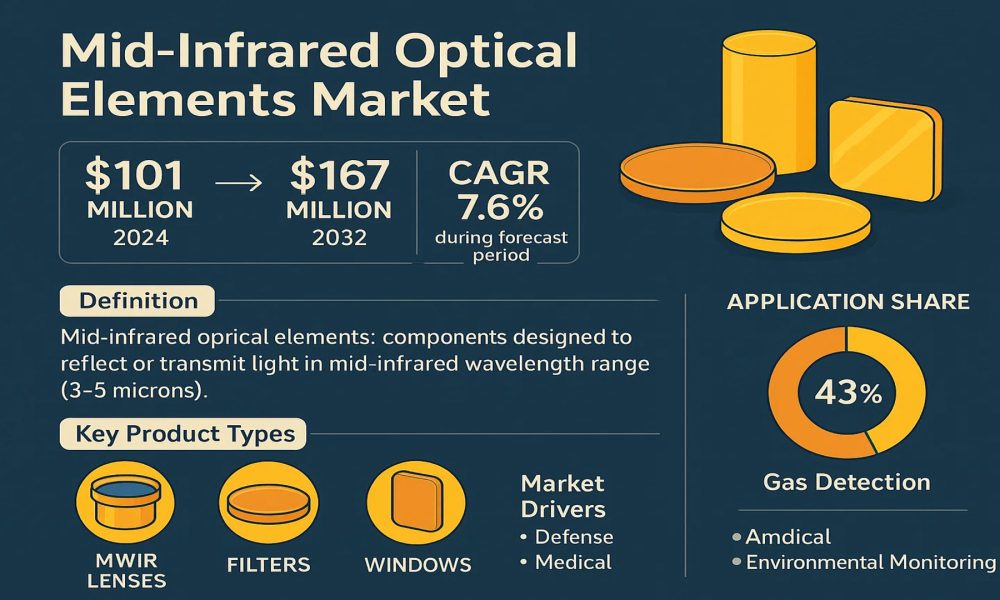
Mid-Infrared Optical Elements Market was valued at 101 million in 2024 and is projected to reach US$ 167 million by 2032, at a CAGR of 7.6% during the forecast period.
Mid-infrared optical elements are specialized components designed to reflect or transmit light in the mid-infrared wavelength range (3-5 microns). These elements play a critical role in applications requiring infrared imaging, spectroscopy, and thermal detection. Key product types include MWIR lenses, filters, and windows, primarily manufactured using specialized materials like zinc selenide and germanium that offer high transmittance, refractive index, and thermal stability.
Market growth is driven by increasing demand across defense, medical, and environmental monitoring sectors. For instance, the gas detection segment accounts for 43% of application share due to stringent industrial safety regulations. Europe dominates the market with 36% revenue share, followed by Asia-Pacific (34%), where China’s growing defense and healthcare sectors are accelerating adoption. Key players like Umicore, Jenoptik, and Edmund Optics collectively hold over 30% market share, with recent investments in advanced coatings and compact optical designs further propelling industry expansion.
Request Your Free Sample Report- https://semiconductorinsight.com/download-sample-report/?product_id=117716
MARKET DYNAMICS
MARKET DRIVERS
Rising Demand for Infrared Imaging in Security and Defense to Accelerate Market Growth
The global mid-infrared optical elements market is experiencing significant growth due to increasing adoption of infrared imaging technologies in security and defense sectors. Mid-infrared optical components, such as lenses and filters, are critical in thermal imaging systems used for surveillance, target identification, and night-vision applications. With rising geopolitical tensions and security concerns, defense budgets in key regions such as North America and Europe have surged, leading to higher procurement of advanced imaging systems. These components are integral to modern military equipment, driving demand for high-performance mid-infrared optical elements.
Additionally, advances in material science have improved the durability and efficiency of these elements, making them more reliable for harsh operational environments. The growing modernization of military infrastructure and increasing investments in unmanned aerial vehicles (UAVs) further contribute to market expansion.
Expansion of Gas Detection and Environmental Monitoring Applications
The application of mid-infrared optical elements in gas detection and environmental monitoring is another key driver of market growth. These components are essential for spectrometers and sensors that detect hazardous gases, greenhouse emissions, and industrial pollutants. Stringent environmental regulations worldwide, particularly in North America and Europe, have increased the demand for precise and efficient monitoring systems.
Moreover, the energy sector’s reliance on infrared-based leak detection systems in oil and gas pipelines has amplified the need for reliable mid-infrared optics. Innovations in optical coating technologies have enhanced the sensitivity and selectivity of these systems, further boosting their adoption.
➤ The gas detection segment accounts for over 43% of the mid-infrared optical elements market, underscoring its dominance in applications.
Besides environmental monitoring, medical diagnostics also benefit from mid-infrared technologies, particularly in non-invasive testing and disease detection, fostering additional market opportunities.
Recent Developments in the Mid-Infrared Optical Elements Market
- Advancements in Laser Sources: Continuous innovations in quantum cascade lasers (QCLs) and interband cascade lasers (ICLs) are driving demand for high-performance mid-infrared optical elements in spectroscopy and sensing applications.
- Growing Applications in Medical Diagnostics: Mid-infrared optical components are increasingly being used in non-invasive glucose monitoring, breath analysis, and early cancer detection, boosting adoption in the healthcare sector.
- Defense & Security Adoption: Rising investment in infrared imaging systems for surveillance, target identification, and threat detection is enhancing market opportunities for advanced optical elements.
- Integration with Photonic Chips: Companies are working on integrating mid-IR optical components with silicon photonics to enable compact, energy-efficient solutions for telecom and environmental monitoring.
- Material Innovations: Development of novel materials such as chalcogenide glasses and fluoride crystals with high transparency in the mid-IR spectrum is improving durability and optical performance.
- Strategic Collaborations: Partnerships between research institutes and industry players are accelerating breakthroughs in mid-IR optical systems for aerospace, industrial sensing, and biomedical applications.
MARKET OPPORTUNITIES
Advancements in Laser Technology Open New Market Avenues
Emerging laser applications in material processing, medical surgery, and defense present lucrative growth opportunities for mid-infrared optical elements. High-power laser systems increasingly utilize infrared optics for beam shaping and wavelength tuning, creating demand for precision components.
Additionally, medical laser systems for dermatology and ophthalmology rely heavily on mid-infrared lenses and filters, opening new revenue streams. The expansion of industrial laser cutting and welding also fuels market prospects.
Strategic Collaborations and Government Funding Boost Innovation
Increased government funding for defense and aerospace R&D is accelerating technological advancements in mid-infrared optics. Key industry players are forming strategic partnerships to enhance production capabilities and develop next-generation optical solutions.
Moreover, rising investments in climate monitoring and renewable energy infrastructure drive the demand for high-performance optical sensors, further expanding market potential. With continuous improvements in material science and manufacturing techniques, the industry is poised for sustained long-term growth.
Request Your Free Sample Report- https://semiconductorinsight.com/download-sample-report/?product_id=117716
List of Key Mid-Infrared Optical Elements Manufacturers
- Umicore N.V. (Belgium)
- Edmund Optics Inc. (U.S.)
- Jenoptik AG (Germany)
- Andover Corporation (U.S.)
- Alkor Technologies (Russia)
- Solaris Optics SA (Poland)
- Thorlabs, Inc. (U.S.)
- Lattice Materials LLC (U.S.)
- LightPath Technologies, Inc. (U.S.)
- Asphericon GmbH (Germany)
- IRD Ceramics (U.K.)
Segment Analysis:
By Type
MWIR Lens Segment Dominates the Market Due to Growing Demand in Imaging and Sensing Applications
The mid-infrared optical elements market is segmented based on type into:
- MWIR Lens
- MWIR Filters
- Others
By Application
Gas Detection and Environmental Monitoring Leads the Market Due to Stringent Industrial Regulations
The market is segmented based on application into:
- Gas Detection and Environmental Monitoring
- Medical and Biomedical Applications
- Security and Defense
- Others
By Material
Germanium-Based Components Hold Significant Market Share Due to Optical Efficiency
Mid-infrared optical elements are segmented by material type into:
- Zinc Selenide (ZnSe)
- Germanium (Ge)
- Silicon (Si)
- Others
Other Topic- Peltier Cooling Modules Market
CONTACT US:
City vista, 203A, Fountain Road, Ashoka Nagar, Kharadi, Pune, Maharashtra 411014
[+91 8087992013]




