
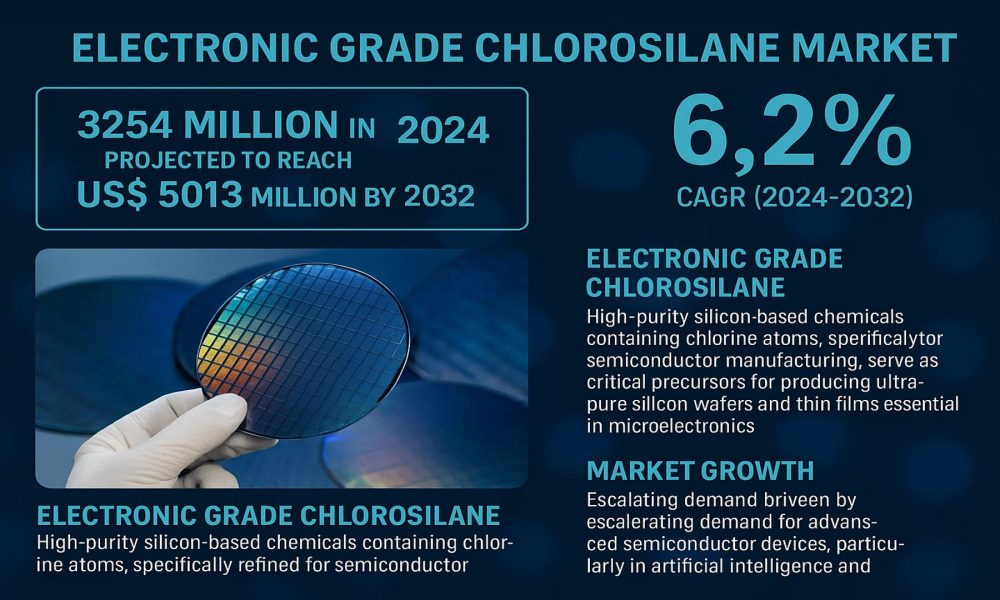
Electronic Grade Chlorosilane Market was valued at 3254 million in 2024 and is projected to reach US$ 5013 million by 2032, at a CAGR of 6.2% during the forecast period.
Electronic grade chlorosilane refers to high-purity silicon-based chemicals containing chlorine atoms, specifically refined for semiconductor manufacturing. These compounds, including dichlorosilane, trichlorosilane, and silicon tetrachloride, serve as critical precursors for producing ultra-pure silicon wafers and thin films essential in microelectronics.
Market growth is driven by escalating demand for advanced semiconductor devices, particularly in artificial intelligence and 5G applications. While Asia-Pacific dominates consumption due to concentrated semiconductor fabrication plants, North America shows strong growth potential with renewed investment in domestic chip manufacturing. Key players like Wacker Chemie and Tokuyama Corporation are expanding production capacities to meet the surging demand from foundries, with the dichlorosilane segment expected to grow at a 7.1% CAGR through 2032.
Click to Access Your Free Sample Report- https://semiconductorinsight.com/download-sample-report/?product_id=117743
MARKET DRIVERS
Growing Semiconductor Industry Fueling Demand for Electronic Grade Chlorosilanes
The global semiconductor market, projected to reach over $800 billion by 2030, is driving substantial demand for high-purity electronic grade chlorosilanes. These critical precursor chemicals are essential for manufacturing silicon wafers and thin film deposition processes in chip fabrication. The semiconductor industry’s expansion is particularly notable in Asia-Pacific, where countries like China, Taiwan, and South Korea account for more than 60% of global semiconductor production capacity. Quality requirements for electronic grade chlorosilanes have become increasingly stringent as semiconductor nodes shrink below 10nm, creating opportunities for manufacturers that can achieve ppb-level purity standards.
Expansion of Solar Energy Sector Creating New Growth Avenues
With global solar PV capacity expected to exceed 2,350 GW by 2027, the polysilicon production sector is driving significant consumption of trichlorosilane (TCS), a key electronic grade chlorosilane. TCS is the primary feedstock for producing solar-grade polysilicon through the Siemens process. As governments worldwide implement renewable energy targets – including the U.S. Inflation Reduction Act and European Green Deal – investments in solar panel manufacturing have increased by over 40% since 2020. This growth directly translates to higher demand for ultra-high purity chlorosilanes, with solar applications accounting for approximately 35% of total electronic grade chlorosilane consumption.
Technological Advancements in Production Processes
Recent innovations in chlorosilane purification technologies have enabled manufacturers to achieve higher purity levels while reducing production costs. Advanced distillation techniques and novel catalyst systems have improved yields by 15-20% compared to traditional methods. Several leading manufacturers have successfully commercialized plasma-based purification systems that can achieve parts-per-trillion purity levels, meeting the exacting requirements of next-generation semiconductor fabrication. These technological improvements are helping reduce the cost premium for electronic grade materials compared to industrial grade chlorosilanes.
Recent Development in the Electronic Grade Chlorosilane Market
In recent years, the Electronic Grade Chlorosilane (EGC) market has witnessed notable advancements driven by the growing semiconductor and photovoltaic industries. Key recent developments include:
- Expansion of Production Capacities: Major chemical manufacturers, such as Dow Chemical and OCI Company, have expanded their EGC production facilities in Asia-Pacific, particularly in South Korea, Japan, and China, to meet the surging demand for high-purity polysilicon used in semiconductor wafers and solar panels.
- Technological Innovations: Companies are investing in advanced purification technologies, such as distillation and hydrolysis techniques, to produce ultra-high purity chlorosilanes with lower metal impurities. This ensures improved efficiency and yield in semiconductor manufacturing.
- Strategic Partnerships: Collaborations between chemical suppliers and semiconductor manufacturers have increased. For instance, partnerships aim to secure a stable supply of EGC for next-generation semiconductor chips, including 5G, AI, and high-performance computing applications.
- Focus on Sustainability: Leading players are implementing eco-friendly production methods, reducing chlorosilane emissions, and adhering to stringent environmental regulations to minimize the impact on surrounding communities.
- Market Diversification: Apart from semiconductors, EGC is increasingly being used in photovoltaic cells, MEMS devices, and other advanced electronics, driving overall market growth.
MARKET OPPORTUNITIES
Expansion in Emerging Semiconductor Manufacturing Hubs
Government initiatives to build domestic semiconductor capabilities in regions like Southeast Asia, India, and the Middle East are creating new growth opportunities for electronic grade chlorosilane suppliers. India’s $10 billion semiconductor incentive program and similar initiatives in Vietnam are expected to add over 20 new wafer fabs by 2030, all requiring reliable supplies of high-purity precursors. This geographic diversification of semiconductor manufacturing helps mitigate the risks of concentration in traditional production centers.
Development of Advanced Packaging Technologies
The growing adoption of 2.5D and 3D semiconductor packaging is driving demand for specialized chlorosilane formulations used in through-silicon via (TSV) and wafer-level packaging applications. These advanced packaging techniques, growing at 15% annually, require ultra-high purity dichlorosilane and silicon tetrachloride for conformal dielectric deposition. Manufacturers that can tailor their product specifications to meet these specialized requirements stand to capture significant value in this high-margin market segment.
List of Key Electronic Grade Chlorosilane Manufacturers
- Wacker Chemie AG (Germany)
- Tokuyama Corporation (Japan)
- SK Specialty (South Korea)
- Hemlock Semiconductor (U.S.)
- OCI Company (South Korea)
- REC Silicon (Norway/U.S.)
- Evonik Industries (Germany)
- SunEdision (China)
- Sunfar Silicon (China)
- KCC Corporation (South Korea)
Click to Access Your Free Sample Report- https://semiconductorinsight.com/download-sample-report/?product_id=117743
Segment Analysis:
By Type
Dichlorosilane Segment Leads Due to High Demand in Semiconductor Manufacturing
The market is segmented based on type into:
- Dichlorosilane
- Trichlorosilane
- Silicon Tetrachloride
- Hexachlorodisilane
- Others
By Application
Silicon Wafer Preparation Dominates as Electronic Grade Chlorosilanes are Essential for Semiconductor Fabrication
The market is segmented based on application into:
- Silicon Wafer Preparation
- Thin Film Deposition
- Etching Process
- Others
By End-Use Industry
Semiconductor Industry Remains Primary Consumer Owing to Increasing Chip Manufacturing Demand
The market is segmented based on end-use industry into:
- Semiconductor Manufacturing
- Photovoltaic Industry
- Electronic Components Production
- Others
By Purity Level
High-Purity Grade Shows Strong Demand for Critical Semiconductor Applications
The market is segmented based on purity level into:
- High Purity Grade (>99.99%)
- Ultra High Purity Grade (>99.999%)
- Others
Other Topic- Wireless Noise Sensor Market
CONTACT US:
City vista, 203A, Fountain Road, Ashoka Nagar, Kharadi, Pune, Maharashtra 411014
[+91 8087992013]




