
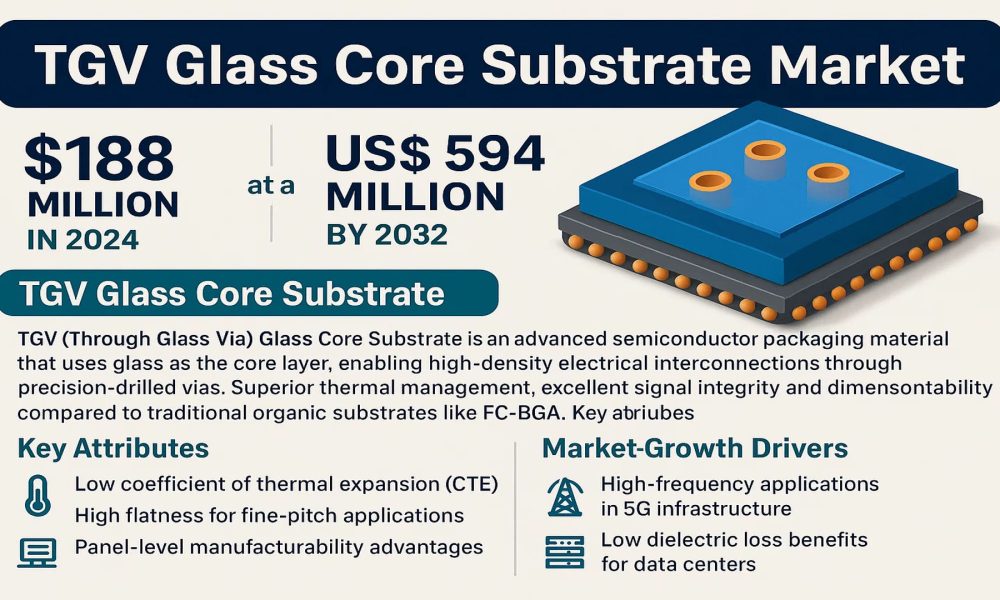
TGV Glass Core Substrate Market was valued at 188 million in 2024 and is projected to reach US$ 594 million by 2032, at a CAGR of 17.4% during the forecast period.
TGV (Through Glass Via) Glass Core Substrate is an advanced semiconductor packaging material that uses glass as the core layer, enabling high-density electrical interconnections through precision-drilled vias. This technology offers superior thermal management, excellent signal integrity, and dimensional stability compared to traditional organic substrates like FC-BGA. Key attributes include a low coefficient of thermal expansion (CTE), high flatness for fine-pitch applications, and panel-level manufacturability advantages.
The market growth is primarily driven by increasing demand for high-frequency applications in 5G infrastructure and data centers, where TGV’s low dielectric loss provides critical performance benefits. Furthermore, the miniaturization trend in consumer electronics and the rise of AI/high-performance computing are accelerating adoption. However, challenges remain in manufacturing yield optimization and cost competitiveness against established TSV technologies. Industry leaders like AGC, Schott, and Corning are investing heavily in process improvements to address these barriers.
Grab Your Complimentary Sample Report- https://semiconductorinsight.com/download-sample-report/?product_id=117717
MARKET DYNAMICS
MARKET DRIVERS
Growing Demand for High-Frequency and RF Applications to Propel TGV Glass Core Substrate Adoption
The expansion of 5G networks and high-speed data centers is creating unprecedented demand for TGV glass core substrates. With 5G requiring components that minimize signal loss at higher frequencies, TGV’s superior electrical properties make it an ideal solution. The technology’s low dielectric loss (below 0.004 at 10 GHz) and stable electrical characteristics across wide frequency ranges are enabling next-gen RF applications. Major telecommunications equipment providers are increasingly incorporating TGV substrates for millimeter-wave applications, where signal integrity is paramount.
Miniaturization Trends in Electronics to Accelerate Market Expansion
The relentless push for smaller, more powerful electronic devices is driving innovation in advanced packaging solutions. TGV glass core substrates offer distinct advantages in this space, including ultra-thin profiles (as low as 100μm) and superior dimensional stability. Smartphone manufacturers are particularly drawn to TGV technology for its potential to reduce package heights while improving thermal management—critical factors as mobile devices incorporate more powerful processors and 5G modems. The automotive sector is adopting glass substrates for advanced driver assistance systems (ADAS) due to their durability in harsh operating conditions. This dual demand is expected to sustain market growth through the forecast period.
HPC and AI Infrastructure Needs to Drive Adoption in Data Centers
Artificial intelligence and high-performance computing applications are creating new requirements for advanced packaging technologies. TGV glass core substrates are uniquely positioned to address the thermal management challenges of modern computing architectures while enabling high-density interconnects needed for chiplet-based designs. High-profile AI accelerator manufacturers are exploring glass substrates to support the increasing I/O density requirements of machine learning processors, where signal integrity and power efficiency are critical performance factors. The superior thermal conductivity (1.1 W/mK) compared to organic substrates makes glass particularly attractive for these demanding applications.
Recent Developments in the TGV Glass Core Substrate Market
- Advancement in 3D Packaging: Leading semiconductor companies are increasingly adopting Through-Glass Via (TGV) substrates for high-density interconnects, supporting advanced packaging for AI, 5G, and HPC applications.
- Collaborations & Partnerships: In 2025, multiple partnerships were formed between substrate manufacturers and foundries to accelerate the commercialization of glass core substrates for high-performance computing.
- Investment in Production Facilities: Companies in Japan, South Korea, and Taiwan are expanding TGV glass substrate production lines to meet rising demand from AI accelerators, GPUs, and server processors.
- Enhanced Material Properties: Recent R&D efforts focus on improving thermal stability, surface flatness, and fine-pitch interconnect capability to make TGV substrates more competitive compared to organic and silicon alternatives.
- Integration in AI and Data Centers: With exponential growth in AI workloads, hyperscale data center operators are pushing adoption of TGV glass core substrates for their superior electrical insulation, low warpage, and high bandwidth capabilities.
MARKET OPPORTUNITIES
Emerging Photonics Applications to Create New Growth Pathways
The co-packaged optics revolution is opening significant opportunities for TGV glass core substrates. The material’s optical transparency and compatibility with waveguide integration make it ideal for hybrid electrical-optical packages. Major data center operators are actively developing solutions that combine silicon photonics with glass interposers to address the bandwidth limitations of traditional copper interconnects. This convergence of electrical and optical packaging could establish glass substrates as a critical enabler of next-generation data communications.
Advanced Display Technologies to Drive Specialty Segment Growth
The mini/micro-LED display market presents significant potential for TGV glass core substrates. Their dimensional stability and thermal properties make them well-suited for high-brightness display applications requiring precise alignment of thousands of micro-emitters. Leading display manufacturers are evaluating glass substrates as an alternative to conventional PCB solutions, particularly for large-format commercial displays where uniformity and reliability are critical parameters. The ability to integrate driver ICs directly onto glass packages could revolutionize display packaging architectures.
Grab Your Complimentary Sample Report- https://semiconductorinsight.com/download-sample-report/?product_id=117717
List of Key TGV Glass Core Substrate Companies Profiled
- AGC Inc. (Japan)
- Schott AG (Germany)
- Corning Incorporated (U.S.)
- Hoya Corporation (Japan)
- Ohara Corporation (Japan)
- Dai Nippon Printing (DNP) (Japan)
- Nippon Electric Glass (NEG) (Japan)
- CrysTop Glass (China)
- Guangdong 3D Chips (China)
- WGTech (South Korea)
Segment Analysis:
By Type
CTE Below 5 ppm/°C Segment Leads the Market Due to High Demand in High-Frequency Applications
The market is segmented based on coefficient of thermal expansion (CTE) into:
- Coefficient of Thermal Expansion (CTE), above 5 ppm/°C
- Coefficient of Thermal Expansion (CTE), below 5 ppm/°C
By Application
Panel Level Packaging Gains Traction Owing to Manufacturing Scalability and Cost Efficiency
The market is segmented based on application into:
- Wafer Level Packaging
- Panel Level Packaging
By End-Use Industry
Consumer Electronics Emerges as Key Growth Sector Driven by Miniaturization Trends
The market is segmented based on end-use industries into:
- Consumer Electronics
- Telecommunications
- Automotive
- Aerospace & Defense
- Others
By Manufacturing Process
Laser Drilling Technology Dominates for Precision Via Formation in Glass Substrates
The market is segmented based on manufacturing processes into:
- Laser Drilling
- Wet Etching
- Photo Structuring
- Others
Other Topic- Linear Variable Displacement Transducers (LVDT) Market
CONTACT US:
City vista, 203A, Fountain Road, Ashoka Nagar, Kharadi, Pune, Maharashtra 411014
[+91 8087992013]




