
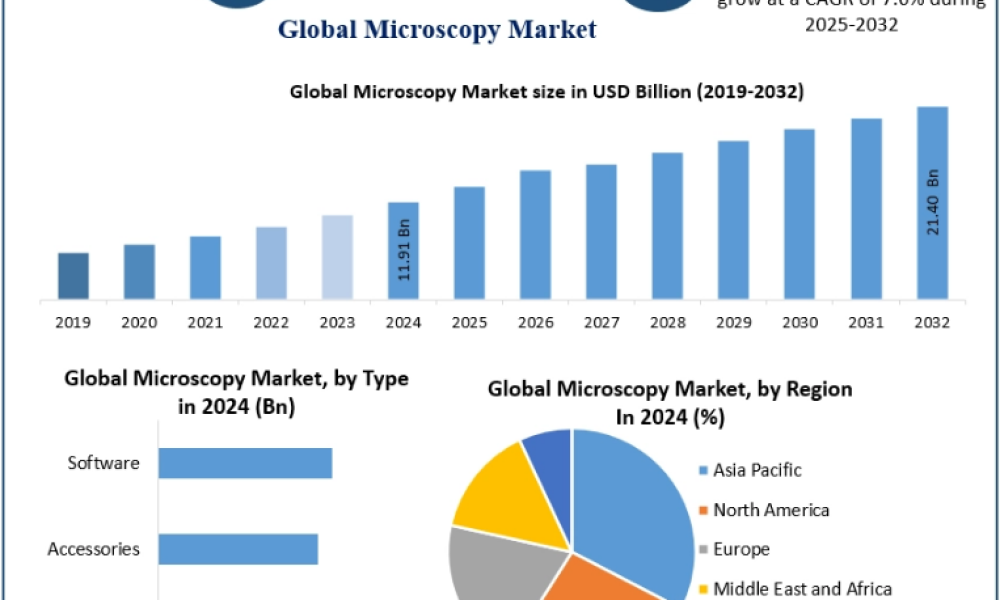
As per a recent study released by Maximize Market Research, titled, “Microscopy Market,” The Microscopy Market, valued at USD 11.91 billion in 2024, is expected to witness robust growth over the forecast period, climbing to nearly USD 21.40 billion by 2032 at a CAGR of 7.6% .
Microscopy Market Overview:
The key driver of this expansion is the increasing demand across life sciences, healthcare, semiconductor, and materials science sectors, fueled by innovations in imaging quality, automation, and analytical capacity. Microscopy, which enables insights into structures unobservable to the naked eye, has rapidly evolved, transitioning from purely hardware-focused tools to integrated systems encompassing advanced software, digitization, and deep learning.
Innovations such as live cell imaging, super-resolution microscopy, high-throughput techniques, and the application of AI and neural networks have significantly enhanced functionality, reducing operational costs and improving the fidelity of observations. Digital microscopy, especially systems capable of full slide scanning and 3D/2D image capture, is increasingly used in research & development, quality control, forensics, and clinical diagnostics.
Download a Free Sample Report Today : https://www.maximizemarketresearch.com/request-sample/159005/
Microscopy Market Dynamics
Continuous refinement in imaging resolution, software-based image analysis, and introduction of new optical modalities have broadened microscopy’s utility. For example, incorporating AI, machine learning, and neural networks into image capture and analysis has made results faster, more accurate, and more automated. IoT integration is converting traditional microscopes into connected imaging systems, enabling remote diagnostics, enhanced image display, and 3D visualization, which are increasingly in demand.
On the demand side, the rise of fields like nanotechnology and regenerative medicine is pushing need for microscopy that can observe at molecular and atomic scales something classical optical microscopes cannot always achieve. Electron microscopy, scanning probe microscopy, and super-resolution technologies are therefore gaining traction. Concurrently, regions with burgeoning research infrastructures—particularly in Asia Pacific—are seeing increased government funding and institutional investments focused on microscopy research and development, which further stimulates market growth.
Microscopy Market Outlook and Future Trends :
Looking ahead, one of the key trends is the continuing shift toward software-centric microscopy platforms, including cloud-based image processing, AI-driven pattern recognition, and integrated data analytics. Users will prioritize platforms that allow richer workflows, such as automated 3D imaging, seamless image-capture to output processes, and real-time analysis. As computational power grows and becomes more accessible, these platforms will likely lower the cost of entry and reduce technical barriers, making advanced microscopy more accessible.
Another major trend will be the expansion of microscopy applications into non-traditional areas and interdisciplinary domains. For example, optogenetics, photochemistry, and nanomaterials manufacturing will demand novel imaging solutions. There is also likely to be growth in applications related to environmental sciences, forensic science, and smart manufacturing, as industries increasingly require microscale imaging for quality control and diagnostics.
Microscopy Market Regional Insights:
The Asia Pacific (APAC) region is projected to be a key growth front, with the microscopy market in APAC expected to grow at a compound annual growth rate of 8.6%, reaching USD 2.67 billion by 2030. Lower costs of raw materials, availability of skilled labor, and growing awareness of advanced microscopy applications (such as in regenerative medicine and nanotechnology) are further aiding growth in this region. Europe also contributes significantly, particularly through research-focused funding and adoption of high-end microscopy solutions. Latin America, the Middle East & Africa represent opportunities for growth, especially as regulatory environments ease, research capacities improve, and awareness of microscopy’s utility spreads.
Microscopy Market Segmentation
by Product
Optical Microscopes
Confocal Microscopes
Stereo Microscopes
Digital Microscopes
Compound Microscopes
Other Optical Microscopes
Electron Microscopes
Scanning electron Microscopes
Transmission electron Microscopes
Scanning Probe Microscopes
Atomic Force Microscopes
Scanning Tunneling Microscopes
by Type
Microscopes
Accessories
Software
by Application
Semiconductor & Electronics
Healthcare & Life Sciences
Clinical Diagnostics
Drug Discovery & Development
Pharma-biopharma Manufacturing
Other Healthcare Applications
Materials Science
Other Applications
Some of the current players in the Microscopy Market are:
1. Zeiss Group
2. Bruker Corp.
3. CAMECA
4. Thermo Fisher Scientific, Inc.
5. Nikon Corp.
6. Olympus Corp.
7. NT-MDT SI
8. Hitachi High-Tech Corp.
9. JEOL Ltd.
10.Oxford Instruments (Asylum Corporation)
About Maximize Market Research:
Maximize Market Research is one of the fastest-growing market research and business consulting firms serving clients globally. Our revenue impact and focused growth-driven research initiatives make us a proud partner of majority of the Fortune 500 companies. We have a diversified portfolio and serve a variety of industries such as IT & telecom, chemical, food & beverage, aerospace & defense, healthcare and others.
Contact Maximize Market Research:
MAXIMIZE MARKET RESEARCH PVT. LTD.
⮝ 3rd Floor, Navale IT park Phase 2,
Pune Banglore Highway, Narhe
Pune, Maharashtra 411041, India.
✆ +91 9607365656
🖂 [email protected]




