
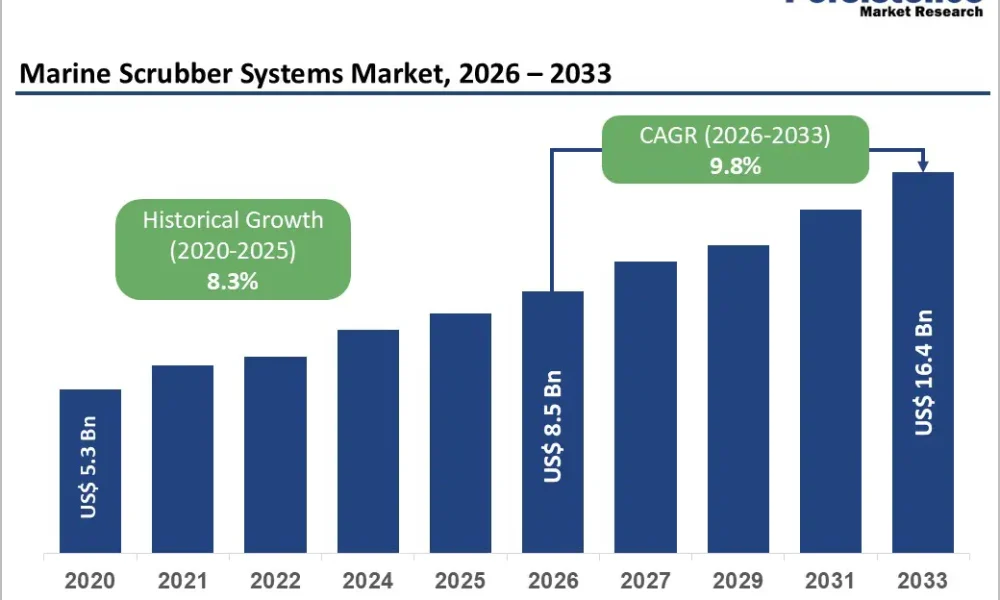
The Marine Scrubber Systems Market is undergoing steady expansion as global shipping companies accelerate compliance with stricter emission norms. According to Persistence Market Research, the global marine scrubber systems market is projected to reach US$ 8.5 billion in 2026 and further expand to US$ 16.4 billion by 2033, reflecting strong industry momentum. Growing environmental accountability across maritime trade routes is compelling vessel operators to install advanced exhaust gas cleaning systems. Marine scrubbers are increasingly viewed as a strategic solution to meet sulfur emission requirements without shifting entirely to higher cost fuel alternatives.
The market is expected to grow at a CAGR of 9.8% over the forecast period, underlining consistent investment activity and regulatory driven demand. Expansion is primarily supported by IMO 2020 sulfur regulations, tightening global emission standards, and the economic advantages scrubbers offer shipowners. These systems enable compliance while delivering significant fuel cost savings with rapid 2 to 3 year payback periods. The leading segment within the market continues to be exhaust gas cleaning systems installed on large commercial vessels due to their higher fuel consumption and compliance urgency. Geographically, Asia Pacific leads the market owing to its dominant shipbuilding industry, dense maritime trade networks, and strong retrofit activities across regional fleets.
One Click to Access Your Free Sample Report : https://www.persistencemarketresearch.com/samples/25126
Key Highlights from the Report
➤ The global marine scrubber systems market is projected to reach US$ 8.5 billion in 2026.
➤ The market is forecast to attain US$ 16.4 billion by 2033 driven by emission compliance demand.
➤ The industry is expected to grow at a CAGR of 9.8% over the forecast period.
➤ Market expansion is supported by IMO 2020 sulfur regulations and tightening emission standards.
➤ Marine scrubbers provide strong fuel cost savings with a rapid 2 to 3 year payback period.
➤ Increasing retrofit installations across commercial fleets are strengthening long term market growth.
Market Segmentation
The Marine Scrubber Systems Market can be segmented based on product type, vessel type, and installation category. Product types primarily include open loop scrubbers, closed loop scrubbers, and hybrid systems. Open loop systems are widely adopted due to their lower operational complexity and cost efficiency in open sea operations. Closed loop scrubbers are gaining traction in regions with stricter discharge regulations, while hybrid systems offer operational flexibility by combining both modes. In terms of installation, retrofit projects form a significant portion of market demand as shipowners upgrade existing fleets to meet compliance requirements. Newbuild installations are also growing steadily in regions with strong shipbuilding activity.
From an end user perspective, commercial vessels represent the leading segment due to their extensive fuel consumption and global trade exposure. Bulk carriers, container ships, oil tankers, and cruise liners are among the primary adopters of exhaust gas cleaning systems. Large commercial fleets benefit significantly from the economic advantages of scrubbers, particularly the rapid 2 to 3 year payback period enabled by fuel cost savings. Smaller vessel operators are gradually entering the market as regulatory enforcement tightens across coastal regions. Overall, segmentation trends indicate rising demand for hybrid systems and retrofit solutions across long haul shipping operations.
Regional Insights
Asia Pacific dominates the Marine Scrubber Systems Market due to its leadership in global shipbuilding and maritime trade activities. Countries in this region operate large commercial fleets that require emission control solutions to meet international standards. High retrofit demand and strong new vessel construction pipelines further strengthen the regional market outlook. The concentration of major ports and shipping routes enhances scrubber installation opportunities. Shipowners in the region are increasingly prioritizing cost effective compliance strategies, driving consistent investment in exhaust gas cleaning systems.
Europe follows closely, supported by strict environmental policies and early adoption of emission control technologies. Strong regulatory enforcement across European waters has accelerated scrubber installations on commercial vessels. North America also demonstrates steady demand, particularly across long distance cargo shipping routes. Regional trends collectively reflect a compliance driven market structure where regulatory clarity and fuel economics shape purchasing decisions.
Make This Report Fit Your Needs – Customize Now : https://www.persistencemarketresearch.com/request-customization/25126
Market Drivers
The primary driver of the Marine Scrubber Systems Market is the implementation of IMO 2020 sulfur regulations. These regulations significantly reduced the permissible sulfur content in marine fuels, compelling shipowners to adopt compliant solutions. Marine scrubbers allow vessels to continue using conventional fuel while meeting emission standards, creating strong financial incentives. The economic viability of scrubbers is reinforced by their rapid 2 to 3 year payback period. This cost recovery advantage has encouraged large commercial operators to prioritize scrubber installations across fleets.
Another critical growth driver is tightening global emission standards beyond sulfur compliance. Environmental sustainability is becoming central to maritime operations, with regulatory bodies increasing oversight across international waters. As emission limits become more stringent, demand for advanced exhaust gas cleaning systems continues to rise. Shipping companies recognize scrubbers as a long term compliance asset that reduces operational uncertainty. The combination of regulatory pressure and measurable fuel savings ensures sustained market growth momentum.
Market Restraints
Despite strong growth prospects, the Marine Scrubber Systems Market faces certain constraints. High initial installation costs remain a challenge for smaller vessel operators with limited capital resources. While the 2 to 3 year payback period is attractive for large fleets, smaller operators may experience longer recovery timelines. Installation complexity and temporary vessel downtime during retrofit projects can also impact operational schedules. These factors may delay purchasing decisions in cost sensitive segments.
Regulatory uncertainties regarding washwater discharge rules in certain ports create additional operational considerations. Variations in regional environmental policies may influence scrubber selection between open loop, closed loop, and hybrid systems. Compliance monitoring requirements can increase administrative responsibilities for shipowners. Although these restraints do not significantly hinder overall growth, they introduce strategic planning considerations for industry participants.
Market Opportunities
The Marine Scrubber Systems Market presents significant opportunities through expanding retrofit demand. As global fleets age, a large number of vessels require emission control upgrades to remain operational under evolving regulations. Retrofit installations offer strong revenue streams for manufacturers and service providers. Growing awareness about fuel cost optimization further enhances market attractiveness. Operators seeking long term operational efficiency are increasingly evaluating scrubbers as a strategic investment.
Emerging maritime economies also create new avenues for market penetration. As international trade volumes expand, more vessels will require compliance solutions aligned with emission standards. Hybrid scrubber systems offer flexibility in regions with mixed regulatory frameworks, opening additional growth opportunities. Continuous innovation in scrubber efficiency and system integration is expected to strengthen market competitiveness. Over the forecast period, sustained compliance requirements and economic incentives will continue shaping favorable growth prospects.
Exclusive Data Awaits – Continue to Checkout : https://www.persistencemarketresearch.com/checkout/25126
Company Insights
Key players operating in the Marine Scrubber Systems Market include:
- Alfa Laval AB
- Wärtsilä Oyj Abp
- Yara Marine Technologies AS
- VDL AEC Maritime
- Feen Marine Scrubbers Inc.
- CR Ocean Engineering LLC
- DuPont
- Mitsubishi Heavy Industries Ltd.
- Hyundai Heavy Industries
- Kwangsung Co. Ltd.
- Shanghai Bluesoul Environmental Technology Co. Ltd.
- Pacific Green Marine Technologies Inc.
- Primarine GmbH
- Ecospray Technologies
- PANASIA Co. Ltd.
- ANDRITZ AG
- Langh Tech Oy Ab
- SAACKE GmbH
Recent Developments
January 2025 A leading scrubber manufacturer expanded its hybrid system portfolio to address stricter regional discharge regulations.
September 2024 A major marine technology provider secured multiple retrofit contracts for commercial vessels to strengthen emission compliance solutions.
Future Opportunities and Growth Prospects
The future of the Marine Scrubber Systems Market remains strongly aligned with environmental compliance trends and fuel cost optimization strategies. With the market projected to grow at a CAGR of 9.8% and reach US$ 16.4 billion by 2033, long term demand is expected to remain robust. Shipowners are increasingly prioritizing solutions that balance regulatory adherence with economic performance. As maritime trade continues expanding, scrubber installations across commercial fleets will play a vital role in shaping sustainable shipping operations worldwide.




