
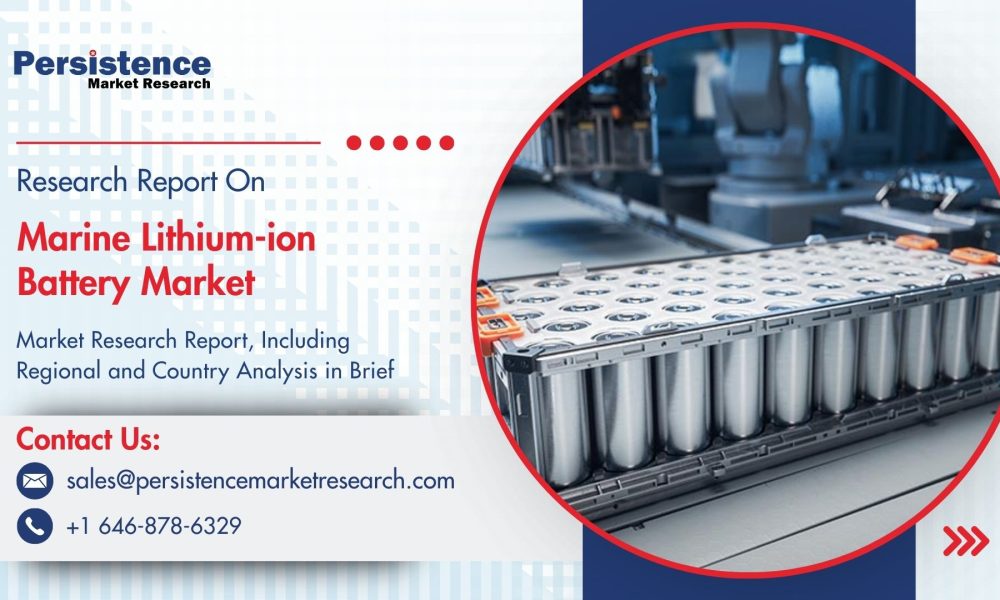
The marine lithium-ion battery market is experiencing remarkable growth as the maritime industry accelerates its shift toward cleaner, more efficient, and sustainable energy solutions. Lithium-ion batteries, known for their high energy density, long life cycles, and low maintenance, are rapidly replacing traditional lead-acid batteries and diesel-based propulsion systems in marine vessels. With global regulatory bodies tightening emission norms and shipowners seeking cost-effective alternatives to fossil fuels, the adoption of lithium-ion batteries in marine applications is gaining significant traction.
According to the latest study by Persistence Market Research, the global marine lithium-ion battery market is projected to grow from US$ 283.7 Mn in 2023 to US$ 856.6 Mn by the end of 2030, expanding at an impressive CAGR of 17.1% during the forecast period. This robust growth is driven by rising investments in electric and hybrid vessels, increasing government regulations on marine emissions, and technological advancements in battery efficiency and safety.
Get a Sample PDF Brochure of the Report (Use Corporate Email ID for a Quick Response): https://www.persistencemarketresearch.com/samples/33649
Growing Focus on Electrification of Marine Vessels
The maritime industry is undergoing a transformative phase as shipowners, fleet operators, and governments aim to reduce greenhouse gas (GHG) emissions and comply with international environmental standards. The electrification of marine vessels—including ferries, tugboats, offshore support vessels, and recreational boats—has emerged as a key strategy to achieve these goals.
Lithium-ion batteries are playing a central role in this transition, offering superior performance over traditional energy storage systems. They provide higher energy density, faster charging capabilities, and reduced maintenance requirements. Moreover, lithium-ion batteries enhance vessel efficiency by enabling hybrid propulsion systems, where electric power complements or replaces diesel engines.
With international regulations such as the International Maritime Organization’s (IMO) 2030 and 2050 decarbonization targets, shipping companies are actively exploring cleaner propulsion alternatives. Governments across Europe, North America, and Asia are incentivizing the adoption of electric and hybrid marine vessels through subsidies and infrastructure development, further boosting demand for marine lithium-ion batteries.
Sustainability and Regulatory Push Driving Market Expansion
Stringent environmental regulations are one of the most significant drivers of the global marine lithium-ion battery market. The IMO’s commitment to reducing global shipping emissions by at least 50% by 2050, compared to 2008 levels, has encouraged the maritime industry to invest in green technologies.
Several European countries are leading this transition, with Norway emerging as a pioneer in electric and hybrid ferries. The Norwegian government’s support for clean maritime technologies has set a global benchmark, prompting other regions to follow suit. Similarly, the European Union’s Fit for 55 package and Zero Emission Ports initiatives are promoting the use of clean energy and electrification in maritime operations.
In addition to regulatory pressure, the growing awareness of the environmental and economic benefits of lithium-ion batteries is influencing market dynamics. These batteries not only reduce carbon emissions but also offer significant fuel cost savings over time, making them a financially viable solution for ship operators in the long run.
Technological Advancements Enhancing Battery Efficiency
Technological innovations are reshaping the marine lithium-ion battery landscape, making them safer, more efficient, and better suited for harsh marine environments. Manufacturers are focusing on developing high-performance battery chemistries such as Lithium Iron Phosphate (LFP) and Nickel Manganese Cobalt (NMC) that provide improved energy density, thermal stability, and lifecycle performance.
Advancements in battery management systems (BMS) are further enhancing safety and operational efficiency. These systems continuously monitor parameters such as voltage, temperature, and charge levels to prevent overheating and optimize energy usage. As a result, lithium-ion batteries are becoming more reliable for large-scale marine applications, including cargo ships and offshore vessels.
Moreover, ongoing R&D in solid-state batteries and next-generation lithium technologies holds promise for further improving energy density and safety standards. These innovations are expected to extend the lifespan of batteries and minimize maintenance needs, thereby reducing total ownership costs for fleet operators.
Expanding Adoption Across Marine Segments
The application of lithium-ion batteries in the marine industry spans across multiple vessel types, from small recreational boats to large commercial ships.
- Passenger Ferries: Ferries are among the earliest adopters of lithium-ion batteries, driven by the need for silent, emission-free operation in urban and coastal waters. Hybrid and fully electric ferries are now common in Europe, particularly in Norway, the UK, and Denmark.
- Offshore Support Vessels (OSVs): In offshore operations, hybrid energy systems powered by lithium-ion batteries help reduce fuel consumption and emissions during standby operations.
- Leisure and Recreational Boats: The rising popularity of electric yachts and personal watercrafts is creating a lucrative niche for lithium-ion battery manufacturers.
- Defense and Research Vessels: Governments and research institutions are increasingly using battery-powered vessels for surveillance, environmental monitoring, and scientific exploration to minimize ecological impact.
As vessel operators recognize the long-term benefits of lithium-ion technology—lower operational costs, quieter performance, and improved efficiency—the market is expected to witness widespread adoption across all marine categories.
Challenges: Cost and Safety Considerations
Despite the growing momentum, certain challenges continue to restrain market expansion. The high initial cost of lithium-ion batteries compared to conventional systems remains a major barrier, especially for small-scale operators and developing regions. However, declining battery prices, driven by economies of scale and advancements in cell chemistry, are gradually mitigating this concern.
Another critical issue is safety, as lithium-ion batteries can pose fire risks if not properly managed. Incidents of thermal runaway have prompted manufacturers to invest heavily in safety innovations, including robust enclosure designs, advanced BMS, and fire suppression systems. Moreover, classification societies and regulatory bodies are introducing stricter safety standards for marine battery installations, enhancing user confidence.
The challenge of recycling and end-of-life battery management is also gaining attention. As the number of battery-powered vessels increases, the industry must develop efficient recycling infrastructure and circular economy practices to manage battery waste sustainably.
Regional Market Insights
Europe
Europe remains the largest and most advanced market for marine lithium-ion batteries, driven by strong regulatory support, technological innovation, and public investment in green maritime infrastructure. Norway leads with its extensive fleet of hybrid and electric ferries, while countries like the Netherlands, the UK, and Denmark are expanding their clean vessel initiatives.
North America
The North American market is witnessing steady growth due to increasing adoption of hybrid propulsion systems in ferries and coastal vessels. The U.S. and Canada are investing in electrification projects for short-sea shipping and port operations to reduce emissions in coastal regions.
Asia-Pacific
Asia-Pacific is emerging as a fast-growing region, fueled by shipbuilding activities in China, Japan, and South Korea. Governments in these countries are promoting the use of electric propulsion in inland waterways and port vessels. The region’s strong manufacturing base also supports large-scale production of lithium-ion batteries at competitive prices.
Rest of the World
In regions such as the Middle East and Latin America, the adoption of marine lithium-ion batteries is at a nascent stage but expected to gain momentum as sustainability initiatives and offshore exploration activities expand.
For Customized Insights on Segments, Regions, or Competitors, Request Personalized Purchase Options: https://www.persistencemarketresearch.com/request-customization/33649
Company Insights
The global marine lithium-ion battery market is characterized by intense competition, with several leading companies investing in technological innovation, partnerships, and capacity expansion to strengthen their positions. Prominent players include:
✦ Corvus Energy Ltd.
✦ Siemens AG
✦ Saft Groupe S.A.
✦ Leclanché SA
✦ Samsung SDI Co., Ltd.
✦ LG Energy Solution Ltd.
✦ CATL (Contemporary Amperex Technology Co. Limited)
✦ Toshiba Corporation
✦ Kokam Co., Ltd.
✦ ABB Ltd.
These companies are focusing on developing customized battery systems for specific vessel types, enhancing battery safety standards, and forming strategic alliances with shipbuilders and naval authorities. Partnerships between battery manufacturers and maritime technology firms are facilitating the integration of advanced energy storage solutions into next-generation vessels.
Future Outlook
The future of the marine lithium-ion battery market looks promising, with continuous innovation and supportive regulatory frameworks driving rapid adoption. As the shipping industry strives to meet global decarbonization goals, lithium-ion batteries are set to become a cornerstone technology for achieving cleaner, more efficient maritime operations.
Emerging technologies such as solid-state batteries, hybrid energy systems, and battery-as-a-service (BaaS) models are expected to further revolutionize the sector. Additionally, advancements in recycling infrastructure and second-life battery applications will strengthen the sustainability credentials of lithium-ion solutions.
In conclusion, with the market projected to reach US$ 856.6 Mn by 2030 and expand at a CAGR of 17.1%, the marine lithium-ion battery industry is at the forefront of the maritime sector’s clean energy transformation. By embracing innovation, safety, and sustainability, manufacturers and operators alike are steering the global shipping industry toward a new era of electrified, emission-free navigation.
Explore the Latest Trending Research Reports:
About Persistence Market Research:
At Persistence Market Research, we specialize in creating research studies that serve as strategic tools for driving business growth. Established as a proprietary firm in 2012, we have evolved into a registered company in England and Wales in 2023 under the name Persistence Research & Consultancy Services Ltd. With a solid foundation, we have completed over 3600 custom and syndicate market research projects, and delivered more than 2700 projects for other leading market research companies’ clients.
Our approach combines traditional market research methods with modern tools to offer comprehensive research solutions. With a decade of experience, we pride ourselves on deriving actionable insights from data to help businesses stay ahead of the competition. Our client base spans multinational corporations, leading consulting firms, investment funds, and government departments. A significant portion of our sales comes from repeat clients, a testament to the value and trust we’ve built over the years.
Contact Us:
Persistence Market Research
G04 Golden Mile House, Clayponds Lane
Brentford, London, TW8 0GU UK
USA Phone: +1 646-878-6329
UK Phone: +44 203-837-5656
Email: [email protected]
Web: https://www.persistencemarketresearch.com




