
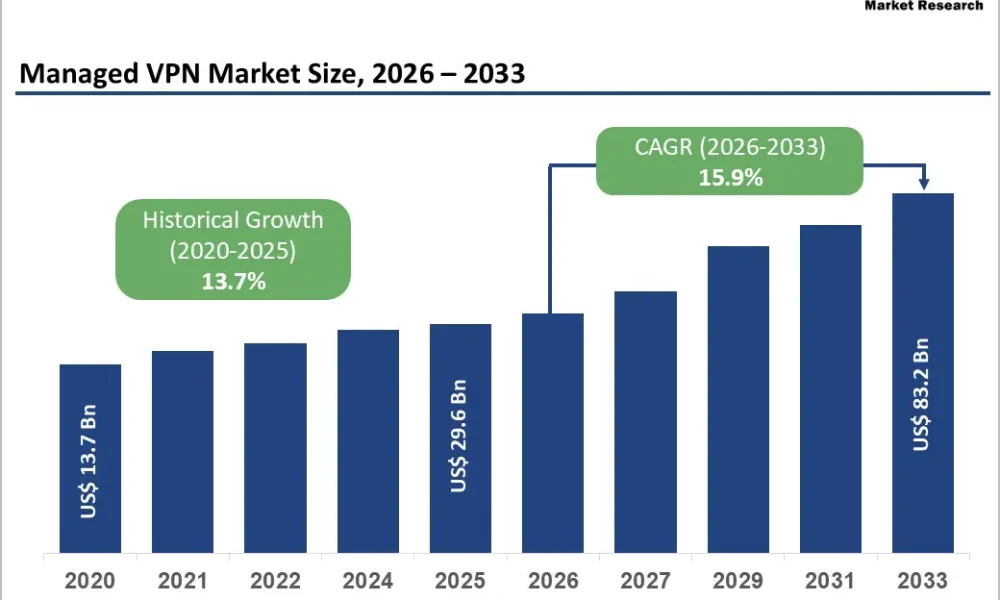
The global managed VPN market is entering a phase of accelerated expansion. Valued at US$ 29.6 billion in 2026, the market is projected to reach US$ 83.2 billion by 2033, growing at a robust 15.9% CAGR during the forecast period. This strong momentum reflects a structural shift in enterprise networking priorities—where secure, scalable, and cloud-integrated connectivity has become foundational to business operations.
As organizations embrace hybrid work, multi-cloud infrastructure, and Zero Trust security frameworks, managed VPN services are evolving from traditional connectivity tools into strategic cybersecurity enablers.
Market Overview and Growth Outlook
The managed VPN market has already demonstrated healthy historical growth of 13.7% CAGR between 2020 and 2025, but the next decade signals even stronger expansion. Enterprises are no longer treating VPNs as optional add-ons; instead, they are core components of secure digital transformation strategies.
Several macro forces are shaping this trajectory:
- Permanent hybrid and remote work models
- Escalating sophistication of cyber threats
- Increased cloud migration and SaaS adoption
- Regulatory pressure for stronger data protection
- Convergence of networking and security through SASE
The shift from on-premise VPN appliances to subscription-based managed services is also reducing capital expenditure burdens, making enterprise-grade security accessible to mid-market organizations.
Key Industry Highlights
- Leading Region: North America (38% market share)
- Fastest Growing Region: Asia Pacific (20% CAGR through 2033)
- Dominant VPN Type: Site-to-Site VPN (49% share in 2025)
- Fastest Growing Channel: Cloud Service Providers (18% CAGR)
- Biggest Opportunity: SASE and Zero Trust convergence
Market Dynamics
Driver: Permanent Shift Toward Hybrid and Remote Work
The global workforce has permanently evolved. Approximately 72% of organizations now plan to maintain hybrid or remote work for part of their workforce. This transition has fundamentally altered network security requirements.
Distributed employees access enterprise applications from homes, co-working spaces, and mobile networks. This distributed access creates expanded attack surfaces that traditional firewall-perimeter models cannot secure effectively.
Managed VPN services provide:
- Encrypted access to corporate systems
- Secure authentication layers
- Centralized monitoring and threat detection
- Scalable user provisioning
Industries such as IT services, finance, healthcare, and consulting are particularly dependent on secure remote access infrastructure.
Technology Evolution: SASE and Zero Trust Integration
The market is witnessing deep architectural consolidation through Secure Access Service Edge (SASE). Vendors such as Palo Alto Networks and Cisco Systems are aggressively integrating managed VPN services into broader SASE platforms.
Industry projections indicate that 65% of SD-WAN purchases by 2027 will include SASE bundles, compared to just 20% in 2024.
This convergence delivers:
- Identity-based access controls
- Cloud-native security enforcement
- Integrated VPN, SD-WAN, CASB, and ZTNA
- Simplified management via unified dashboards
As enterprises move away from implicit trust models, managed VPN services are becoming integrated components of Zero Trust architectures rather than standalone tools.
Restraints Impacting Market Expansion
- Skill Gaps in Network Security
The cybersecurity talent shortage remains a structural challenge. Enterprises struggle to deploy advanced VPN architectures, especially when integrating SD-WAN and Zero Trust models.
While managed services reduce operational burdens, migration from legacy systems still requires:
- Network reconfiguration
- Policy redesign
- Security testing
- Workforce training
Mid-sized enterprises often delay modernization due to these complexities.
- Regulatory and Compliance Complexities
Global data protection regulations are increasing operational constraints.
For example, India’s CERT-In directive requires VPN providers to retain user data for five years. This led major providers such as ExpressVPN and NordVPN to remove physical servers from India to maintain privacy standards.
In Europe, GDPR mandates strict encryption, logging, and data handling requirements. In North America, compliance frameworks such as HIPAA and PCI-DSS drive demand for secure connectivity.
While regulation boosts demand for managed VPN services, it also increases operational complexity and costs for providers.
Major Market Opportunities
Expansion into Small and Medium Enterprises (SMEs)
Historically, SMEs lacked access to advanced VPN infrastructure due to cost barriers. However, subscription-based managed models now enable:
- Zero upfront capital investment
- Cloud-native onboarding
- Simplified scalability
- Integrated compliance monitoring
Over 35% of WAN users plan to implement VPN solutions in coming years, highlighting substantial untapped SME potential.
Artificial Intelligence in Managed VPN Platforms
AI integration is redefining competitive differentiation.
Leading vendors are embedding:
- Behavioral analytics
- Encrypted traffic inspection
- Automated anomaly detection
- Predictive threat modeling
For example, Palo Alto Networks has expanded AI-driven capabilities within its Prisma SASE platform, reporting strong revenue growth in its SASE segment.
AI-powered VPN solutions can detect encrypted malware activity and zero-day exploits that traditional VPN systems may miss, enhancing enterprise resilience.
Elevate your business strategy with comprehensive market data. Request a sample report now: https://www.persistencemarketresearch.com/samples/14368
Category-Wise Analysis
VPN Type Insights
Site-to-Site VPN holds approximately 49% of market share in 2025, making it the dominant segment.
Why?
- Enables secure, always-on inter-office connectivity
- Reduces repeated user authentication overhead
- Supports centralized applications and data centers
- Provides deterministic routing and encrypted tunnels
Large enterprises with global branches rely heavily on site-to-site architectures.
Distribution Channel Insights
Managed Service Providers (MSPs) account for roughly 38% market share.
Their advantage lies in:
- 24/7 monitoring and incident response
- Service-level agreements (SLAs)
- Compliance reporting
- Bundled connectivity + security services
Telecom providers such as AT&T and Verizon Communications leverage extensive enterprise relationships to deliver managed VPN solutions.
End-User Industry Insights
The IT & ITES sector represents approximately 28% of managed VPN adoption.
This dominance is driven by:
- Distributed development teams
- Offshore delivery centers
- Global client collaboration
- Intellectual property protection
Secure remote access is mission-critical for software development, outsourcing, and managed IT service providers.
Regional Insights
North America: Market Leader (38% Share)
North America maintains its dominant position due to:
- Advanced cloud adoption
- Mature IT spending
- Strong compliance mandates
- Established vendor ecosystems
Companies such as Microsoft Corporation (Azure), IBM, and Fortinet play significant roles in delivering managed VPN and integrated security platforms.
High enterprise awareness of cybersecurity risk further drives investment.
Europe: Compliance-Driven Growth
Europe’s growth is strongly influenced by GDPR enforcement.
Countries like Germany and the UK are accelerating decentralized access policies and data sovereignty initiatives. Enterprises prefer managed VPN providers with localized data centers and certified compliance capabilities.
Asia Pacific: Fastest Growing Region (20% CAGR)
Asia Pacific is emerging as the most dynamic growth engine.
Key drivers include:
- Rapid digital transformation in India and Southeast Asia
- 1.6+ billion mobile internet users
- Expansion of SMEs
- 5G infrastructure rollouts
Telecom providers such as Tata Communications and NTT Corporation are expanding managed VPN services across multinational enterprises.
India is forecast to grow at 25% CAGR through 2035, reflecting its expanding digital economy.
Competitive Landscape
The managed VPN market is moderately concentrated but increasingly competitive. Traditional telecom operators and cloud-native security vendors are competing for enterprise budgets.
Key players include:
- Cisco Systems
- Palo Alto Networks
- AT&T
- Verizon Communications
- BT Group
- Vodafone Group
- Orange Business Services
- Juniper Networks
- Fortinet
Strategic Trends Shaping Competition
- Platform unification (VPN + SD-WAN + ZTNA)
- AI-driven automation
- Recurring subscription models
- Single-vendor SASE adoption
- Cloud-native deployment frameworks
Consolidation is likely to continue as vendors seek to expand integrated security portfolios.
Future Outlook: From Connectivity to Security Fabric
The managed VPN market is transitioning from being a connectivity solution to becoming a foundational layer within enterprise security fabrics.
Future developments will likely include:
- Deeper AI-powered anomaly detection
- Seamless hybrid cloud integration
- Browser-level security enforcement
- Identity-first access governance
- Integration with edge computing and 5G
By 2033, managed VPN solutions will be inseparable from enterprise cybersecurity architecture, embedded within SASE and Zero Trust frameworks.
Conclusion
The global managed VPN market is poised for transformative growth, expanding from US$ 29.6 billion in 2026 to US$ 83.2 billion by 2033 at a strong 15.9% CAGR.
This expansion is fueled by:
- Permanent hybrid work models
- Rising cyber threats
- Regulatory compliance demands
- Cloud migration acceleration
- SASE and Zero Trust convergence
While skill shortages and regulatory complexities pose challenges, opportunities in SMEs, AI-powered platforms, and Asia Pacific markets offer immense upside.
As enterprises prioritize secure, scalable, and intelligent connectivity, managed VPN services will evolve into critical pillars of next-generation digital infrastructure.
Related Reports:




