
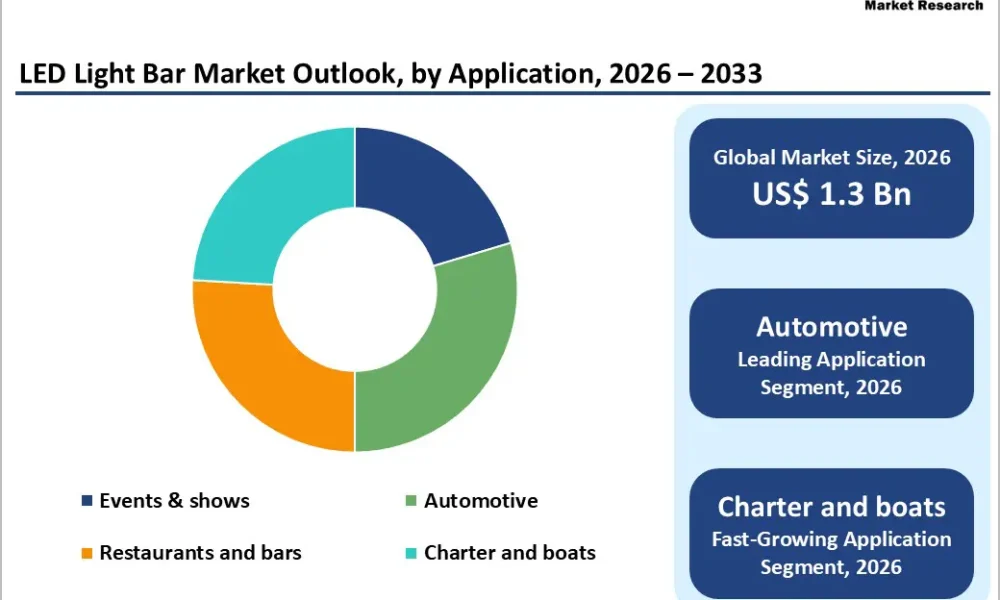
The global LED Light Bar Market is witnessing steady expansion, driven by the increasing adoption of energy-efficient lighting systems across automotive, marine, and recreational applications. According to Persistence Market Research, the global LED light bar market size is expected to be valued at US$ 1.3 billion in 2026 and projected to reach US$ 1.9 billion by 2033, growing at a CAGR of 5.7% between 2026 and 2033. Rising demand for durable, high-lumen output lighting products and growing preference for advanced illumination systems in off-road vehicles are accelerating industry growth.
The market statistics reflect a consistent upward trajectory, supported by technological improvements in LED chips, enhanced thermal management, and compact design innovations. Automotive remains the leading segment due to increased integration of LED light bars in trucks, SUVs, and specialty vehicles. Regionally, North America leads the LED light bar market owing to strong demand for off-road vehicles, marine lighting systems, and recreational utility vehicles. Expansion of aftermarket automotive accessories and rising outdoor adventure activities further reinforce regional dominance.
Download Your Free Sample & Explore Key Insights : https://www.persistencemarketresearch.com/samples/33688
Key Highlights from the Report
➤ The LED Light Bar Market is projected to grow from US$ 1.3 billion in 2026 to US$ 1.9 billion by 2033 at a CAGR of 5.7%.
➤ Increasing demand for energy-efficient automotive lighting solutions is a primary growth driver.
➤ Automotive applications account for the dominant share in overall market revenue.
➤ North America remains the leading geographical region due to high off-road vehicle adoption.
➤ Technological advancements in LED efficiency and lifespan are reshaping product innovation.
➤ Rising marine and recreational vehicle applications are expanding market opportunities.
Market Segmentation
The LED light bar market is segmented based on product type, application, and end-user. By product type, straight LED light bars and curved LED light bars represent key categories. Straight variants dominate due to ease of installation and compatibility with a wide range of vehicles. Curved light bars, however, are gaining popularity for improved light dispersion and aesthetic appeal in premium automotive segments. Increasing preference for customizable lighting configurations is further shaping product development strategies among manufacturers.
In terms of application, automotive holds the largest share, followed by marine and recreational uses. Within automotive, off-road vehicles, trucks, and SUVs contribute significantly to demand. Marine applications are expanding as LED light bars offer corrosion resistance and enhanced durability in harsh conditions. Recreational applications, including camping and outdoor utility vehicles, are witnessing steady growth due to improved battery efficiency and lightweight design of LED systems.
Regional Insights
North America leads the LED Light Bar Market due to a strong culture of vehicle customization and widespread adoption of off-road driving activities. The presence of a robust automotive aftermarket industry supports consistent demand for LED lighting upgrades. Consumers in the region prioritize energy-efficient and long-lasting lighting solutions, boosting sales of premium LED light bars. Recreational boating and outdoor utility vehicle usage further enhance market expansion.
Asia Pacific is emerging as a promising market supported by rising automotive production and growing interest in vehicle personalization. Increasing disposable income and expanding recreational vehicle usage are contributing to regional demand. Additionally, improvements in manufacturing capabilities and cost-effective LED production are strengthening the supply chain in this region.
Customize This Report for Your Exact Requirements : https://www.persistencemarketresearch.com/request-customization/33688
Market Drivers
The primary driver of the LED Light Bar Market is the rising demand for energy-efficient lighting systems. LEDs consume significantly less power compared to traditional halogen or HID lighting, making them highly suitable for automotive and marine applications. Their long operational life and minimal maintenance requirements make them an attractive option for both OEM and aftermarket customers.
Another critical driver is the growth of off-road and adventure vehicle segments. Consumers increasingly seek enhanced visibility and performance in extreme conditions, fueling demand for high-intensity LED light bars. The expansion of recreational activities such as camping and boating further supports product adoption. Technological advancements in brightness levels and heat dissipation capabilities are also contributing to broader acceptance across industries.
Market Restraints
Despite positive growth prospects, the LED light bar market faces certain challenges. High initial costs compared to traditional lighting solutions may deter price-sensitive consumers. Although LEDs provide long-term savings, upfront pricing can limit adoption in developing markets. This creates a barrier for entry-level buyers and smaller fleet operators.
Another restraint involves regulatory standards related to vehicle lighting intensity and road safety. In some regions, restrictions on brightness and beam patterns may limit usage of certain LED light bar models on public roads. Compliance requirements can increase manufacturing costs and slow product approvals, affecting overall market expansion.
Market Opportunities
The LED Light Bar Market presents significant opportunities through innovation and product differentiation. Integration of smart lighting technologies, adjustable beam patterns, and wireless control systems can create new revenue streams. Manufacturers focusing on compact and modular designs may gain competitive advantages in automotive and marine sectors.
Emerging economies offer untapped potential due to increasing vehicle ownership and infrastructure development. Growing awareness of energy-efficient solutions and rising popularity of outdoor recreational activities are likely to support future demand. Partnerships with automotive OEMs and expansion into specialized industrial applications can further strengthen long-term growth prospects.
Unlock Complete Insights – Buy the Full Report : https://www.persistencemarketresearch.com/checkout/33688
Company Insights
Key players operating in the LED Light Bar Market include:
- Philips
- Ledvance
- Rigid Industries
- Baja Designs
- KC HiLiTES
- Auxbeam
- Nilight
- Larson Electronics
- Tough Industries
- Hella GmbH & Co. KGaA
- Cree (Wolfspeed)
- Vision X Lighting
- Aurora LED Lighting
- Bliauto
- Surya Roshni
Recent Developments:
- March 2024: A leading manufacturer introduced an advanced high-lumen curved LED light bar designed for off-road vehicles.
- September 2023: A key market player expanded its automotive lighting portfolio with enhanced thermal management LED technology.
Future Opportunities and Growth Prospects
The LED Light Bar Market is expected to maintain steady momentum through 2033, supported by energy efficiency trends and expanding automotive customization culture. Continuous innovation in brightness, durability, and smart integration will define competitive positioning. As demand rises across automotive, marine, and recreational sectors, manufacturers that prioritize performance, compliance, and cost optimization will benefit from sustained market growth.




