
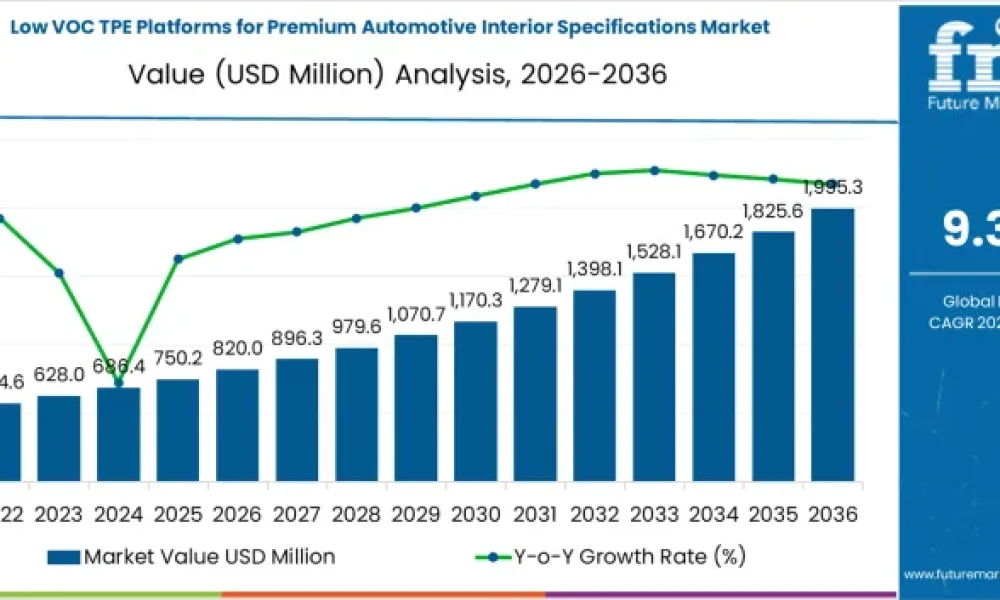
The global Low-VOC Thermoplastic Elastomer (TPE) Platforms for Premium Automotive Interior Specifications market is on a trajectory to expand from an estimated USD 820.0 million in 2026 to approximately USD 1,995.3 million by 2036, delivering a robust 9.3 % compound annual growth rate (CAGR) over the forecast period. This performance underscores a decisive shift in automotive materials strategy, driven by tightening interior air quality standards, heightened consumer expectations for odor-free cabins, and stringent OEM emission compliance frameworks that place low-VOC materials at the core of next-generation mobility experiences.
With regulators intensifying limits on volatile organic compound (VOC) emissions and premium vehicle segments prioritizing refined tactile environments, low-VOC TPE platforms are rapidly transitioning from niche solutions to foundational materials in dashboards, door panels, soft-touch surfaces, and other interior components. The growing electric vehicle (EV) sector, with reduced drivetrain noise that accentuates cabin smell and material feel, further accelerates adoption of these advanced elastomer systems.
Key Market Insights at a Glance
Market value projections reveal nearly 150 % growth over the next decade, reflecting sustained demand across Asia-Pacific, Europe, and North America. Styrenic block copolymer (SBC) TPEs currently dominate platform type share due to their balanced performance and formulation flexibility, while ultra-low volatility plasticizer systems lead VOC control strategies owing to their superior emission reduction attributes. Instrument panels and dashboards remain the largest application segment, given their proximity to occupants and exposure to rigorous emission and fogging tests.
As automotive manufacturers intensify efforts to meet global cabin air quality mandates and elevate occupant comfort, these low-VOC elastomer platforms are becoming a critical differentiator for premium interior experiences in both combustion and EV lineups.
Segment Overview
The low-VOC TPE market is segmented across platform type, VOC control strategy, and application. Platforms include Styrenic Block Copolymer (SBC) TPE, olefin-based TPO & TPV systems, polyester-based TPE (COPE), and bio-attributed/low-extractables TPEs. SBC TPEs hold the largest share, offering softness and formulation adaptability for high-end interior surfaces. Ultra-low volatility plasticizer systems are widely adopted as the leading VOC mitigation approach, reducing interior emissions without compromising performance. Application segmentation reflects strong demand for instrument panels and dashboards, which command the highest share due to visibility, material volume, and emission scrutiny, followed by door panels, seating surfaces, and center console elements.
Citizens and regulators alike are increasingly conscious of volatile compound exposure within vehicle cabins, prompting OEMs and material suppliers to integrate specialized emission-reducing TPE systems as part of standard interior design and platform planning.
To access the complete data tables and in-depth insights — Request Your Sample Report Now
Regional Overview
Demand for low-VOC TPE platforms exhibits strong regional variance, yet growth is consistent across major automotive hubs. China leads with an estimated CAGR of around 9.9 %, propelled by rapid premium and EV production expansion and tightening interior emission norms. India’s market follows closely with roughly 9.6 % CAGR, supported by localization of premium interiors and evolving quality expectations. Germany and the United States also demonstrate robust CAGR figures near 9.4 % and 9.1 % respectively, while South Korea reflects sustained industry innovation at about 8.9 % CAGR. These trends highlight the global push toward compliance-driven material adoption and interior refinement across diverse manufacturing ecosystems.
Across Asia-Pacific, the rise of EVs and premium vehicle demand is a key impetus, while European OEMs emphasize engineering precision and rigorous material qualification. In North America, interior redesign cycles and sustainability mandates bolster TPE platform penetration.
Competitive Landscape
The competitive environment is anchored by major chemical and materials players focused on advanced elastomer development, emission compliance, and interior comfort performance. Leading companies in this domain include Avient Corporation, BASF SE, Covestro, Kuraray, and Celanese, each leveraging proprietary chemistry and validation protocols to secure OEM approvals and multi-platform integration. Competitive differentiation is increasingly tied to emission control consistency, tactile quality, thermal aging stability, and global support capabilities that align with evolving automotive interior specifications.
Strategic partnerships between tier-1 suppliers and OEMs are fostering tailored solutions that meet stringent cabin air quality benchmarks while enabling design innovation.
Market Outlook: Powering the Next Decade
Over the next decade, the low-VOC TPE platforms market is expected to flourish as emission standards tighten and consumers demand healthier, more refined interior environments across vehicle classes. Sustained innovation in polymer chemistry, VOC control technologies, and global harmonization of emission testing protocols will be critical drivers of growth. Investments in low-extractable and bio-attributed TPE variants also signal an emerging sustainability narrative, aligning material choice with broader environmental and health objectives.
As manufacturers escalate platform integration early in vehicle development cycles, low-VOC TPE platforms are set to redefine premium interior benchmarks and support cleaner, healthier mobility experiences worldwide.
Key Players of Sustainable Label Industry
Industry leaders shaping this market include Avient Corporation, BASF SE, Covestro, Kuraray, and Celanese, each contributing specialized low-VOC elastomer systems optimized for premium interior applications. Their ongoing R&D efforts, global supply footprints, and certification capabilities position them at the forefront of the industry’s evolution.
Have a specific Requirements and Need Assistant on Report Pricing or Limited Budget please contact us – [email protected]
About Future Market Insights (FMI)
Future Market Insights, Inc. (FMI) is an ESOMAR-certified, ISO 9001:2015 market research and consulting organization, trusted by Fortune 500 clients and global enterprises. With operations in the U.S., UK, India, and Dubai, FMI provides data-backed insights and strategic intelligence across 30+ industries and 1200 markets worldwide.
Why Choose FMI: https://www.futuremarketinsights.com/why-fmi



