
Definition
Low loss coaxial cables are highly specialized electrical transmission lines designed to minimize signal attenuation, distortion, and electromagnetic interference at high frequencies. These cables utilize advanced dielectric materials, precision-engineered shielding, and conductive layers to ensure superior signal integrity. Unlike standard coaxial cables, low loss variants are optimized for high-speed data transmission applications, maintaining consistent impedance and phase stability across a wide range of frequencies.
They are widely employed in 5G infrastructure, aerospace & defense, satellite communication, medical electronics, and industrial automation. Common impedance variants include 50 ohm (primarily used for RF and telecommunication systems) and 75 ohm (commonly used for video distribution and broadband applications). The demand for these cables is rising sharply as industries require reliable, high-performance connectivity solutions in mission-critical environments.
Recent Developments
The low-loss coaxial cables market is experiencing significant growth, primarily fueled by the global rollout of 5G networks, the expansion of the Internet of Things (IoT), and the increasing demand for high-speed data transmission in various applications. Recent developments are focused on improving the performance and durability of these cables. This includes the use of advanced dielectric materials, such as foamed polyethylene and PTFE, to further reduce signal attenuation and enhance signal integrity, especially at higher frequencies. Additionally, manufacturers are innovating with improved shielding technologies and flexible, lightweight designs to meet the specific needs of modern applications in the aerospace, defense, and mobile communication sectors.
Major Distribution
The distribution of low-loss coaxial cables is a highly specialized business-to-business (B2B) model. The primary channel is direct sales from major manufacturers like Huber+Suhner, Molex, and Amphenol to large-scale end-users. This includes telecommunications companies, military and aerospace contractors, and manufacturers of high-end electronic equipment. These direct relationships are essential for providing customized solutions and technical support. In addition, specialty distributors play a critical role, serving a wide range of customers from small-scale integrators and installation companies to research institutions. These distributors provide a broad catalog of products and the logistical expertise needed to get the right cable to the right place for a diverse set of applications.
Market Size
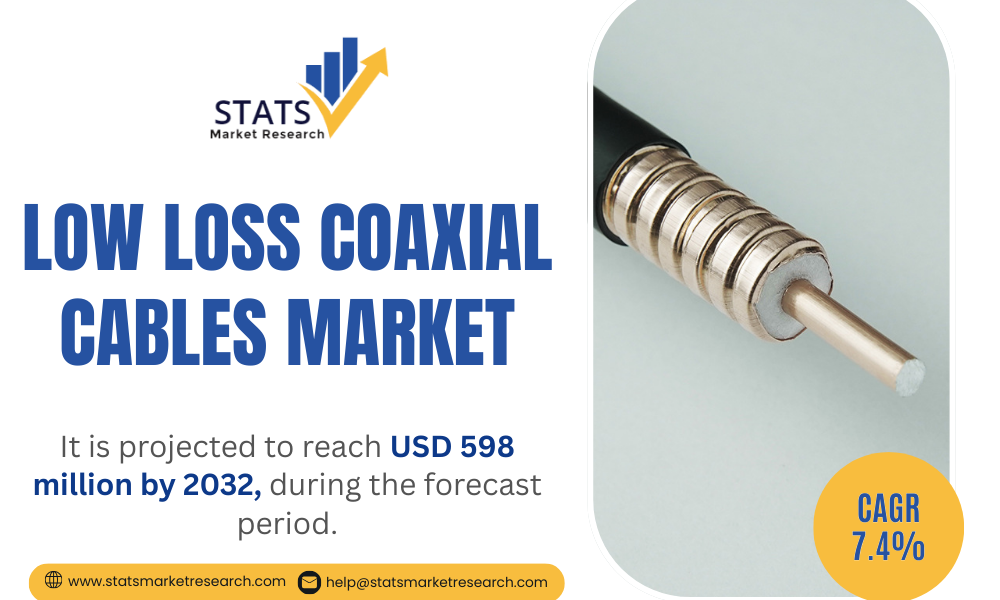
Global low loss coaxial cables market size was valued at USD 368 million in 2024 and is projected to grow from USD 395 million in 2025 to USD 598 million by 2032, registering a CAGR of 7.4% during the forecast period.
Key Highlights:
- Telecom sector is the largest consumer, driven by global 5G rollouts and advanced RF communication infrastructure.
- Aerospace & defense applications contribute significantly due to military modernization and satellite deployment programs.
- Asia Pacific is witnessing the fastest growth, attributed to large-scale investments in digital infrastructure across China, India, and Southeast Asia.
- North America maintains technological dominance, with strong adoption in defense, aerospace, and next-gen wireless deployments.
The overall market outlook suggests steady expansion, fueled by demand for high-frequency, phase-stable, and ruggedized cable assemblies that can withstand extreme environmental and operational conditions.
Download FREE Sample of this Report @ https://www.statsmarketresearch.com/download-free-sample/8054660/global-low-loss-coaxial-cables-market
Market Dynamics (Drivers, Restraints, Opportunities, and Challenges)
Market Drivers
- 5G Network Expansion Accelerating Demand
- Global 5G rollout requires cables supporting frequencies up to 39–69 GHz with minimal loss.
- Telecom operators are investing $150+ billion annually in infrastructure, boosting demand for high-performance coaxial solutions.
- Rising Defense and Space Applications
- Military systems and satellites require ruggedized, radiation-resistant, and phase-stable cables.
- With defense budgets exceeding $2 trillion, coaxial cables remain critical in radar, EW systems, and secure communications.
Market Restraints
- High Material Costs and Manufacturing Complexity
- Premium materials like PTFE and silver-plated copper significantly increase costs.
- Custom cable lead times range from 12–16 weeks, impacting project agility.
- Size & Weight Constraints
- Aerospace and compact electronic systems demand lighter solutions.
- Reducing weight without compromising performance remains a challenge.
- Installation Complexities
- Requires skilled technicians; improper installation can degrade performance by up to 30%.
Market Opportunities
- Emergence of Millimeter-Wave Applications
- Growth in 77 GHz automotive radar, 28/39 GHz 5G, and 60 GHz satellite communications.
- Advanced cables now achieve <0.5 dB/m loss at 60 GHz, opening new markets.
- IoT and Smart Factories
- Expanding industrial IoT requires durable, high-performance RF connectivity across thousands of sensors.
- Presents opportunities for application-specific coaxial designs.
Market Challenges
- Competition from Alternatives
- Fiber optics and wireless backhaul offer cost and installation advantages in some cases.
- Adoption of fiber in broadband poses a long-term challenge.
- Regulatory Pressures
- Compliance with RoHS, REACH, and EMC standards requires constant product reformulation.
- Supply Chain Risks
- Shortages of fluoropolymers and specialty metals lead to long lead times and higher prices.
Regional Analysis
- North America: Leads in innovation, particularly in aerospace, defense, and 5G R&D. Companies like Amphenol and Gore are headquartered here.
- Europe: Strong adoption in defense and telecom; Huber+Suhner (Switzerland) and Nexans (France) play key roles.
- Asia Pacific: Fastest-growing region, driven by China’s 5G expansion and industrial automation in India and Southeast Asia.
- Middle East & Africa: Increasing investments in telecom and defense, though at a slower adoption pace.
- Latin America: Growing demand for internet connectivity and telecom infrastructure, particularly in Brazil and Mexico.
Competitor Analysis (in brief)
The competitive landscape is marked by established multinationals and regional specialists.
- Huber+Suhner holds ~18.2% share with its RADOX® series setting industry benchmarks.
- Molex and Amphenol collectively account for ~24%, focusing on 5G and automotive radar applications.
- Gore offers PHASEFLEX® microwave assemblies, supporting frequencies up to 40 GHz.
- Sumitomo Electric is pioneering cables for 6G development.
- Asian players (Kingsignal Technology, Hitachi Cable) are gaining ground with cost-effective telecom solutions.
Global Low Loss Coaxial Cables Market: Segmentation Analysis
This report provides a deep insight into the global Low Loss Coaxial Cables Market, covering all its essential aspects. This ranges from a macro overview of the market to micro details of the market size, competitive landscape, development trend, niche market, key market drivers and challenges, SWOT analysis, value chain analysis, etc.
The analysis helps the reader to shape the competition within the industries and strategies for the competitive environment to enhance the potential profit. Furthermore, it provides a simple framework for evaluating and assessing the position of the business organization. The report structure also focuses on the competitive landscape of the Global Low Loss Coaxial Cables Market. This report introduces in detail the market share, market performance, product situation, operation situation, etc., of the main players, which helps the readers in the industry to identify the main competitors and deeply understand the competition pattern of the market.
In a word, this report is a must-read for industry players, investors, researchers, consultants, business strategists, and all those who have any kind of stake or are planning to foray into the Low Loss Coaxial Cables Market in any manner.
Market Segmentation (by Application)
- Video Distribution
- Radio Frequency Transfer
- Internet Data Transfer
- Others
Market Segmentation (by Type)
- 50 Ohm Impedance
- LMR Series
- RG Series
- Others
- 75 Ohm Impedance
Get the Complete Report & TOC @ https://www.statsmarketresearch.com/global-low-loss-coaxial-cables-market-8054660
Key Company
- Huber+Suhner (Switzerland)
- Molex (U.S.)
- Hitachi Cable (Japan)
- Nexans (France)
- Amphenol (U.S.)
- CommScope (U.S.)
- Cicoil (U.S.)
- Gore (U.S.)
- Sumitomo Electric (Japan)
- Belden (U.S.)
- Kingsignal Technology (China)
- Tessco (U.S.)
- Habia (Sweden)
- Pasternack (U.S.)
- Galaxy Wire & Cable (U.S.)
Geographic Segmentation
- North America
- Europe
- Asia Pacific
- Middle East & Africa
- Latin America
FAQ Section
- What is the current market size of the Low Loss Coaxial Cables Market?
The market size was USD 368 million in 2024 and is projected to reach USD 598 million by 2032. - Which are the key companies operating in the Low Loss Coaxial Cables Market?
Key players include Huber+Suhner, Molex, Amphenol, Gore, Sumitomo Electric, Belden, Hitachi Cable, Kingsignal Technology, and Nexans. - What are the key growth drivers in the Low Loss Coaxial Cables Market?
Major drivers include 5G expansion, aerospace & defense modernization, and rising millimeter-wave applications. - Which regions dominate the Low Loss Coaxial Cables Market?
North America dominates in technology leadership, while Asia Pacific shows the fastest growth due to rapid digitalization. - What are the emerging trends in the Low Loss Coaxial Cables Market?
Trends include cables optimized for millimeter-wave frequencies, lightweight aerospace designs, IoT-driven demand, and advanced shielding technologies.
About Us
☎️ International: +1 (332) 2424 294
📄 Website: www.statsmarketresearch.com
Join us on LinkedIn:- https://www.linkedin.com/company/statsmarketresearch




