
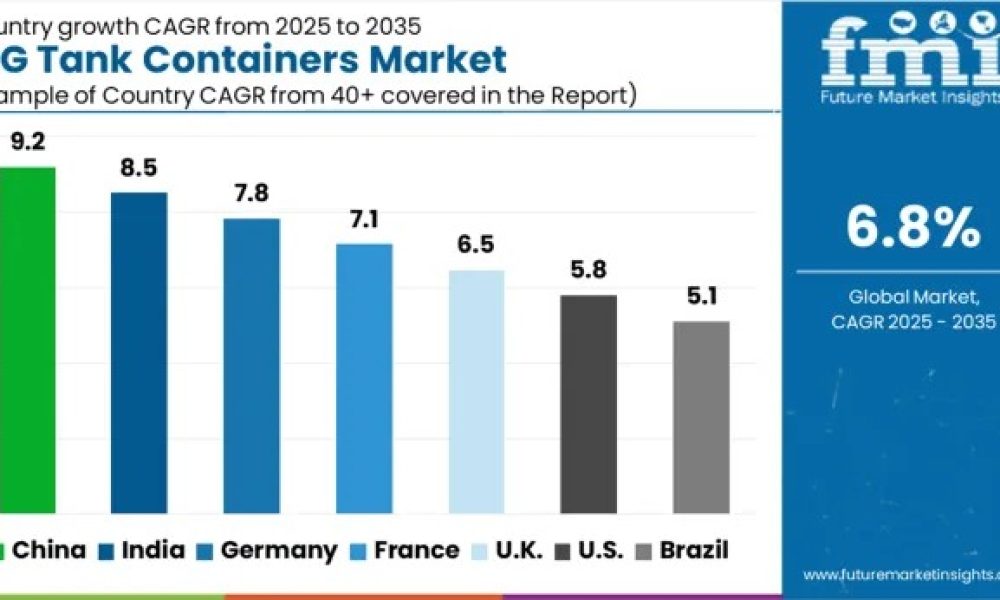
The global LNG tank containers market is entering a phase of sustained expansion as energy supply chains adapt to rising liquefied natural gas (LNG) trade volumes and the growing need for flexible, safe, and compliant transportation solutions. The market is estimated to be valued at USD 0.7 billion in 2025 and is projected to reach USD 1.3 billion by 2035, registering a compound annual growth rate (CAGR) of 6.8% over the forecast period.
This growth reflects a structural shift in global energy logistics, where LNG tank containers are increasingly positioned as a critical link between production terminals, storage hubs, and end-use sites. Their ability to support multimodal transportation across road, rail, and sea, while maintaining cryogenic temperatures and meeting stringent safety standards, is strengthening their role across industrial, commercial, and energy applications.
Expanding LNG Trade Strengthens Demand for Flexible Transport Solutions
Market expansion is being driven by the rising demand for efficient and safe LNG transportation, particularly as LNG adoption accelerates across power generation, industrial fuel switching, and transportation sectors. LNG tank containers account for approximately 20–22% of the LNG transportation and logistics market, underscoring their growing importance in enabling decentralized and small-to-mid-scale LNG distribution.
Supply chains are being reinforced to accommodate rising LNG volumes, while container manufacturers focus on standardized designs, pressure resistance, and compliance with international shipping and handling regulations. Regulatory emphasis on containment integrity, inspection protocols, and certification processes is shaping procurement decisions, pushing operators toward high-quality, durable container solutions with long operational lifespans.
Get access to comprehensive data tables and detailed market insights — request your sample report today!
https://www.futuremarketinsights.com/reports/sample/rep-gb-24934
Absolute Market Position Across Adjacent Industries Highlights Strategic Importance
Beyond LNG logistics, tank containers hold meaningful shares across several parent markets. Within the cryogenic equipment market, LNG tank containers represent approximately 15–17%, reflecting their reliance on advanced insulation and temperature control technologies. In bulk liquid storage and handling, their share stands at 12–14%, emphasizing their role in bridging fixed storage facilities and distributed consumption points while minimizing boil-off losses. Within the energy infrastructure market, LNG tank containers account for roughly 10–12%, facilitating reliable fuel supply to power plants, industrial operations, and commercial users.
This cross-market presence highlights the versatility and operational relevance of LNG tank containers in modern energy systems, particularly where pipeline infrastructure is limited or economically unviable.
Standard LNG Tank Containers Lead Product Adoption
By product type, standard LNG tank containers are projected to account for 39.4% of market revenue in 2025, maintaining their position as the most widely adopted solution. Their dominance is supported by a balance of cost efficiency, design versatility, and regulatory compliance, making them suitable for a wide range of logistics routes and transport distances.
Standard LNG tank containers are preferred for their compatibility with existing handling infrastructure and their ability to maintain cryogenic temperatures over extended transit periods. As LNG trade routes continue to expand and diversify, this segment is expected to remain the primary choice for operators seeking scalable and reliable transport solutions.
25,000-Liter Capacity Emerges as the Preferred Size
By capacity, the 25,000-liter segment is projected to account for 34.8% of market revenue in 2025, establishing itself as the most widely used configuration. This capacity offers an optimal balance between payload efficiency, transport economics, and regulatory compliance. Its suitability for intermodal transport across road, rail, and maritime routes has made it a core component of LNG distribution networks.
The widespread compatibility of 25,000-liter containers with port terminals, depots, and handling equipment further reinforces their adoption, supporting flexible deployment across both large-scale industrial customers and smaller distribution points.
Oil & Gas Sector Anchors End-User Demand
By end user, the oil & gas segment is expected to contribute 41.6% of market revenue in 2025, maintaining its leading position. Energy companies increasingly deploy LNG tank containers to supply remote extraction sites, refineries, offshore platforms, and distributed industrial customers where fixed infrastructure is constrained.
Strict safety, reliability, and performance requirements in the oil & gas sector have driven demand for specialized LNG tank container designs capable of operating under diverse climatic and regulatory conditions. As LNG continues to be integrated into upstream, midstream, and downstream operations, this segment is expected to sustain its dominance.
Asia-Pacific Leads Growth, Supported by Emerging Markets
Geographically, the LNG tank containers market is expanding across all major regions, with Asia-Pacific emerging as the fastest-growing market. China, growing at a 9.2% CAGR, leads global demand, driven by rising LNG imports, industrial energy consumption, and government-backed energy diversification initiatives. India follows closely at 8.5% CAGR, supported by increasing LNG use in power generation, industry, and transportation, along with infrastructure investments in ports and logistics.
In Europe, France (7.1% CAGR) and the United Kingdom (6.5% CAGR) benefit from LNG adoption in industrial and marine applications, while the United States, growing at 5.8% CAGR, continues to see demand from LNG exports, domestic distribution, and industrial energy use.
Drive Your Business Growth Strategy: Checkout the Report for Key Insights
https://www.futuremarketinsights.com/checkout/24934
Competitive Landscape Focused on Efficiency, Safety, and Compliance
The competitive landscape is shaped by manufacturers and logistics solution providers competing on thermal efficiency, pressure resistance, certification standards, and global transport compliance. Key players including CIMC Holdings, CXIC Group Containers Company Ltd., Nantong Tank Container, Chart Industries, Taylor Wharton, Furuise Europe, and Singamas emphasize vacuum insulation technology, container durability, and adherence to international safety regulations.
Competition increasingly centers on modular designs, digital monitoring capabilities, and after-sales support, as buyers prioritize long-term operational reliability and lifecycle cost optimization.
Market Outlook
As global energy systems continue to transition toward cleaner fuels, LNG tank containers are positioned as an essential enabler of flexible and efficient LNG distribution. Rising LNG trade, infrastructure development in emerging economies, and advances in cryogenic and digital container technologies are expected to sustain market momentum through 2035. The market’s steady growth profile and expanding role across energy logistics underscore its strategic importance within the global LNG value chain.
Why Choose FMI: Empowering Decisions that Drive Real-World Outcomes: https://www.futuremarketinsights.com/why-fmi
About Future Market Insights (FMI)
Future Market Insights, Inc. (FMI) is an ESOMAR-certified, ISO 9001:2015 market research and consulting organization, trusted by Fortune 500 clients and global enterprises. With operations in the U.S., UK, India, and Dubai, FMI provides data-backed insights and strategic intelligence across 30+ industries and 1200 markets worldwide.



