
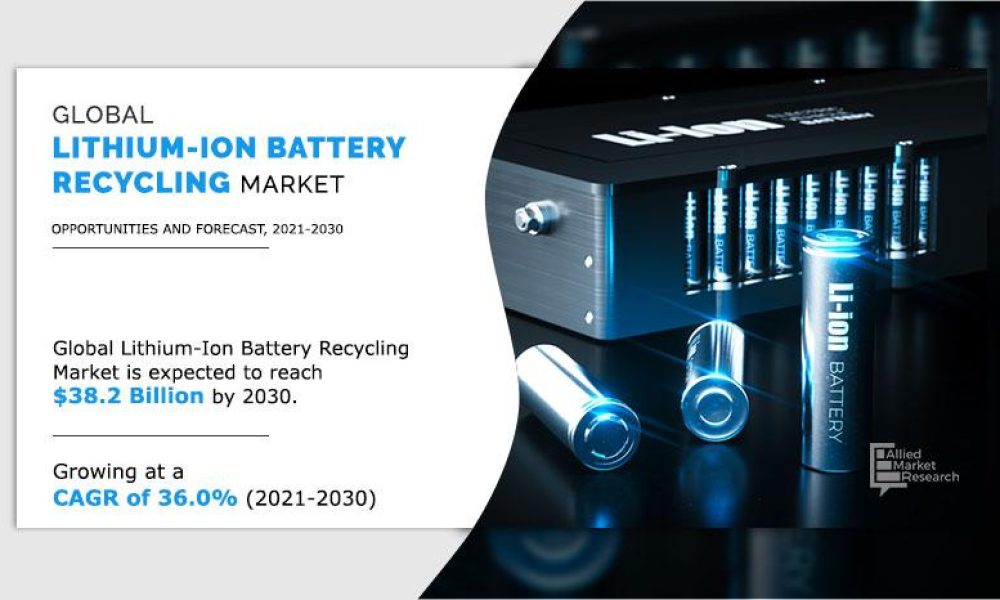
According to a new report published by Allied Market Research titled, “lithium-ion battery recycling market by battery chemistry, source, recycling process and end-use: global opportunity analysis and industry forecast, 2021–2030,” the lithium-ion battery recycling market size was valued at $1.33billion in 2020, and is projected to reach $38.21billion by 2030, growing at a CAGR of 36.0% from 2021 to 2030.
The lithium-ion battery recycling market involves the recovery and reuse of materials from used or end-of-life lithium-ion batteries. These batteries, widely used in electric vehicles (EVs), consumer electronics, and energy storage systems, contain valuable and finite resources such as lithium, cobalt, nickel, and manganese. Recycling helps conserve these critical materials, reduce environmental pollution, and support the sustainability of the battery supply chain. With the rapid rise in electric vehicle adoption and growing concerns over resource scarcity and battery waste management, the lithium-ion battery recycling market has become a vital component of the clean energy ecosystem. The market is driven by technological advancements in recycling processes, supportive government regulations, and increasing awareness of environmental responsibility.
Download PDF Brochure: https://www.alliedmarketresearch.com/request-sample/A11683
The rapid adoption of electric vehicles (EVs) is one of the primary growth drivers for the lithium-ion battery recycling market. As global efforts to reduce carbon emissions intensify, governments and automakers are increasingly shifting toward electric mobility. This transition is resulting in a surge in demand for lithium-ion batteries, which in turn is driving the need for sustainable battery disposal and recycling solutions. With EV battery packs reaching the end of their life cycle after several years of use, the recycling market is gaining momentum as a means to recover valuable materials and reduce environmental impact.
Another significant driver is the rising demand for critical battery materials such as lithium, cobalt, and nickel. These resources are limited and subject to supply chain risks and price volatility. Recycling lithium-ion batteries allows manufacturers to recover and reuse these critical materials, ensuring a more secure and cost-effective supply. This circular approach not only conserves natural resources but also supports the production of new batteries, reducing the dependency on raw material extraction and contributing to the overall sustainability of the battery industry.
In addition, stringent environmental regulations and growing awareness about e-waste management are pushing industries and governments to adopt battery recycling practices. Regulatory frameworks across regions, especially in Europe, North America, and parts of Asia-Pacific, are encouraging recycling initiatives through mandates, subsidies, and extended producer responsibility (EPR) programs. As a result, manufacturers and recyclers are investing in advanced recycling technologies and infrastructure, further boosting the growth of the lithium-ion battery recycling market.
For Purchase Inquiry: https://www.alliedmarketresearch.com/purchase-enquiry/A11683
The global lithium-ion battery recycling market analysis is segmented based on battery chemistry, source, recycling process, end-use, and region. By battery chemistry, the market includes lithium-iron phosphate, lithium-manganese oxide, lithium-nickel-cobalt-aluminum oxide, lithium-nickel-manganese-cobalt, and lithium-titanate oxide. In terms of source, it is divided into electric vehicles, electronics, power tools, and other segments. The recycling process segment comprises hydrometallurgical, physical/mechanical, and pyrometallurgical methods. Based on end-use, the market is categorized into automotive and non-automotive applications. Regionally, the market is studied across North America, Europe, Asia-Pacific, and LAMEA.
The market is analyzed across four major regions, namely, North America, Europe, Asia-Pacific, and LAMEA. Europe garnered dominant market share in 2020, and is anticipated to maintain this trend during the forecast period. This is attributed to numerous factors such as presence of huge consumer base and the existence of key players in the region. Moreover, regulations toward environmental pollution and rapid growth of electric vehicle industry in the region are anticipated to contribute toward growth of the lithium-ion battery recycling market in Europe.
The global lithium-ion battery recycling market analysis covers in-depth information of the major industry participants. The key players operating and profiled in the report include Ganfeng Lithium Co., Ltd., American Battery Technology Company, Accurec Recycling GmbH, Akkuser Oy, Duesenfeld GmbH, Li-Cycle Corp., Fortum Corporation, Retriev Technologies, Inc., Lithion Recycling, Inc., and Umicore.
Other players operating in the value chain of the global lithium-ion battery recycling market are Neometals Ltd., Primobius, Green Li-ion Pvt., Ltd., SungEel MCC Americas, Redux GmbH, and others.
The report provides a detailed analysis of these key players in the global lithium-ion battery recycling industry. These players have adopted different strategies such as new product launches, collaborations, expansion, joint ventures, and agreements to increase their market share and maintain dominant shares in different regions. The report is valuable in highlighting business performance, operating segments, product portfolio, and strategic moves of market players to highlight the competitive scenario.
Key Findings Of The Study
- In 2020, the lithium-manganese oxide segment accounted for majority of share of the global lithium-ion battery recycling market, and is expected to maintain its lead during the forecast period.
- In 2020, the electronics segment accounted for about 67.5%, and is expected to maintain its dominance till the end of the forecast period.
- The hydrometallurgical process segment accounted for 64.8% in 2020, and is anticipated to grow at a rate of 39.7% in terms of revenue, increasing its share in the global lithium-ion battery recycling market.
- Electric vehicle is the fastest-growing source segment in the lithium-ion battery recycling market, and is expected to grow at a CAGR of 46.1%.
- Asia-Pacific is expected to grow at the fastest rate, registering a CAGR of 40.8% during the lithium-ion battery recycling forecast period.




