
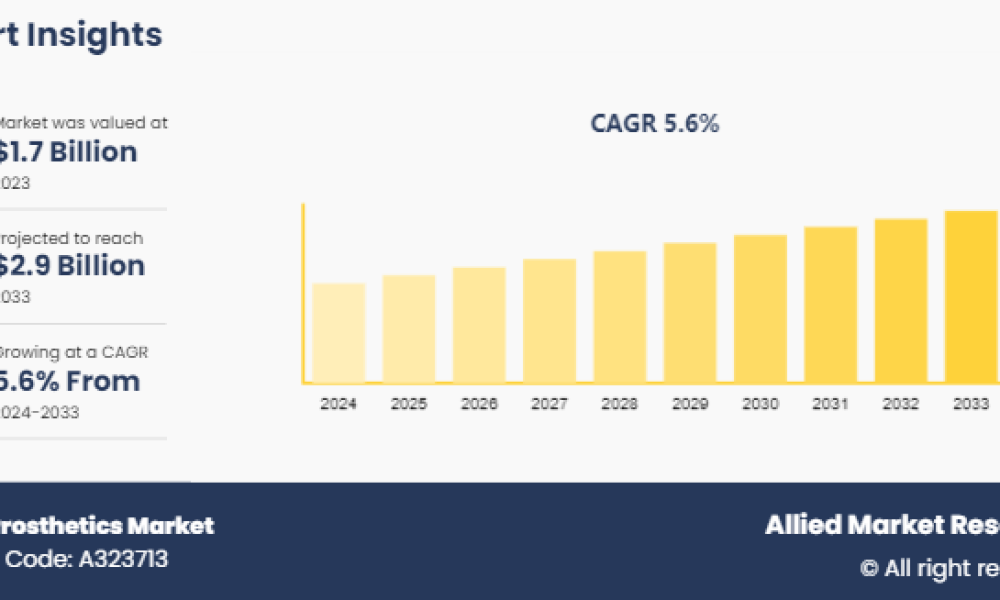
The global limb prosthetics market, valued at $1.7 billion in 2023, is projected to reach $2.9 billion by 2033, growing at a CAGR of 5.6% between 2024 and 2033. Market growth is underpinned by advances in prosthetic technology, growing awareness and acceptance of prosthetic solutions, and the rising prevalence of limb loss due to conditions such as diabetes, vascular diseases, and traumatic injuries.
Market Overview and Definition
Limb prosthetics are artificial devices designed to replace missing limbs, enabling individuals to regain mobility, independence, and improved quality of life after amputation or congenital limb deficiencies. Modern prosthetics go far beyond simple cosmetic replacements—today’s devices integrate lightweight materials, 3D printing, sensor-based controls, and myoelectric systems to enhance comfort, functionality, and aesthetics.
Limb prosthetics are broadly categorized into:
Passive Prosthetics – Primarily cosmetic, providing appearance restoration without active movement.
Body-Powered Prosthetics – Controlled by cables and harnesses linked to the user’s muscle movements.
Myoelectric Prosthetics – Powered by electrical signals from the user’s muscles, offering precise and natural movements.
These innovations are transforming the prosthetics landscape, making devices more personalized, affordable, and accessible.
Get a Sample Copy of this Report: https://www.alliedmarketresearch.com/request-sample/A323713
Key Growth Drivers
1. Rising Incidence of Limb Loss
The demand for prosthetics is closely tied to global amputation rates. According to the National Library of Medicine (2024), approximately 150,000 lower extremity amputations are performed annually in the U.S. alone. Diabetes-related complications, vascular diseases, and traumatic injuries are the primary causes.
Vascular diseases, including diabetes and peripheral arterial disease, account for 54% of amputations.
Traumatic injuries—from accidents, workplace hazards, and combat—make up 45%.
Cancer-related amputations account for around 1% of cases.
The global rise in diabetes, particularly in developing countries, is expected to substantially increase the demand for advanced lower-limb prosthetics.
2. Growing Awareness and Societal Acceptance
The stigma surrounding prosthetics has significantly diminished in recent years. Public awareness campaigns, inspirational stories of amputees excelling in sports and professional life, and improved prosthetic designs have helped normalize prosthetic use. Increasing awareness has also encouraged early adoption of advanced prosthetic solutions.
3. Technological Advancements
Innovation is at the heart of the limb prosthetics market’s growth. Developments such as biomimetic prosthetics, microprocessor-controlled knees, and 3D-printed customized limbs have improved comfort, natural movement, and accessibility.
For example:
IIT Madras launched a polycentric prosthetic knee in April 2022, enhancing mobility at an affordable cost in India.
Ossur’s POWER KNEE—the world’s first actively powered microprocessor-controlled knee—offers unmatched adaptability for above-knee amputees.
New biocompatible materials reduce skin irritation and improve durability.
Market Segmentation
By Type
Upper Limb Prosthetics
Lower Limb Prosthetics (dominates due to high prevalence of lower-limb amputations)
By Technology
Conventional Prosthetic Devices
Electric Prosthetic Devices
Hybrid Prosthetic Devices
By Component
Socket
Appendage
Joint
Connecting Module
Others
By End User
Hospitals
Clinics
Others
Regional Outlook
North America
The largest market in 2023, supported by:
High amputation rates due to diabetes and vascular conditions
Presence of major prosthetic manufacturers
Government funding for advanced prosthetics (e.g., NHS program in the UK for microprocessor knees)
Asia-Pacific
Expected to register the fastest CAGR due to:
Growing healthcare investments
Rising incidence of diabetes and traumatic injuries
Expanding rehabilitation infrastructure
However, affordability remains a challenge, particularly for advanced devices.
Europe
Home to innovative prosthetic developers like Ottobock and Ossur, Europe benefits from robust public healthcare support and R&D funding.
Industry Trends
Affordable Prosthetics for Emerging Markets
In May 2024, South Dakota State University engineering students developed a low-cost prosthetic solution aimed at the estimated 40 million amputees worldwide, of whom only 2 million currently have access to prosthetic devices.
Biomimetic and AI-Driven Prosthetics
According to the National Library of Medicine (2024), biomimetic prosthetics with AI-assisted movement control are offering enhanced integration with the human body, promising more natural motion and reduced energy expenditure.
3D Printing for Personalization
3D printing allows for rapid, cost-effective production of customized sockets and components, reducing production costs and improving comfort.
High-Profile Partnerships and Donations
Humanitarian initiatives, such as Siemens Caring Hands’ $250,000 grant to Unlimited Tomorrow for prostheses for war victims in Ukraine, showcase the social responsibility aspect of the industry.
Competitive Landscape
Key market players include:
Ottobock
Ossur
Hanger, Inc.
Blatchford Limited
WillowWood Global LLC
Fillauer LLC
Spinal Technology Inc.
Steeper Inc.
Uniprox
Ortho Europe
These companies are focusing on product innovation, strategic collaborations, and regional expansion to meet growing demand.
Future Opportunities
The next decade presents multiple growth avenues for the limb prosthetics industry:
Integration of robotics and AI to improve gait analysis and adaptive movement.
Expansion in emerging economies through affordable, mass-produced devices.
Enhanced rehabilitation ecosystems combining prosthetics with physiotherapy and wearable monitoring.
Given the increasing amputee population and rapid pace of technological development, the market is well-positioned to meet the mobility needs of millions globally.
Conclusion
The limb prosthetics market is undergoing a profound transformation—shifting from basic replacements to high-tech, personalized mobility solutions. By 2033, with an expected market value of $2.9 billion, the industry will be shaped by technological breakthroughs, greater accessibility, and changing societal perceptions of limb loss. As innovation continues and affordability improves, limb prosthetics will not only restore movement but also empower users to lead active, independent, and fulfilling lives.




