
Light Sensors Market Overview
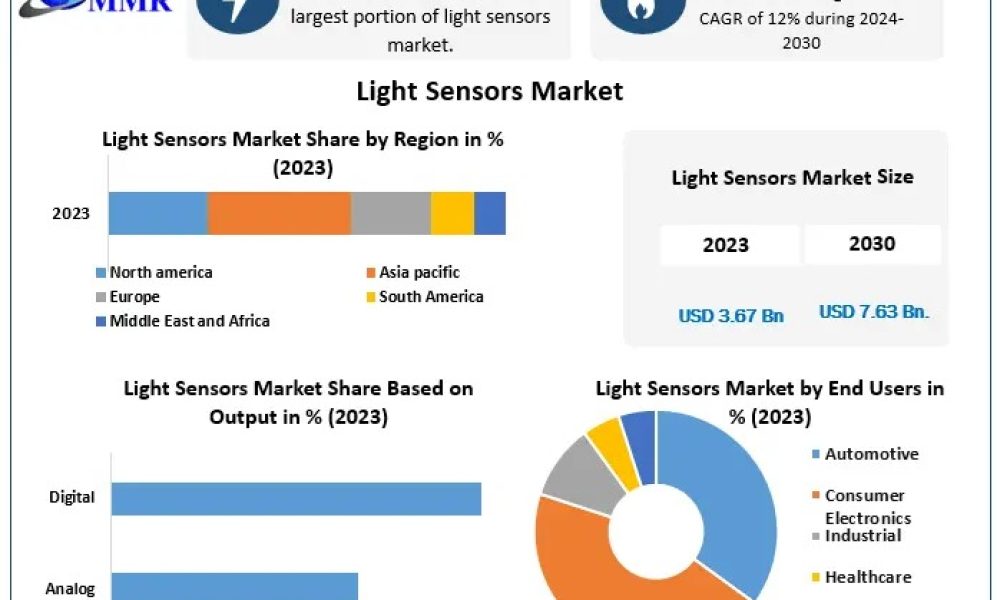
Light Sensors Market was valued at USD 3.67 billion in 2023 and is expected to reach approximately USD 7.63 billion by 2030, growing at a CAGR of about 12%. This robust growth is led by rising demand for energy-efficient solutions, widespread integration into smartphones and smart home systems, advances in digital sensor technology, and expanding adoption in automotive, healthcare, and industrial automation sectors.
Key Highlights & Insights
Market Size & Forecast: USD 3.67 billion (2023) to USD 7.63 billion (2030), CAGR 12%. Estimates for 2025 show the market around USD 5.24 billion, with projections for 2032/2033 reaching USD 8–11.7 billion, depending on the research source.
Dominating Region: Asia Pacific commands the largest market share (about 36–40.5% as of 2024), driven by high smartphone production, expanding consumer electronics, and increasing smart device adoption. Most sensor manufacturing is concentrated in Asia, even though the U.S. and Europe lead design and innovation.
Leading Segment: Digital output sensors dominate in 2023, largely due to their integration in consumer electronics like smartphones, tablets, and smart home systems. Ambient light sensing is a key application area.
Key Driver: Surging demand for automated, energy-efficient smart lighting, coupled with innovations in photodiodes, phototransistors, and CMOS sensor technologies, is fueling sector expansion. Adoption in automotive for ADAS and lighting control, as well as growth in medical and industrial use cases, further supports strong market momentum.
Recent Developments
In January 2024, Phlux Technology introduced advanced InGaAs APD light sensors for long-range LiDAR with 12x greater sensitivity.
Ams-OSRAM AG (November 2022) released a three-channel UV-A/B/C light sensor, supporting smart purification and medical uses.
In May 2023, INGY, CALUMINO, and DANLERS launched an AI-embedded computer vision light sensor for precise, privacy-preserving occupancy measurement in smart buildings.
Market Dynamics
Growth Drivers: Growth in smart home, smartphone, and automotive adoption; integration of AI and IoT for responsive automation; government push for energy efficiency and safer vehicles.
Challenges: High technology and production costs, significant R&D investment, price competition from low-cost vendors.
Trends: Miniaturization for wearables and AR/VR devices, AI/ML-based intelligent lighting, development of flexible/curved sensors for innovative displays.
For full access to the data, request a sample report now :https://www.maximizemarketresearch.com/request-sample/2893/
Regional Analysis
Asia Pacific: Leads market share with growth mainly from China, Japan, Korea, and India; key hub for manufacturing and electronics exports.
North America: Significant growth expected, led by leading innovation, demand in smart homes, and major automotive and industrial applications.
Europe: Strong presence in sensor R&D, automotive, and smart infrastructure projects.
Product Segmentation
By Function: Ambient light sensing, proximity detection, RGB color sensing, gesture recognition, IR/UV detection.
By Output: Digital (dominant), analog.
By End User: Automotive, consumer electronics, industrial, healthcare.
Key Trends
Integration with smart home and city infrastructure, expansion into healthcare and industrial IoT.
Growth in advanced driver-assistance systems (ADAS) and adaptive lighting, especially in automotive.
Proliferation of flexible, compact sensors for wearables, AR, and biomedical interfaces.
Segment Insights and Technology Trends
Digital output sensors lead the global market, dominating in applications like lighting control, HVAC, and screen-based devices. Precision in measurement and compatibility with digital control systems encourage widespread adoption. Analog light sensors—although accounting for a smaller market share—remain vital for backlight control, proximity detection, gesture recognition, and ambient light sensing, especially in automotive and healthcare applications.
Ambient light sensing and proximity detection are key functions, with proximity sensors representing around 21% of global revenue in recent years. Miniaturized low-power CMOS architectures now enable their integration into wearables, AR/VR devices, and even curved/flexible displays.
Quote
Asia Pacific’s manufacturing strength and surging demand for connected, intelligent electronics are powering the global light sensors market. With ongoing innovation in digital technology, energy efficiency, and AI-driven automation, the industry is poised for sustained growth across applications worldwide.




