
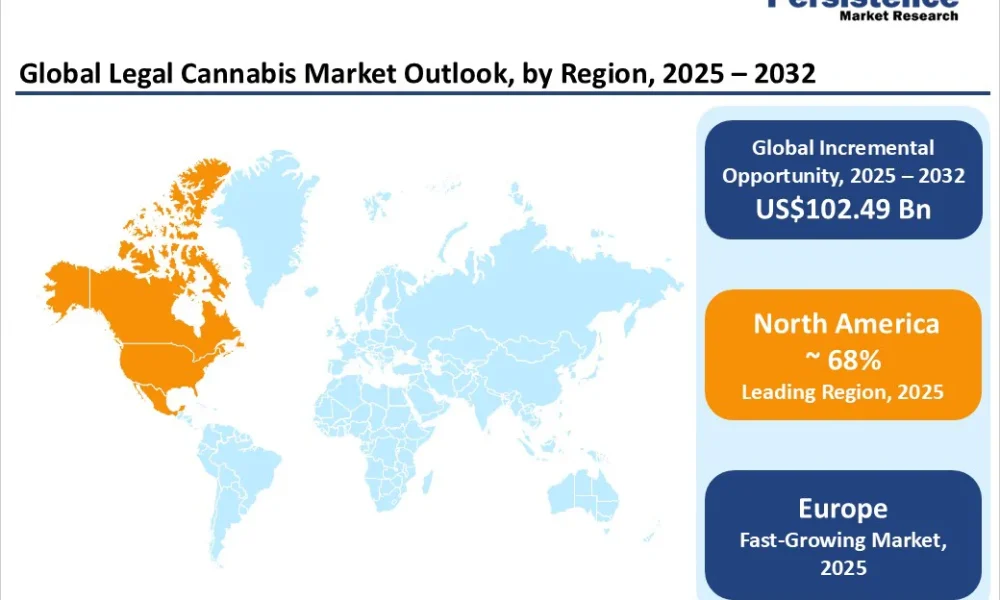
The global legal cannabis market is witnessing remarkable growth as regulatory reforms and changing consumer perceptions transform cannabis from an illicit substance into a regulated commercial industry. The market is projected to reach a value of US$38.73 billion in 2025 and is forecast to grow significantly to US$141.22 billion by 2032, expanding at a compound annual growth rate (CAGR) of 20.3% between 2025 and 2032. The expansion is largely fueled by increasing legalization for both medical cannabis and recreational cannabis, alongside a surge in consumer awareness regarding cannabis-based therapeutic products. Governments in multiple regions are progressively creating regulated frameworks that allow cultivation, distribution, and consumption of cannabis, thereby unlocking substantial commercial opportunities. The rising demand for cannabis-derived products such as oils, tinctures, edibles, and concentrates further contributes to the market’s rapid expansion. Additionally, technological advancements in cultivation methods, including hydroponics and controlled-environment agriculture, are improving product quality and supply chain efficiency, supporting market growth.
Several key drivers are accelerating the development of the legal cannabis industry. Increasing acceptance of cannabis-based therapies for chronic pain, neurological disorders, epilepsy, and mental health conditions has significantly strengthened demand in the medical sector. Healthcare professionals and patients are increasingly considering cannabis as an alternative or complementary treatment option to traditional pharmaceuticals. The medical cannabis segment currently leads the market, accounting for nearly 71% of global revenue, due to well-structured regulatory frameworks and higher-value pharmaceutical-grade formulations. From a product standpoint, dried cannabis flower dominates the market with approximately 51% share, as it remains the most familiar and widely consumed format among users. Geographically, North America leads the global market with around 68% market share, primarily due to early legalization initiatives, strong consumer adoption, and a mature retail infrastructure across the United States and Canada. The region also benefits from extensive research initiatives, product innovation, and the presence of large multistate cannabis operators, all of which continue to drive market leadership.
Download Your Free Sample & Explore Key Insights: https://www.persistencemarketresearch.com/samples/35660
Key Highlights from the Report
• The legal cannabis market is projected to grow from US$38.73 billion in 2025 to US$141.22 billion by 2032 at a CAGR of 20.3%.
• North America dominates the market with approximately 68% global share due to advanced regulatory frameworks and high consumer adoption.
• Medical cannabis applications account for nearly 71% of global revenue, supported by healthcare integration and structured patient programs.
• Dried cannabis flower leads the product segment, representing about 51% of total market demand worldwide.
• Europe is emerging as the fastest-growing regional market, driven by regulatory reforms and expanding medical cannabis programs.
• Increasing investments in cultivation technology, product innovation, and international expansion are shaping competitive dynamics.
Market Segmentation
The legal cannabis market can be segmented based on product type, application, and distribution structure, each contributing uniquely to market expansion. In terms of product type, the market is primarily divided into dried flower, cannabis oils and tinctures, concentrates, edibles, beverages, and other derivative products. Among these, dried flower remains the most widely consumed product due to its long-standing presence in cannabis culture and its relatively low production and processing costs. Consumers often prefer dried flower for its versatility, as it can be smoked or vaporized, making it an accessible entry point for both new and experienced users. The well-established cultivation infrastructure and retail distribution channels further reinforce the dominance of this segment. Meanwhile, cannabis oils and concentrates are gaining significant popularity, especially in medical markets, where precise dosing and higher potency are crucial.
The growing popularity of edibles and cannabis-infused beverages is also reshaping product segmentation within the industry. These products appeal to consumers who prefer discreet consumption methods that avoid smoking. Edibles such as gummies, chocolates, baked goods, and beverages offer consistent dosing and are increasingly marketed as lifestyle products aligned with wellness trends. As more jurisdictions legalize recreational cannabis, these formats are expected to experience accelerated adoption among younger consumers and first-time users.
From an application perspective, the market is broadly categorized into medical use, recreational use, and wellness applications. Medical cannabis currently represents the largest share of the market due to government-approved programs and physician oversight in many countries. Medical cannabis products are commonly prescribed for conditions such as chronic pain, epilepsy, multiple sclerosis, cancer-related symptoms, and anxiety disorders. These products often require stringent quality control and pharmaceutical-grade manufacturing standards, which contribute to higher pricing and revenue generation.
Recreational cannabis, although smaller in share compared to medical cannabis, is expanding rapidly as more governments legalize adult-use consumption. Recreational markets create new retail opportunities and stimulate demand for innovative products such as cannabis beverages, vape cartridges, and microdose edibles. Additionally, wellness applications are emerging as a significant growth area, where cannabis-derived compounds like CBD are incorporated into skincare products, dietary supplements, and functional foods aimed at promoting relaxation, stress relief, and improved sleep quality.
Regional Insights
North America continues to dominate the global legal cannabis market, accounting for the majority of total revenue. The region’s leadership is largely driven by progressive regulatory frameworks, high consumer awareness, and strong industry infrastructure. In the United States, although cannabis remains federally restricted, numerous states have legalized either medical or recreational cannabis, creating a complex but highly lucrative market environment. State-level legalization has enabled the development of large multistate operators that control cultivation, processing, and retail distribution. Canada, which legalized recreational cannabis nationwide earlier than most countries, continues to expand its domestic market while simultaneously strengthening its export capabilities. Canadian producers are investing heavily in advanced cultivation techniques and pharmaceutical-grade formulations to maintain global competitiveness.
Europe is currently the fastest-growing regional market for legal cannabis. Several European countries are expanding their medical cannabis programs, while others are considering broader legalization policies. Germany has emerged as a central hub for the European cannabis industry after introducing major regulatory reforms that permit adult-use consumption and encourage domestic production and imports. The expansion of medical cannabis prescriptions and the establishment of cannabis social clubs have significantly increased demand in the country. Additionally, nations such as the United Kingdom, the Netherlands, and Portugal are strengthening their roles in cultivation, distribution, and pharmaceutical research, further contributing to regional growth.
The Asia Pacific region remains in the early stages of cannabis legalization but presents substantial long-term growth potential. Governments in the region are cautiously exploring medical cannabis frameworks while maintaining strict regulatory oversight. Australia is one of the most advanced markets in the region, with a rapidly growing medical cannabis industry supported by increasing prescription rates and expanding cultivation licenses. The country is also positioning itself as a global exporter of high-quality medical cannabis products. Other nations in the region are gradually evaluating regulatory reforms, indicating that Asia Pacific could become a significant market in the coming years as policy environments evolve.
Latin America and the Middle East & Africa are also emerging as potential markets for legal cannabis, particularly in medical applications. Countries in Latin America are exploring cannabis cultivation as an economic opportunity due to favorable agricultural conditions and lower production costs. Meanwhile, certain Middle Eastern and African nations are beginning to examine regulatory frameworks that allow limited medical cannabis usage. Although these regions currently represent a smaller share of the global market, gradual regulatory shifts could unlock new investment opportunities and production hubs.
Market Drivers
One of the primary drivers of the legal cannabis market is the increasing adoption of cannabis-based therapies within the healthcare sector. Medical research has demonstrated the potential of cannabinoids in managing a wide range of conditions, including chronic pain, epilepsy, anxiety disorders, and neurodegenerative diseases. As clinical evidence supporting these therapeutic benefits continues to grow, healthcare professionals are becoming more willing to prescribe cannabis-based treatments. Governments are also establishing regulated medical cannabis programs that ensure product safety, quality control, and patient access, further strengthening market growth.
Technological innovation is another significant driver shaping the cannabis industry. Advances in cultivation techniques such as vertical farming, hydroponics, and controlled indoor environments are improving crop yield and consistency. These technologies allow producers to maintain precise temperature, humidity, and lighting conditions, resulting in higher-quality cannabis products. Additionally, advanced extraction techniques are enabling manufacturers to produce refined oils, concentrates, and cannabinoid isolates that meet strict regulatory standards. The adoption of digital technologies such as blockchain and artificial intelligence for seed-to-sale tracking is also enhancing transparency and regulatory compliance across the supply chain.
Changing consumer attitudes toward cannabis are further accelerating market expansion. Over the past decade, public perception has shifted dramatically as consumers increasingly recognize cannabis as a legitimate therapeutic and recreational product rather than an illicit substance. This shift has encouraged governments to reconsider prohibition policies and implement regulated frameworks that generate tax revenue and create employment opportunities.
Get Custom Insights Designed for Your Business: https://www.persistencemarketresearch.com/request-customization/35660
Market Restraints
Despite its strong growth prospects, the legal cannabis market faces several challenges that could hinder expansion. One of the most significant obstacles is the complex and fragmented regulatory environment that varies widely across countries and even within regions. Companies operating in multiple jurisdictions must comply with different cultivation rules, packaging requirements, labeling standards, and distribution regulations. This regulatory complexity often increases operational costs and delays product launches, particularly for smaller companies that lack the resources to navigate multiple compliance systems.
Limited access to traditional financial services is another major constraint affecting the industry. Many cannabis businesses continue to face restrictions from banks and financial institutions due to the sector’s classification as high-risk or federally illegal in certain jurisdictions. As a result, companies often rely on cash transactions or specialized financial service providers that charge higher fees. This lack of banking access creates operational challenges, including difficulties in securing loans, managing payroll, and processing payments.
Quality control and product standardization also present ongoing challenges in the cannabis market. Because cannabis is a biological product influenced by environmental factors, maintaining consistent potency and chemical composition can be difficult. Regulatory authorities are increasingly imposing strict testing requirements to ensure product safety and prevent contamination from pesticides, heavy metals, or microbial agents. Meeting these standards requires significant investment in laboratory testing and quality assurance processes.
Market Opportunities
The legal cannabis industry offers numerous growth opportunities, particularly through product innovation and advanced delivery systems. Emerging technologies such as nanoemulsions and nanocapsules are improving the bioavailability of cannabinoids, allowing them to be absorbed more efficiently by the human body. These innovations are enabling the development of new product formats such as dissolvable strips, oral sprays, and fast-acting beverages that provide controlled dosing and improved user experience. As research into cannabinoid pharmacology expands, companies that invest in advanced formulation technologies are likely to gain a competitive advantage.
Another promising opportunity lies in the expansion of cannabis products within the wellness and lifestyle sectors. Cannabis-derived compounds, particularly cannabidiol (CBD), are increasingly incorporated into skincare products, supplements, and functional beverages. Consumers seeking natural alternatives for stress management, sleep improvement, and overall well-being are driving demand for these products. This trend aligns with broader global interest in plant-based wellness solutions, making cannabis an attractive ingredient in health and beauty applications.
The development of cannabis products for pet health and veterinary therapeutics also represents a growing niche market. Pet owners are increasingly exploring CBD-based treatments to manage anxiety, inflammation, and chronic pain in animals. As research and regulatory approvals expand, pet-focused cannabis products could become a significant revenue stream for manufacturers.
Additionally, the biosynthetic production of cannabinoids through biotechnology offers an innovative approach to addressing supply limitations. Using engineered yeast or microorganisms, companies can produce rare cannabinoids such as CBG and CBN more efficiently than traditional cultivation methods. This technology has the potential to reduce production costs while enabling large-scale manufacturing of specialized cannabinoid compounds.
Checkout Now & Download Complete Market Report: https://www.persistencemarketresearch.com/checkout/35660
Company Insights
The legal cannabis market features a competitive landscape dominated by multinational corporations, regional leaders, and emerging start-ups focusing on niche product categories. Companies are expanding cultivation capacity, developing innovative product lines, and entering international markets to strengthen their positions in the global industry.
Key Players
• Canopy Growth Corporation
• Tilray Brands
• Aurora Cannabis
• Curaleaf Holdings
• Green Thumb Industries
• Trulieve Cannabis Corp.
• Cresco Labs
• Verano Holdings
• Glass House Brands
• Eaze
• Budr Cannabis
• Vireo Growth
• MedMen Enterprises
• Aphria Inc.
• Cronos Group
• HEXO Corp
• OrganiGram Holdings
• Supreme Cannabis Company
• iAnthus Capital Holdings
• The Green Organic Dutchman
Recent Developments
In August 2025, a South Norwalk-based distillery launched its first THC-infused beverage called HZE, containing the maximum legally permitted THC content in Connecticut. The product represents a growing trend toward cannabis-infused beverages as alternatives to alcoholic drinks.
In June 2025, Vireo Growth Inc. completed the acquisition of Proper Brands, a cannabis company based in Missouri. The acquisition aims to strengthen Vireo’s cultivation and processing capabilities while expanding its presence in the U.S. medical cannabis market.
Conclusion
The global legal cannabis market is undergoing a transformative phase driven by regulatory reforms, evolving consumer attitudes, and increasing recognition of cannabis as both a therapeutic and lifestyle product. With market value expected to grow substantially over the coming decade, the industry is attracting significant investment from pharmaceutical companies, consumer goods firms, and agricultural enterprises. North America currently leads the market due to its advanced regulatory environment and strong consumer adoption, while Europe is rapidly emerging as the fastest-growing region as legalization spreads.




