
Leather Goods Market Market Overview:
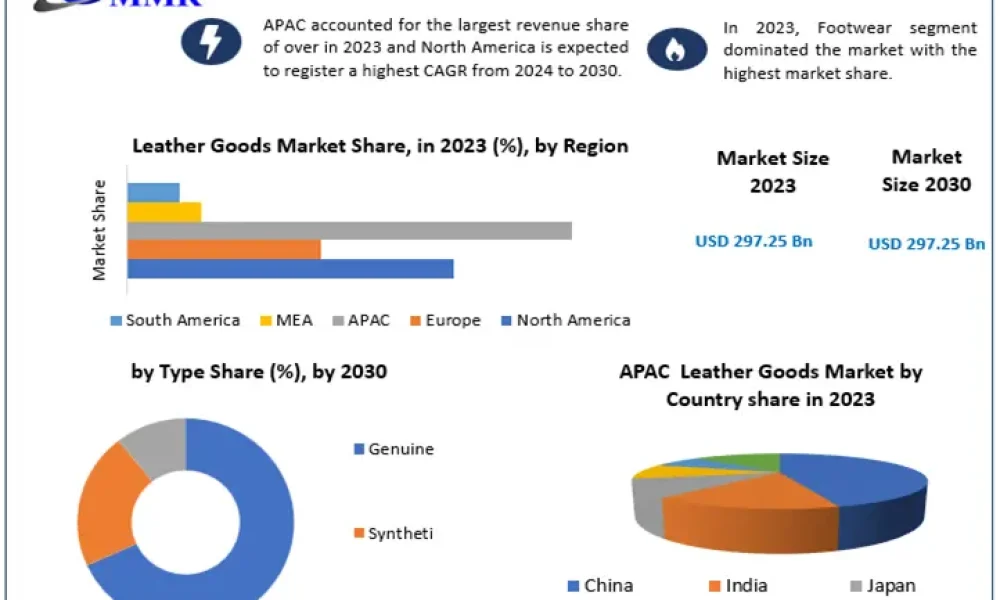
Leather Goods market is set for robust expansion, expected to grow from USD 297.25 billion in 2023 to USD 475.31 billion by 2030, registering a CAGR of 6.94%. This impressive growth is driven by escalating consumer demand for premium leather footwear, accessories, and apparel, alongside rising investments in manufacturing capacities—particularly in the Asia Pacific region.
Key Highlights & Insights
Market Size & Growth: The leather goods market is forecast to expand from USD 297.25 billion in 2023 to USD 475.31 billion by 2030, growing at a CAGR of nearly 7%.
Dominating Region: Asia Pacific leads the market, favored by a strong leather manufacturing ecosystem in countries like China and India, supportive government policies, and surging domestic and export demand.
Leading Segment: Footwear dominates the product landscape, accounting for roughly 40.5% of the market, driven by premium and athletic leather shoes from major brands.
Key Driver: Consumer preference for genuine leather products, supported by increasing urbanization, disposable incomes, and appetite for luxury and durable fashion items fuels market growth.
► Get a sample of the report:https://www.maximizemarketresearch.com/request-sample/115698/
Recent Developments
In 2021, Adidas launched a sustainable sneaker line featuring mushroom-based leather material, reflecting the growing focus on eco-friendly and innovative leather substitutes.
Nike’s 2017 introduction of Flyleather—comprising leather scraps combined with recycled polyester—highlights industry trends toward sustainability without compromising quality.
India’s government unveiled a USD 250 billion development program targeting footwear, leather, and accessories to boost manufacturing, enhance technology, and create skilled workforce capabilities.
Market Dynamics
Growth Drivers:
Increasing consumer inclination toward premium, durable, and stylish leather goods.
Expanding urbanization and lifestyle changes globally, especially in emerging markets.
Rapid growth in athleisure and luxury footwear segments.
Growing adoption of synthetic and vegan leather alternatives complementing traditional leather products.
Challenges:
Environmental regulations related to tanning processes, particularly in Europe and North America, restrict certain practices.
Skill gaps and technological limitations in some manufacturing hubs.
High production costs and fluctuating raw material prices.
Opportunities:
Rising global demand for synthetic leather alternatives boosts market inclusivity.
Technological innovations such as bio-based and plant-based leather substitutes.
Expansion into untapped markets within Latin America and Africa fueled by rising disposable incomes.
Regional Analysis
Asia Pacific: The fastest-growing and largest market, driven by China and India’s manufacturing strength, export volume, and rising domestic consumption.
North America: Strong demand for luxury handcrafted leather goods supports stable growth.
Europe: Focuses on premium and artisanal leather products from heritage brands, along with strict environmental compliance driving sustainable practices.
Latin America and Middle East & Africa: Emerging opportunities influenced by improving infrastructure and evolving consumer lifestyles.
Product Segmentation
By Product: Footwear, Bags & Wallets, Apparel, Gloves, Travel Goods, Others.
By Material: Genuine Leather, Synthetic Leather, Exotic Leather, Recycled Leather, Others.
By Distribution Channel: Offline Retail, Online Retail, Direct Sales.
Key Trends
The rise of eco-friendly and vegan leather alternatives as a response to sustainability concerns.
Increasing collaboration between traditional leather manufacturers and biotech firms to develop innovative materials.
Growing consumer preference for personalized and customized leather goods.
Digital transformation and e-commerce expansion fueling accessible buying experiences.
Market growth being bolstered by millennials and Gen Z consumers who value both fashion and environmental responsibility.
FAQs
Which region dominates the leather goods market? Asia Pacific leads, attributed to its manufacturing dominance.
What is the leading product segment? Footwear commands the largest share.
Who are the key players? Hermès, Louis Vuitton, Woodland Worldwide, Adidas, Nike.
What is driving market growth? Rising demand for luxury, durability, and sustainable materials.
What are the key challenges? Environmental regulations and production cost fluctuations.
Conclusion
With increasing consumer wealth, rapidly evolving fashion trends, and technological advancements in sustainable materials, the leather goods market is set for impressive growth by 2030. Asia Pacific’s manufacturing prowess and expanding domestic consumption underpin the market’s dominance, while emerging regions offer new avenues for expansion. Industry players focusing on eco-friendly practices, innovation, and digital distribution are well-poised to capitalize on evolving global demand—making the leather goods sector a cornerstone of the broader fashion and luxury goods market in the coming decade.
◉ Get Market Research Latest Trends
♦ Maximize Market Research is launching a subscription model for data and analysis in the MMR Statistics
Contact Maximize Market Research:
3rd Floor, Navale IT Park, Phase 2
Pune Bangalore Highway, Narhe,
Pune, Maharashtra 411041, India
[email protected]
+91 96071 95908, +91 9607365656
About Maximize Market Research:
Maximize Market Research is a multifaceted market research and consulting company with professionals from several industries. Some of the industries we cover include medical devices, pharmaceutical manufacturers, science and engineering, electronic components, industrial equipment, technology and communication, cars and automobiles, chemical products and substances, general merchandise, beverages, personal care, and automated systems. To mention a few, we provide market-verified industry estimations, technical trend analysis, crucial market research, strategic advice, competition analysis, production and demand analysis, and client impact studies.




