
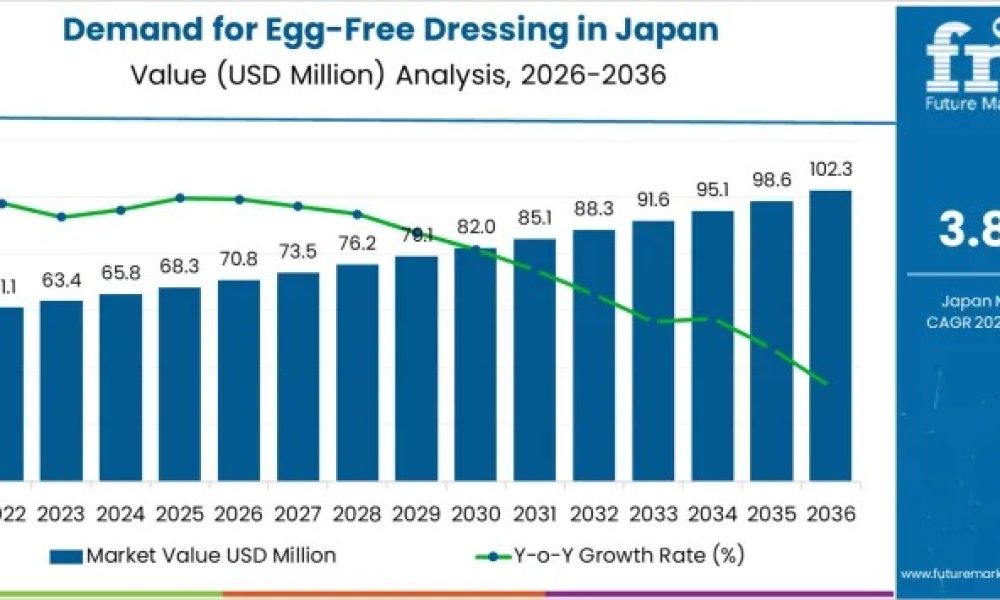
The demand for egg-free dressing in Japan is valued at USD 70.8 million in 2026 and is projected to reach USD 102.3 million by 2036, expanding at a compound annual growth rate (CAGR) of 3.8%. Growth reflects Japan’s methodical shift toward allergen-conscious food solutions, driven by structured foodservice procurement, gradual household adoption, and incremental product diversification rather than rapid dietary disruption.
Market expansion builds on a clear historical base. Demand increased from USD 56.8 million in 2020 to USD 70.8 million by 2026, supported primarily by foodservice usage and standardized institutional purchasing cycles. Ranch and vinaigrette formats currently hold the largest shares, while bulk packaging dominates volumes due to high consumption by restaurants, catering operations, and central kitchens. Early demand has been reinforced by predictable menu planning, allergen-control policies, and consistent reordering patterns across Japan’s commercial food ecosystem.
Explore trends before investing – request a sample report today!
From 2027 to 2031, the market is expected to grow from USD 73.5 million to USD 82.0 million, reflecting controlled but steady expansion. During this phase, growth is shaped by gradual retail penetration, increased product trials in supermarkets and convenience stores, and selective adoption by manufacturers reformulating prepared foods. Between 2031 and 2036, demand accelerates more visibly, reaching USD 102.3 million, as repeat purchasing strengthens, private labels scale egg-free variants, and foodservice operators broaden allergen-friendly offerings nationwide.
Foodservice Anchors Market Stability
Foodservice accounts for approximately 50% of total demand, making it the central growth engine through 2036. Restaurants, cafés, catering firms, and prepared-meal suppliers rely on egg-free dressings to simplify allergen management and standardize recipes across locations. Bulk formats are favored for operational efficiency, long shelf life, and stable emulsification under refrigeration. This consistent, high-frequency usage supports predictable procurement volumes and underpins long-term market stability.
Household Demand Grows Gradually
Household consumption is expanding at a measured pace as retail availability improves. Consumers are increasingly experimenting with egg-free Caesar, blue cheese, and Thousand Island variants, motivated by allergy awareness, lighter textures, and versatility across salads, cold noodles, and tofu-based dishes. Small-bottle packaging and clear allergen labeling encourage trial without long-term commitment, aligning with Japanese purchasing preferences.
Ranch Dressing Leads by Type
Ranch dressing represents around 30% of total demand, maintaining leadership due to its compatibility with ready-to-eat salads, dipping applications, and fast-service menus. Plant-based emulsifiers now replicate the creamy texture expected in ranch formats, allowing processors to reformulate without altering familiar flavor profiles. Consistent viscosity, heat stability, and shelf performance remain decisive purchasing criteria for commercial buyers.
Regional Demand Patterns Reflect Consumption Density
Growth varies by region, reflecting differences in foodservice density, retail penetration, and dietary adoption rates. Kyushu & Okinawa lead with a CAGR of 4.7%, supported by rising use in quick-service outlets and allergen-friendly menus. Kanto follows at 4.3%, driven by dense urban consumption and strong supermarket distribution. Kansai records 3.8%, while Chubu, Tohoku, and other regions show moderate but stable growth aligned with local food habits.
Regional CAGR Highlights (2026–2036):
- Kyushu & Okinawa: 4.7%
- Kanto: 4.3%
- Kansai: 3.8%
- Chubu: 3.3%
- Tohoku: 2.9%
Institutional and Industrial Use Reinforces Demand
Schools, hospitals, and institutional kitchens increasingly favor egg-free dressings to meet strict allergen-control standards. Central kitchens supplying convenience stores and supermarkets depend on formulations that withstand cold-chain logistics without separation. Industrial buyers, including prepared-food manufacturers, maintain stable intake for deli salads, bento components, and chilled meal kits where consistency and shelf-life predictability are critical.
To Access The Full Market Analysis, Strategic Recommendations, And Analyst Support, Purchase The Complete Report Here.
Competitive Landscape and Supply Dynamics
The market is shaped by established domestic and global players including Kewpie, Ajinomoto, Unilever, Kraft Heinz, Dr Oetker, and American Garden. These companies focus on clean-label formulations, stable emulsification, and compatibility with Japanese flavor profiles such as sesame, citrus, and shiso. Competition centers on formulation reliability, allergen transparency, and cost control rather than aggressive price competition.
Overall, Japan’s egg-free dressing market reflects a disciplined growth trajectory grounded in substitution patterns, procurement consistency, and incremental innovation. Rather than rapid disruption, demand is advancing through practical adoption across foodservice, retail, and institutional channels, positioning the category for sustained expansion through 2036.
About Future Market Insights (FMI)
Future Market Insights, Inc. (FMI) is an ESOMAR-certified, ISO 9001:2015 market research and consulting organization, trusted by Fortune 500 clients and global enterprises. With operations in the U.S., UK, India, and Dubai, FMI provides data-backed insights and strategic intelligence across 30+ industries and 1,200 markets worldwide.



