
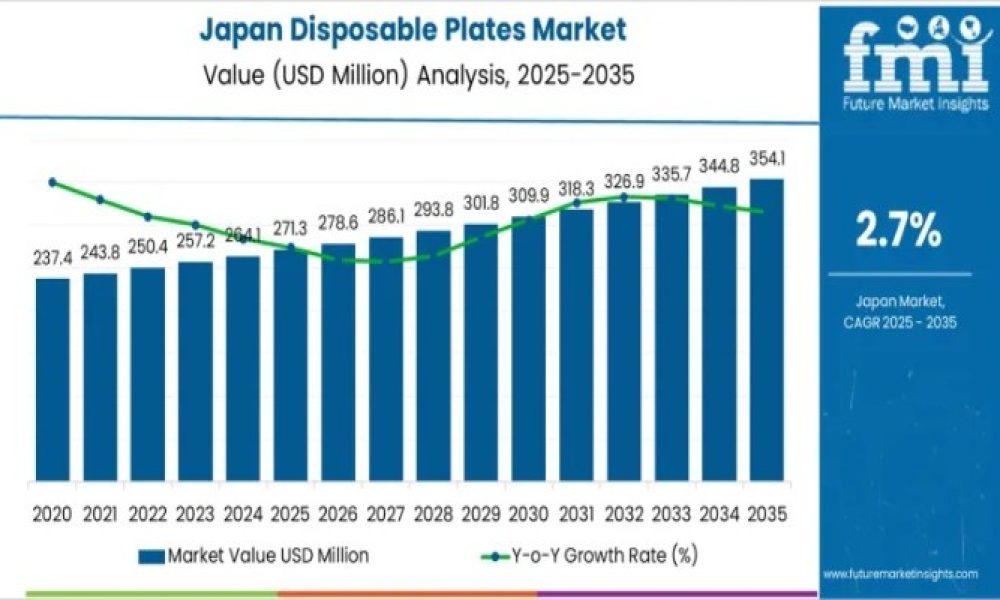
The demand for disposable plates in Japan is set to grow steadily over the next decade, reflecting the country’s evolving food consumption habits, expanding foodservice sector, and a gradual but meaningful shift toward sustainability. Valued at USD 271.3 million in 2025, the market is projected to reach USD 354.1 million by 2035, registering a compound annual growth rate (CAGR) of 2.7% during the forecast period.
This growth trajectory highlights how disposable plates remain deeply embedded in Japan’s everyday dining culture spanning convenience stores, takeaway meals, catering services, festivals, and large-scale events while also adapting to rising environmental expectations.
Subscribe for Year-Round Insights → Stay ahead with quarterly and annual data updates – https://www.futuremarketinsights.com/reports/sample/rep-gb-29603
Steady Growth Anchored in Convenience and Foodservice Expansion
Between 2025 and 2030, demand is expected to rise gradually from USD 271.3 million to USD 326.9 million, adding approximately USD 11.7 million annually. This period reflects stable adoption rather than rapid expansion, driven largely by Japan’s busy urban lifestyles and continued reliance on disposable tableware in hospitality and catering.
From 2030 to 2035, the market is forecast to add another USD 27.2 million, reaching USD 354.1 million. Growth during this phase will be supported by the increasing number of foodservice establishments, rising consumption of ready-to-eat and on-the-go meals, and gradual acceptance of eco-friendly disposable plate alternatives.
Quick Market Snapshot
- Market Value (2025): USD 271.3 million
- Forecast Value (2035): USD 354.1 million
- Forecast CAGR (2025–2035): 2.7%
- Leading Product Type: Paper plates
- Dominant Design: Compartmental plates
- Key Growth Regions: Kyushu & Okinawa, Kanto, Kansai, Chubu
- Major Players: Vegware Global, Cedo Ltd., BioBag International AS, Clondalkin Group Holdings B.V., Cardia Compostable
Why Disposable Plates Continue to Matter in Japan
The demand for disposable plates in Japan is primarily driven by convenience, hygiene, and operational efficiency. Restaurants, convenience stores, and catering companies rely heavily on disposable plates to serve high volumes of food quickly, especially in takeaway and delivery formats. For consumers, disposable plates reduce cleanup time—an appealing benefit in a society where efficiency and time-saving solutions are highly valued.
Seasonal festivals, corporate events, school functions, and community gatherings further reinforce demand, as disposable plates offer a practical and hygienic way to serve large groups.
Sustainability Is Reshaping Material Choices
While convenience remains the core driver, sustainability is increasingly influencing purchasing decisions. Heightened awareness of plastic waste and government initiatives aimed at reducing single-use plastics are encouraging a shift toward biodegradable, compostable, and recyclable alternatives.
Innovations in materials such as paper pulp, bagasse (sugarcane fiber), and plant-based composites are making disposable plates more environmentally acceptable without compromising functionality. As costs gradually decline and performance improves, eco-friendly disposable plates are expected to gain stronger traction across both commercial and household segments.
Segment Insights: Paper and Compartmental Plates Lead
Paper plates dominate Japan’s disposable plate market, accounting for over 50% of total demand. Their biodegradable nature, lightweight structure, and affordability make them a preferred option for picnics, events, takeout meals, and casual dining. As environmental consciousness grows, paper plates continue to outperform plastic and aluminum alternatives.
By design, compartmental plates command approximately 68.4% of demand. These plates are widely used in foodservice, institutional catering, schools, and hospitals, where separating food items enhances hygiene, presentation, and portion control. The design aligns well with Japanese dining preferences, particularly for bento-style meals and organized food presentation.
Regional Outlook: Growth Varies Across Japan
Demand for disposable plates is expanding across all regions, though at different rates:
- Kyushu & Okinawa (3.4% CAGR): The fastest-growing region, fueled by tourism, hospitality, festivals, and resort dining.
- Kanto (3.1% CAGR): Strong demand driven by Tokyo’s dense urban population, fast-paced lifestyles, and booming food delivery ecosystem.
- Kansai (2.7% CAGR): Supported by a rich food culture, events, and casual dining in cities like Osaka and Kyoto.
- Chubu (2.4% CAGR): Growth linked to foodservice expansion and increased use in catering and delivery services.
- Tohoku (2.1% CAGR) and Rest of Japan (2.0% CAGR): Moderate but stable demand, driven by festivals, community events, and everyday convenience.
Challenges and Market Constraints
Despite positive growth, the market faces notable challenges. Stricter regulations on single-use plastics, rising raw material costs, and growing consumer interest in reusable tableware could limit long-term expansion. Eco-friendly disposable plates also carry higher production costs, which may slow adoption among price-sensitive buyers.
However, ongoing material innovation and economies of scale are expected to gradually reduce these barriers.
Competitive Landscape and Key Suppliers
Leading suppliers such as Vegware Global, Cedo Ltd., BioBag International AS, Clondalkin Group Holdings B.V., and Cardia Compostable are actively shaping the market. These companies focus on expanding sustainable product portfolios while meeting the functional needs of foodservice operators and households. Vegware Global currently holds a leading share, supported by its strong emphasis on compostable solutions.
Outlook: A Market Balancing Convenience and Responsibility
Looking ahead to 2035, the demand for disposable plates in Japan is expected to remain moderate but resilient. While sustainability concerns will continue to reshape product offerings, disposable plates will remain essential in foodservice, events, and everyday dining. The market’s future lies in striking a balance delivering convenience and hygiene while aligning with Japan’s long-term environmental goals.
Why FMI: https://www.futuremarketinsights.com/why-fmi
About Future Market Insights (FMI)
Future Market Insights, Inc. (FMI) is an ESOMAR-certified, ISO 9001:2015 market research and consulting organization, trusted by Fortune 500 clients and global enterprises. With operations in the U.S., UK, India, and Dubai, FMI provides data-backed insights and strategic intelligence across 30+ industries and 1200 markets worldwide.



