
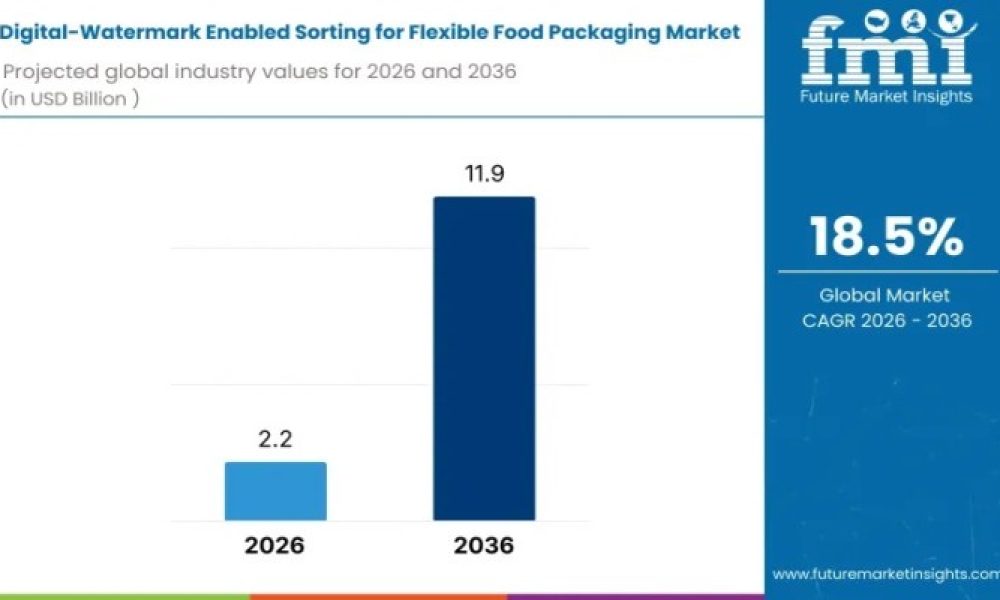
The market for digital-watermark enabled sorting for flexible food packaging is set to accelerate rapidly over the next decade, growing from an estimated USD 2.2 billion in 2026 to USD 11.9 billion by 2036, at a compound annual growth rate (CAGR) of 18.5%, according to a new market outlook. The surge reflects urgent industry needs to identify visually similar flexible packs, improve recovery rates, and meet increasingly strict circular-economy and recyclability regulations.
“Flexible packaging has been the blind spot of modern recycling systems for too long,” said the lead analyst. “Digital watermarks give brand owners and recyclers a reliable, imperceptible way to tag and identify packaging at industrial speeds — and that capability is now moving from pilot projects to full commercial deployment.”
Subscribe for Year-Round Insights → Stay ahead with quarterly and annual data updates – https://www.futuremarketinsights.com/reports/sample/rep-gb-29812
Quick snapshot
- Market (2026): USD 2.2 billion
- Market (2036 forecast): USD 11.9 billion
- Forecast CAGR (2026–2036): 18.5%
- Leading technology: Machine-vision digital watermark detection systems
- Top growth regions: China, India, USA, Japan
- Notable players: Digimarc Corporation, Tomra, Pellenc ST, Suez, Amcor
Why demand is rising
Three converging forces are driving uptake of digital-watermark enabled sorting for flexible food packaging:
- Regulatory momentum. Extended producer responsibility (EPR) rules and recyclability mandates around the world are pushing brands and converters to prove traceability and raise recycling yields for flexible formats.
- Technological maturity. Machine-vision systems combined with AI pattern recognition can now read imperceptible marks at high throughput, even across complex print designs and film distortions. Hybrid systems that pair near-infrared (NIR) spectroscopy with watermark detection further improve material discrimination.
- Commercial incentive. As mono-material PE and PP flexible packaging grows, recyclers need higher-purity streams to justify investment in washing and reprocessing lines; digital watermarks materially increase the purity and value of recovered feedstock.
Technology and format leaders
Machine-vision watermark detection leads global deployments, accounting for nearly half (47.3%) of technology share. These systems are prized for high resolution scanning and micro-pattern recognition — key when reading marks on fast-moving, lightweight pouches and films.
Flexible food pouches dominate format demand (45.6%), driven by snack, sauce, ready-meal and frozen food segments where high volumes and variable printing present identification hurdles that watermarks are well suited to overcome.
Mono-PE flexible materials represent the largest material segment (43.8%), reflecting parallel industry moves toward mono-material structures to simplify recycling and meet PPWR-style requirements.
Regional dynamics
- China (CAGR 19.6%): High flexible-packaging production and aggressive automation investments make China a leading adopter of watermark sorting.
- India (CAGR 18.9%): Rapid packaged-food growth and regulatory focus on recyclability support strong uptake.
- USA (CAGR 17.5%): Modernization of material-recovery facilities (MRFs) and industry pilots drive adoption.
- Japan (CAGR 16.3%) and UK (CAGR 15.7%): Precision recycling agendas and policy alignment underpin gradual but steady deployment.
Competitive landscape
Market development is anchored by technology providers and packaging leaders collaborating across the value chain. Digimarc, Tomra, Pellenc ST, Suez, and Amcor figure prominently — each contributing watermark standards, detection hardware, systems integration, or watermark-embedded packaging design. Buyers are prioritizing interoperability with existing NIR equipment, software update support, and traceability features that feed into compliance reporting.
Challenges and scaling considerations
Implementation is not plug-and-play. Sorting facilities must invest in camera arrays, processing hardware, and software tuned to read marks reliably under variable lighting and film deformation. Converters and printers must adapt artwork workflows to ensure consistent mark placement and print quality. Mixed and contaminated waste streams can reduce detection performance, emphasizing the need for cooperative standardization between producers and recyclers.
Outlook and implications for stakeholders
For recyclers, the technology promises measurable gains in material purity and downstream yield — making investments in washing and compounding equipment more commercially viable. Brand owners who embed digital watermarks can bolster recyclability claims and streamline take-back or closed-loop programs. Policymakers and EPR administrators will find watermark-enabled traceability helpful in enforcement and in designing reward structures for recyclable packaging.
Recommended next steps for market participants
- Packaging producers: Pilot watermark-compatible mono-material designs and align artwork workflows with detection tolerances.
- MRFs and recyclers: Run hybrid trials pairing NIR and watermark detectors to benchmark purity gains and throughput impacts.
- Brand owners and retailers: Join or fund standardization consortia to harmonize watermark specifications and data-management practices.
Why FMI: https://www.futuremarketinsights.com/why-fmi
About Future Market Insights (FMI)
Future Market Insights, Inc. (FMI) is an ESOMAR-certified, ISO 9001:2015 market research and consulting organization, trusted by Fortune 500 clients and global enterprises. With operations in the U.S., UK, India, and Dubai, FMI provides data-backed insights and strategic intelligence across 30+ industries and 1200 markets worldwide.



