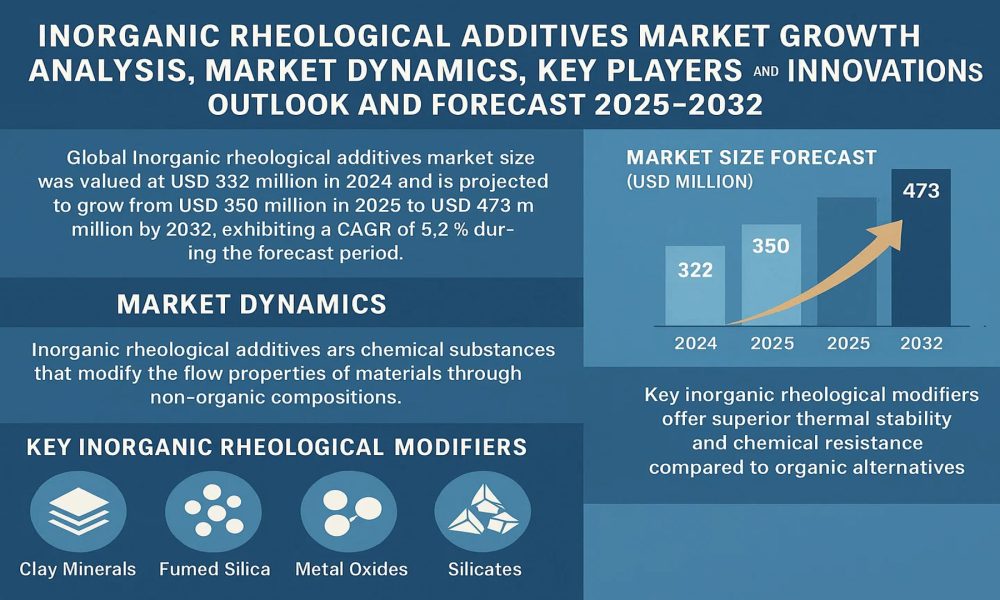
Inorganic Rheological Additives Market size was valued at USD 332 million in 2024 and is projected to grow from USD 350 million in 2025 to USD 473 million by 2032, exhibiting a CAGR of 5.2% during the forecast period.
Inorganic rheological additives are chemical substances that modify the flow properties of materials through non-organic compositions. These additives play a critical role in adjusting viscosity, suspension, and rheological behavior across industrial applications. Key inorganic rheological modifiers include clay minerals, fumed silica, metal oxides, and silicates, which offer superior thermal stability and chemical resistance compared to organic alternatives.
The market growth is driven by expanding demand from paint and coatings industries, where these additives improve application properties and durability. While construction sector applications show steady demand, the personal care segment is emerging as a high-growth area. Recent innovations in nano-sized inorganic additives are creating new opportunities, though raw material price volatility remains a challenge. Leading players like BASF, Elementis, and BYK are expanding production capacities to meet the growing global demand across multiple industries.
Download Your Complimentary Sample Report- https://www.intelmarketresearch.com/download-free-sample/4368/inorganic-rheological-additives-2025-2032-768
MARKET DYNAMICS
MARKET DRIVERS
Expanding Coatings Industry Fueling Demand for Inorganic Rheological Additives
The global coatings industry, valued at over $160 billion in 2024, represents the largest application segment for inorganic rheological additives. These additives play a critical role in maintaining optimal viscosity, preventing sagging, and improving application properties in both water-based and solvent-based coatings. With increasing construction activities worldwide – particularly in emerging economies where infrastructure spending exceeds $2 trillion annually – demand for architectural and industrial coatings continues to rise. The superior temperature resistance of inorganic additives makes them indispensable for automotive and industrial coatings that must withstand extreme conditions.
Growing Personal Care Market Creating New Opportunities
The $600+ billion personal care industry is increasingly adopting inorganic rheological additives for their stability and performance in formulations. Silica-based additives, for instance, have seen 7.8% CAGR growth in cosmetic applications as they provide superior texture control in sunscreens, foundations, and skincare products. Regulatory pressures to replace certain organic thickeners with inorganic alternatives have further accelerated adoption. The shift toward natural and mineral-based cosmetic formulations presents significant growth potential, with market penetration in premium skincare products exceeding 35% in developed markets.
Technological Advancements in Additive Formulations
Recent innovations have significantly enhanced the performance characteristics of inorganic rheological additives. New surface-modified silica particles demonstrate 40% greater efficiency in viscosity modification at lower loading levels. Major players have introduced hybrid inorganic-organic additives that combine the thermal stability of inorganic materials with the processability of organic compounds. For example, recent developments in fumed silica technology have enabled precise control of particle morphology, resulting in additives that provide superior shear-thinning behavior crucial for modern high-performance applications.
MARKET OPPORTUNITIES
Emerging Green Construction Technologies Creating New Applications
The global green construction market, projected to grow at 11% CAGR through 2030, presents significant opportunities for inorganic rheological additives. These materials are essential for advanced cement formulations that reduce CO2 emissions while improving durability. Recent innovations in geopolymer and low-carbon cement technologies rely heavily on specialized rheology modifiers to achieve workable consistencies at reduced water content. The growing adoption of Building Information Modeling (BIM) and 3D concrete printing technologies requires precise rheological control that inorganic additives can provide.
Electric Vehicle Battery Manufacturing Driving Demand
The explosive growth in lithium-ion battery production, expected to exceed 4 TWh annual capacity by 2030, creates new opportunities for inorganic rheological additives. These materials are crucial for controlling the viscosity and application properties of electrode slurries in battery manufacturing. Silica-based additives in particular are finding increasing application in advanced battery separator coatings where they provide both rheological control and thermal stability. With battery manufacturers targeting 30-40% reduction in production costs, optimizing slurry formulations through inorganic additives presents a key avenue for efficiency improvements.
Segment Analysis:
By Type
Clay Minerals Segment Leads the Market Due to Widespread Use in Industrial Applications
The market is segmented based on type into:
- Clay Minerals
- Subtypes: Bentonite, Kaolin, Hectorite, and others
- Fumed Silica
- Metal Oxides
- Subtypes: Aluminum Oxide, Titanium Dioxide, Zinc Oxide
- Carbon Black
- Silicates
By Application
Coatings Segment Dominates Owing to Increasing Demand for High-Performance Products
The market is segmented based on application into:
- Paints
- Coatings
- Subtypes: Automotive coatings, Industrial coatings, Architectural coatings
- Personal Care Products
- Adhesives and Sealants
- Others
By End User
Construction Industry Accounts for Significant Market Share Due to Infrastructure Growth
The market is segmented based on end user into:
- Construction
- Automotive
- Oil & Gas
- Cosmetics
- Others
List of Prominent Inorganic Rheological Additive Manufacturers
- BASF SE (Germany)
- Elementis Global (UK)
- Akzo Nobel (Netherlands)
- DuPont de Nemours, Inc. (U.S.)
- Lubrizol Corporation (U.S.)
- BYK Additives (Germany)
- CP Kelco (U.S.)
- Wanhua Chemical Group (China)
- Zhejiang Fenghong New Material Co., Ltd. (China)
- Tolsa Group (Spain)
- Ashland Global Holdings (U.S.)
- Croda International (UK)
- Lhoist Group (Belgium)
- Kusumoto Chemicals (Japan)
- Noelson Chemicals (India)
INORGANIC RHEOLOGICAL ADDITIVES MARKET TRENDS
Growing Demand from Paints & Coatings Industry Driving Market Expansion
The global inorganic rheological additives market is witnessing significant growth, primarily fueled by rising demand from the paints and coatings industry. These additives, including fumed silica and clay minerals, enhance viscosity control, sag resistance, and application properties in architectural and industrial coatings. With the construction sector projected to grow at approximately 4.5% annually through 2030, formulators are increasingly adopting inorganic additives to meet performance requirements for high-quality finishes. Furthermore, regulatory pressures to reduce VOC content in coatings have accelerated the shift toward inorganic solutions that maintain performance without compromising environmental compliance.
Other Trends
Sustainability-Driven Innovation in Formulations
Manufacturers are intensifying R&D efforts to develop eco-friendly inorganic rheological additives that align with global sustainability goals. Recent advancements include low-energy production methods for metal oxides and surface-modified silicates that offer enhanced performance at reduced dosage levels. The circular economy push has also spurred interest in mineral-based additives derived from industrial byproducts, with some formulations achieving 30-40% lower carbon footprints compared to conventional options. This trend is particularly prominent in Europe and North America, where environmental regulations are most stringent.
Download Your Complimentary Sample Report- https://www.intelmarketresearch.com/download-free-sample/4368/inorganic-rheological-additives-2025-2032-768
Recent Developments in the Inorganic Rheological Additives Market
- Product Innovation in Organoclay Alternatives – Companies are enhancing inorganic additives such as hectorite and bentonite clays to provide improved thermal stability, anti-sagging, and thickening performance for coatings and adhesives. This is expanding their applications in industrial paints and sealants.
- Rising Demand from EV Battery and Energy Storage Applications – Inorganic rheological additives are increasingly being adopted in electrode slurries for lithium-ion batteries, enabling better dispersion, viscosity control, and improved battery performance.
- Focus on Sustainable and Low-VOC Formulations – Leading manufacturers are developing eco-friendly rheology modifiers to align with environmental regulations, particularly in the paints, coatings, and construction industries.
- Expansion in 3D Printing Materials – Inorganic rheological additives are being explored for use in 3D printing formulations, where they enhance printability, layer adhesion, and structural strength.
- Strategic Collaborations & Capacity Expansion – Key market players such as BYK Additives, Elementis, and BASF are investing in production capacity expansion and partnerships with coating manufacturers to meet rising demand in Asia-Pacific and North America.
About Intel Market Research
Intel Market Research delivers actionable insights in technology and infrastructure markets. Our data-driven analysis leverages:
- Real-time infrastructure monitoring
- Techno-economic feasibility studies
Competitive intelligence across 100+ countries
Trusted by Fortune 500 firms, we empower strategic decisions with precision.
International: +1(332) 2424 294 | Asia: +91 9169164321
Website:https://www.intelmarketresearch.com
Follow us on LinkedIn: https://www.linkedin.com/company/intel-market-research




