
The global inkjet printers market is experiencing consistent growth as industries increasingly adopt advanced digital printing technologies. Inkjet printers are widely used across commercial printing, packaging, textile printing, and home office applications due to their high-resolution output, cost efficiency, and versatility. Businesses and consumers are gradually shifting toward printers that provide efficient printing solutions with lower operational costs. Inkjet technology has gained widespread acceptance because it enables precise printing on different surfaces and materials, making it ideal for modern digital production environments.
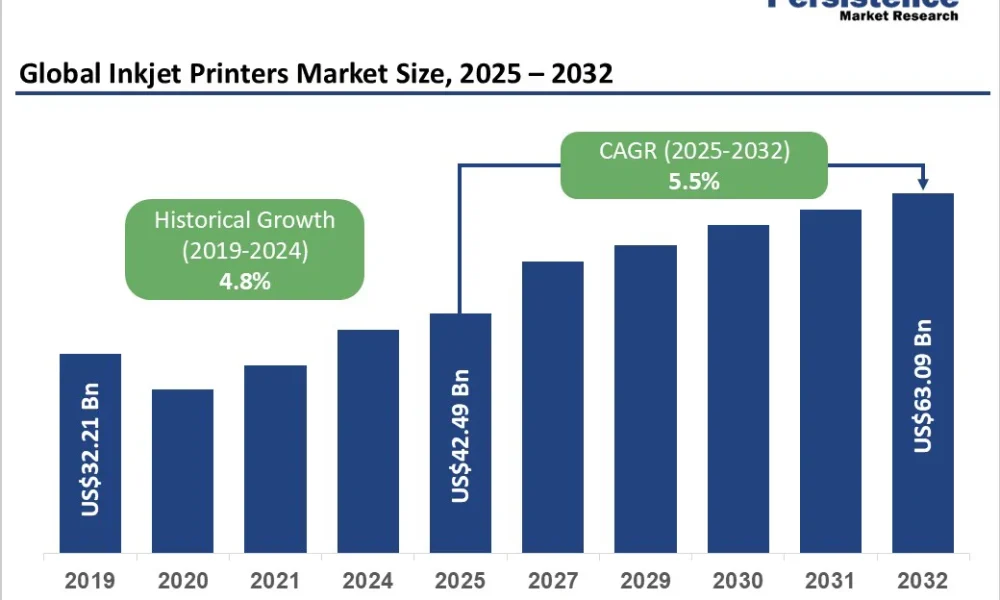
According to Persistence Market Research, the global inkjet printers market size is likely to be valued at US$42.49 Billion in 2025 and is expected to reach US$63.09 billion by 2032, growing at a CAGR of 5.5% during the forecast period from 2025 to 2032. The market growth is primarily driven by the increasing demand for digital printing in packaging and textile applications, the development of cost-effective high-resolution printing technologies, and the growing adoption of refillable ink systems among consumers and small businesses. Among product segments, multifunction inkjet printers are widely preferred due to their ability to combine printing, scanning, and copying functions in a single device. North America remains a leading regional market, supported by strong technology adoption and high demand for efficient printing solutions in businesses and households.
Download Your Free Sample & Explore Key Insights : https://www.persistencemarketresearch.com/samples/35730
Key Highlights from the Report
- The inkjet printers market is projected to grow from US$42.49 Billion in 2025 to US$63.09 Billion by 2032.
➤ Increasing adoption of digital printing in packaging and textile industries is accelerating market demand.
• Growing preference for refillable ink tank systems is helping reduce long-term printing costs for consumers.
➤ High-resolution printing capabilities are encouraging the adoption of inkjet technology across commercial printing applications.
• Rising demand from home offices and small businesses is expanding the consumer base.
➤ Continuous innovation in multifunction and wireless inkjet printers is shaping the future of the industry.
Market Segmentation
The inkjet printers market can be segmented based on product type, application, and end-user industries. Product categories typically include single-function printers and multifunction printers. Multifunction printers have gained significant popularity as they integrate multiple capabilities such as printing, scanning, copying, and faxing into a single device. This integration helps businesses and home users optimize workspace efficiency and reduce equipment costs. Additionally, technological advancements such as wireless connectivity, mobile printing, and cloud integration are making modern inkjet printers more attractive to users.
From an application perspective, inkjet printers are widely used in commercial printing, packaging, textiles, advertising, and household printing. The packaging and textile printing segments are emerging as major growth areas due to the rising need for customized and high-quality printed materials. Digital inkjet printing allows manufacturers to create vibrant designs, short-run packaging solutions, and personalized textile prints without complex setup procedures. As a result, industries seeking flexible and efficient printing technologies are increasingly investing in advanced inkjet systems.
Get Personalized Data – Request Customization Today : https://www.persistencemarketresearch.com/request-customization/35730
Regional Insights
North America holds a strong position in the inkjet printers market due to the widespread adoption of digital printing technologies across industries. Businesses in the region actively invest in modern printing solutions to enhance productivity and reduce operational costs. The presence of leading technology companies and the high demand for home office equipment have further strengthened the market. Additionally, the rising popularity of refillable ink systems among consumers has supported sustained growth in the region.
Asia-Pacific is expected to witness significant growth due to rapid industrialization and expanding packaging and textile manufacturing sectors. Countries such as China, India, and Japan are increasingly adopting digital printing solutions to support mass customization and cost-efficient production. The growth of small and medium-sized enterprises and the rising popularity of online retail businesses are also contributing to the demand for inkjet printers across the region.
Market Drivers
One of the primary drivers of the inkjet printers market is the rising demand for digital printing in packaging and textile applications. Modern manufacturing industries require printing technologies that can produce high-quality graphics with flexibility and speed. Inkjet printing allows businesses to print directly onto packaging materials and fabrics with minimal setup time. This capability supports short-run production, personalized designs, and rapid product launches, which are essential in today’s competitive marketplace.
Another major growth factor is the increasing adoption of refillable ink tank systems. Traditional cartridge-based printers often lead to higher printing costs for frequent users. Refillable ink systems offer a more cost-effective alternative by allowing users to refill ink tanks rather than replacing cartridges. This technology has gained widespread popularity among students, home offices, and small businesses seeking affordable long-term printing solutions.
Market Restraints
Despite positive growth prospects, the inkjet printers market faces certain limitations. One key challenge is the growing competition from alternative printing technologies, such as laser printers. Laser printers are often preferred for high-volume office printing due to their faster printing speeds and durability. As a result, some corporate environments may continue to rely on laser printing solutions instead of switching to inkjet systems.
Another restraint is the maintenance requirements associated with inkjet printers. Inkjet printheads can sometimes become clogged when printers remain unused for extended periods, leading to maintenance costs and potential downtime. These operational challenges can discourage certain consumers and businesses from fully adopting inkjet technology, particularly in environments where frequent printing is not required.
Market Opportunities
The market presents strong opportunities through technological advancements in smart and connected printers. Modern inkjet printers are increasingly equipped with wireless connectivity, cloud printing capabilities, and mobile device integration. These features enable users to print documents directly from smartphones, tablets, or remote devices, making printing more convenient and accessible in both home and office environments.
Another promising opportunity lies in the expansion of digital textile printing and customized packaging solutions. As fashion brands and packaging manufacturers continue to seek unique and personalized designs, inkjet technology offers the flexibility required to produce vibrant, high-resolution prints. This trend is expected to encourage further investment in advanced inkjet systems and open new growth avenues for printer manufacturers.
Get Instant Access – Complete Your Purchase : https://www.persistencemarketresearch.com/checkout/35730
Company Insights
Key players operating in the inkjet printers market include:
HP Inc.
Canon Inc.
Seiko Epson Corporation
Brother Industries Ltd.
Ricoh Company Ltd.
Konica Minolta Inc.
Xerox Corporation
Kyocera Corporation
Roland DG Corporation
Mimaki Engineering Co., Ltd.
Recent Developments
March 2024 – Epson introduced a new series of refillable ink tank printers designed to reduce printing costs for small businesses and home users.
October 2023 – HP launched advanced wireless inkjet printers integrated with smart cloud printing features for enhanced remote printing capabilities.
Future Opportunities and Growth Prospects
The future of the inkjet printers market is expected to be shaped by ongoing innovation and increasing demand for flexible digital printing solutions. Manufacturers are focusing on improving printing speed, resolution, and efficiency while reducing operational costs for users. Advancements in refillable ink systems and multifunction printing devices are likely to attract more consumers and businesses seeking reliable printing technologies.
Furthermore, the rising demand for customized packaging, digital textile printing, and smart printing solutions will create new growth opportunities for the market. As industries continue to shift toward digital transformation and automation, inkjet printing technology will play a crucial role in enabling efficient and high-quality printing across multiple sectors.




