
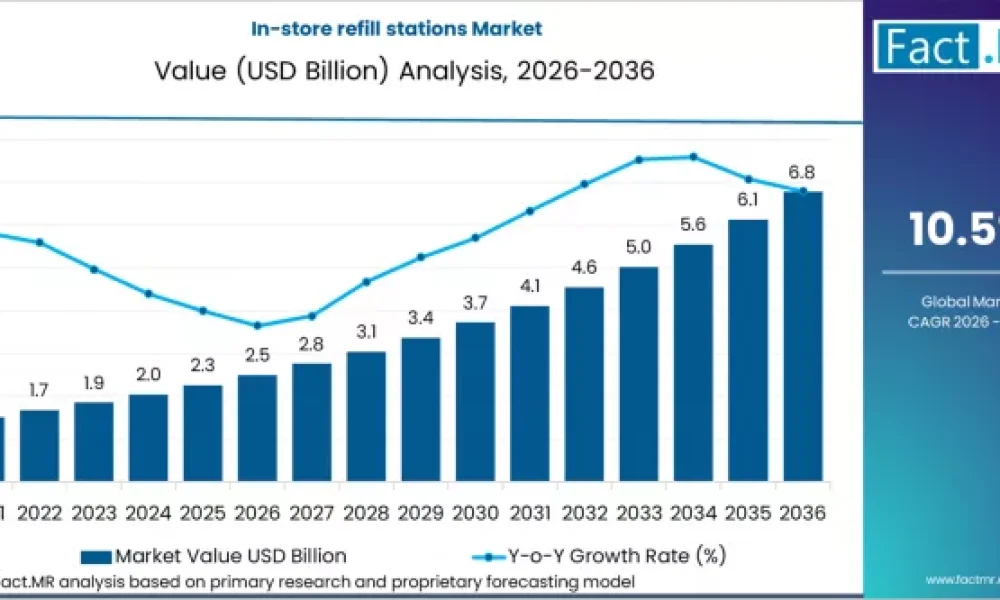
Global In-Store Refill Stations Market Projected to Reach USD 6.2 Billion by 2036 as Retailers Pivot to Circular Economy Infrastructure
The global in-store refill stations market is entering a decisive scale-up phase, as retailers and consumer packaged goods (CPG) brands transition from experimental pilots to standardized, high-volume infrastructure. According to the latest industry data, the market is valued at USD 2.3 billion in 2026 and is projected to expand at a compound annual growth rate (CAGR) of 10.4%, reaching USD 6.2 billion by 2036.
This growth is being propelled by a convergence of stringent environmental regulations, such as the EU’s Packaging and Packaging Waste Regulation (PPWR), and a fundamental shift in consumer behavior. Retailers are increasingly adopting automated, IoT-enabled dispensing systems to eliminate single-use plastics in high-turnover categories, including personal care, household cleaners, and beverages.
Request for Sample Report | Customize Report |purchase Full Report – https://www.factmr.com/connectus/sample?flag=S&rep_id=14020
Strategic Market Dynamics: Who, What, and Why
The rapid adoption of in-store refill technology is driven by three primary stakeholders:
Who is Leading: Large-scale supermarket chains (holding a 42.1% distribution share) and global CPG leaders like Unilever, Nestlé, and The Body Shop are spearheading the movement. Technology providers such as Algramo, MIWA, and Loop (TerraCycle) are supplying the smart-dispensing hardware necessary for retail integration.
What is Changing: The market is shifting from manual bulk bins to Smart/IoT-Enabled Stations. These units offer touchless operation, real-time inventory tracking, and RFID-linked packaging to ensure product hygiene and traceability—addressing previous barriers to consumer adoption.
Why Now: Regulatory mandates are no longer elective. In 2024, the EU established targets requiring large retailers to dedicate 10% of floor space to refillable formats by 2036. Simultaneously, 64% of consumers now report that refillable systems are more effective than recycling alone in reducing waste.
Leading Product Segments and Regional Growth
While the movement spans multiple sectors, specific categories are emerging as the primary engines of growth:
Water Refill Stations: Currently the largest segment with a 34.8% market share, driven by municipal smart city integrations and the ubiquity of touchless bottle-filling stations in high-traffic transportation hubs.
Household and Personal Care: Projected to be the fastest-growing category, with a 9.78% CAGR for detergents and soaps as brands like Persil and Radox scale refill zones across North America and Europe.
Regional Outlook: Europe remains the market leader due to proactive circular economy policies in Germany and France. However, North America is seeing a surge in technology-driven deployments, while the Asia-Pacific region is emerging as the fastest-growing hub, fueled by urbanization and rising middle-class demand for eco-friendly alternatives.
Operational Efficiency and Reuse Economics
The transition to refill stations is increasingly viewed through the lens of Reuse Economics. Industry analysts note that while initial capital expenditure (CapEx) for smart dispensers can be high, the long-term reduction in packaging materials and shipping weight offers a significant competitive advantage.
The market is moving from messaging to execution, notes a lead industry analyst. Success in 2026 is defined by operational reliability—cleanliness, workflow simplicity, and POS integration. Refill is no longer a niche alternative; it is becoming a scalable, competitive retail model.
Key Market Drivers for 2026 and Beyond
Technological Innovation: Integration of smartphone apps for digital track and trace and cash-free payments.
Sustainability Compliance: Expansion of Extended Producer Responsibility (EPR) frameworks that incentivize reuse over recycling.
Consumer Value: Refill systems often reduce product costs by 30–60% by removing the packaging tax, passing savings directly to the consumer.
About the In-Store Refill Stations Market Report: This market analysis provides a comprehensive overview of the global transition toward circular retail. It includes data-backed insights into segmentation by product (Liquid vs. Dry), technology (Conventional vs. Smart), and distribution channel (Supermarkets, Stand-alone, Online).
Related Reports



