
Overview
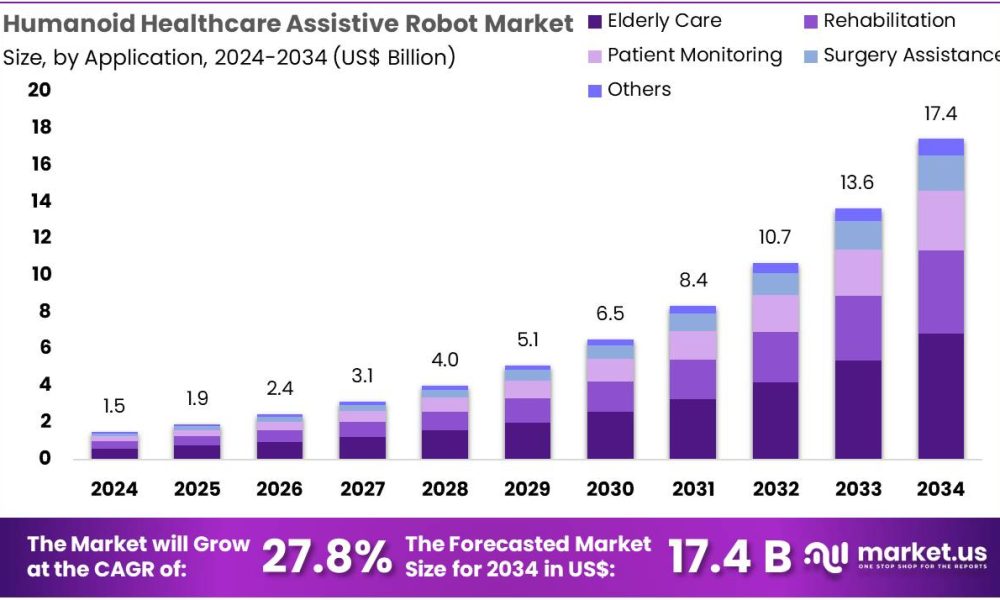
The Global Humanoid Healthcare Assistive Robot Market is projected to grow significantly, from USD 1.5 billion in 2024 to USD 17.4 billion by 2034. This represents a strong CAGR of 27.8% during the forecast period. Growth is primarily driven by the increasing demand for efficient, patient-centered care. Humanoid robots perform a range of supportive tasks, including monitoring vital signs, dispensing medications, and assisting with rehabilitation. Their ability to offer emotional support and companionship enhances patient satisfaction, especially among the elderly and those in long-term care facilities.
The rapid growth of the aging global population is a major market driver. In 2023, approximately 1 billion people were aged 65 and above. This number is expected to rise to 1.5 billion by 2050. Aging-related conditions such as limited mobility and cognitive decline necessitate advanced support solutions. Humanoid healthcare assistive robots help elderly individuals with daily activities and health monitoring. These robots reduce reliance on human caregivers and enable healthcare systems to manage higher patient volumes more efficiently.
Technological advancements are further enhancing the market’s potential. Integration of artificial intelligence, machine learning, and advanced sensors allows humanoid robots to adapt and respond more effectively in diverse healthcare settings. Companies are developing robots that can navigate autonomously, recognize speech, and provide personalized interaction. These innovations improve clinical outcomes and reduce operational strain on healthcare providers. As robots become smarter, their role in supporting medical staff and improving patient care is expected to grow.
Strategic partnerships are contributing to market expansion. In September 2021, Keenon Robotics and SoftBank Robotics Group Corp. formed a partnership to advance service robotics. This collaboration aims to improve productivity and operational efficiency through innovative technologies. The alliance is particularly relevant to healthcare, as it brings together SoftBank’s robotics capabilities and Keenon’s expertise in automation. Such partnerships are expected to accelerate the deployment of humanoid robots in hospitals, clinics, and eldercare facilities.
Despite the strong growth potential, the high cost of humanoid robots remains a key restraint. Developing these robots requires substantial investment in hardware, software, and system integration. This results in high prices, limiting adoption in low-resource settings and among smaller healthcare providers. Maintenance costs and limited insurance coverage also hinder broader deployment. To support market growth, stakeholders must focus on affordable production, increased government support, and wider reimbursement policies to make humanoid robots more accessible across various regions.

Key Takeaways
- In 2024, the Humanoid Healthcare Assistive Robot market generated revenue of US$ 1.5 billion, with projections reaching US$ 17.4 billion by 2033.
- The market is growing rapidly at a compound annual growth rate (CAGR) of 27.8% during the forecast period from 2025 to 2033.
- The hardware segment led the product type category in 2024, contributing the largest market share of 52.6% due to increasing robotic deployment.
- Among applications, elderly care dominated the market in 2024, accounting for a significant 39.4% share, driven by rising aging population demands.
- The hospital segment emerged as the top end-user, capturing 48.3% of the market revenue due to high adoption of robotic healthcare support systems.
- Regionally, North America maintained market leadership in 2024 with a commanding share of 52.6%, attributed to advanced infrastructure and supportive policies.
Regional Analysis
North America currently leads the global humanoid healthcare assistive robot market, accounting for the largest revenue share of 40.6% in 2024. This dominance is driven by advanced technological infrastructure and high demand for innovative healthcare solutions. A key milestone was the December 2023 partnership between SoftBank Robotics America and Formant, which improved the integration and performance of robots in healthcare environments. These developments highlight the region’s strong commitment to robotics and automation as a solution to evolving healthcare challenges and rising patient care demands.
The growing elderly population in North America is creating a surge in demand for eldercare technologies. Humanoid robots are increasingly used for patient monitoring, mobility assistance, and providing companionship. This trend is supported by significant investments in healthcare automation and robotics. Healthcare providers are adopting these robots to reduce the burden on staff and improve patient outcomes. The rising need for efficient, scalable solutions is pushing hospitals and care facilities toward robotics to support routine, non-clinical functions.
Additionally, staff shortages and operational pressures in healthcare facilities are accelerating robot adoption. Robots help manage repetitive and time-consuming tasks, allowing clinicians to concentrate on critical care. Collaborations between robotics firms and healthcare providers are further expanding market reach. Supportive regulatory policies and government-backed innovation programs are playing a vital role in enabling market growth. These factors collectively position North America as a hub for healthcare robotics advancement and implementation.
Meanwhile, the Asia Pacific region is projected to register the highest CAGR during the forecast period. Growth is fueled by rising healthcare needs and rapid investments in robotic technologies. A notable example is Intuitive Surgical Inc.’s 700 million yuan investment in a Shanghai innovation center, announced in August 2022. Countries like China, Japan, and South Korea are building robust healthcare infrastructure. This expansion, coupled with supportive policies and increasing disease burden, is expected to boost adoption of assistive humanoid robots across the region.
Segmentation Analysis
In 2024, the hardware segment led the humanoid healthcare assistive robot market, accounting for 52.6% of the total share. This dominance is due to the rising demand for advanced robotics in healthcare. Hardware components such as sensors, actuators, and processors are essential for robot performance. The continuous development of robotics and artificial intelligence is boosting the need for reliable and intelligent hardware. As healthcare automation increases, hardware with better mobility, precision, and dexterity is expected to become more important, supporting the segment’s future growth.
The application of humanoid robots in elderly care held a significant share of 39.4% in 2024. This is largely due to the global rise in the aging population and the growing need for senior support. These robots assist the elderly by offering mobility help, daily task support, and social interaction. With more older adults choosing to age at home, the demand for assistive robots is growing. The need to address age-related conditions like cognitive decline further contributes to the expansion of this segment.
Hospitals captured the largest end-user share at 48.3% in 2024, driven by the push for improved care quality and efficiency. Humanoid robots help hospitals with tasks such as patient monitoring, surgical support, and admin operations. Their ability to work with precision and reduce staff workload is highly valued. The shortage of medical professionals and increasing patient loads are key drivers for robot integration. Hospitals see robots as essential for enhancing patient safety, minimizing errors, and supporting critical healthcare operations efficiently.
By Product Type
- Hardware
- Software
- Services
By Application
- Rehabilitation
- Elderly Care
- Patient Monitoring
- Surgery Assistance
- Others
By End-user
- Hospitals
- Clinics
- Rehabilitation Centers
- Home Care Settings
- Others
Key Players Analysis
Key players in the humanoid healthcare assistive robot market are advancing robotics and AI to improve healthcare delivery. These companies focus on developing robots that support patient care, rehabilitation, and elderly assistance. Investments in R&D help enhance the functionality and human-like interaction of assistive robots. Safety features and easy-to-use designs are prioritized for smooth integration in clinical environments. These technologies are increasingly adopted in hospitals, nursing homes, and home care settings. The growing need for automation in healthcare is driving sustained market expansion globally.
Strategic partnerships between companies and healthcare institutions are boosting innovation. Collaborations with hospitals help test and deploy robots in real-world environments. These partnerships promote broader adoption of assistive robotics. Geographic expansion into regions with rising healthcare investments is also a key growth factor. Companies are tailoring their technologies to meet the unique needs of different markets. The growing demand for patient-centric and efficient care solutions supports this trend. Robots with conversational AI and mobility features are in high demand.
SoftBank Robotics is a major player, known for developing the humanoid robot Pepper for caregiving support. In April 2022, United Robotics Group acquired SoftBank Robotics Europe SAS, while SoftBank Robotics retained a minority stake. This move supports global innovation in robotics. In January 2022, Labrador Systems introduced a home assistant robot and secured $3.1 million in funding from Amazon’s Alexa Fund, iRobot Ventures, and others. Other notable companies include Toyota Motor Corporation, Honda Motor Co., Ltd., Hanson Robotics, Ubtech Robotics Inc., and FANUC Corporation.
Conclusion
Get in Touch with Us:
Market.us (Powered By Prudour Pvt. Ltd.)
Address: 420 Lexington Avenue, Suite 300, New York City, NY 10170, United States.
Contact No: +1 718 874 1545 (International), +91 78878 22626 (Asia).
Email: [email protected]
View More



