

Like other people, I have been using the Ethereum network for most of my smart contracts usage. I always encountered high fees. I got fed up with transaction fees over $15, which is excessively high…
This made me look elsewhere. So I looked into Stabila.
I am going to answer the following:
How much are Stabila fees? I will compare them to Ethereum fees and look at how they might be changing in the future.
Stabila is the native cryptocurrency on Stabila Public Chain. Transferring Stabila is free. This is a nice treat from the Stabila team. Compared to transferring on Ethereum, you will pay a fee in the range of $7. So, Stabila is a great platform to make those transfers. However, smart contracts transactions are a different type of transaction, so let us move on and find out about fees on smart contract transactions.
Stabila smart contracts fees are maxed at $0.2 per transaction. The Governing Committee sets the fees and depends on byte size and the traffic or competition for SVM resources, which increases when the trigger contract traffic on the blockchain increases. Compared to Ethereum, Stabila has 100 times lower fees. This is because of the efficiency of Stabila compared to Ethereum. As Stabila keeps scaling better, the fees will decrease even more in the future.
In other words: Stabila has low fees and is way cheaper to use than Ethereum or Bitcoin. Below will show you a chart showing the difference.
Does this mean Ethereum is in trouble? Maybe not. I think Ethereum is one of the good investments globally, but it seems heavily overpriced. You can make good returns with ETH investing and trading if you have a decent strategy. However, I feel that 2022 is all about change, and we all know things can change quickly in the world of cryptocurrencies.
How Tx Fees Are Set, And How They Change Over Time?
The first cause for an uptrend in fees is that too many transactions have to be squeezed in little or no time. In other words, some sort of a scaling issue. If a Blockchain can do 5 transactions per second (TPS), and 500 people broadcast the exact second, the fees may shoot up as the competition for “resources” increases.
Let me explain.
When you send a transaction to someone, this transaction has to be placed in a “block.” This block is a cell with transactions. After a specified interval, the block gets added to the blockchain. The blockchain is a public database where all transactions are stored.
Once the block is added to the blockchain, your transactions are complete. One block can carry a certain amount of transactions! If the block gets filled up, the subsequent transactions have to wait for the following block to be added to the blockchain, and hopefully, there will be room for them.
“Okay, but who decides which transactions get to populate the block?”
The algorithm is set up to follow the rule: whoever pays the highest transaction fee. Transaction fees are the price someone pays to guarantee a place in the next block, which will complete the transaction by adding it to the blockchain and solidifying it. There are 2 factors in the formula that decides the transaction fees:
1) The time it takes to create a new block
2) The number of transactions that fit in a block.
If blocks are created frequently, like on Stabila, and many transactions can fit into the block, the competition to get the place will be low, resulting in lower transaction fees. If blocks are created infrequently and fewer transactions per block, the competition will be high, resulting in high transaction fees.
To learn more about how Stabila blockchain works, read this article:
What is Stabila Blockchain?
Great, now it is time to look at these two factors for Stabila and Ethereum and predict future transaction fees. Below you see a table showing the two factors mentioned above for Stabila and Ethereum so that you can see the difference
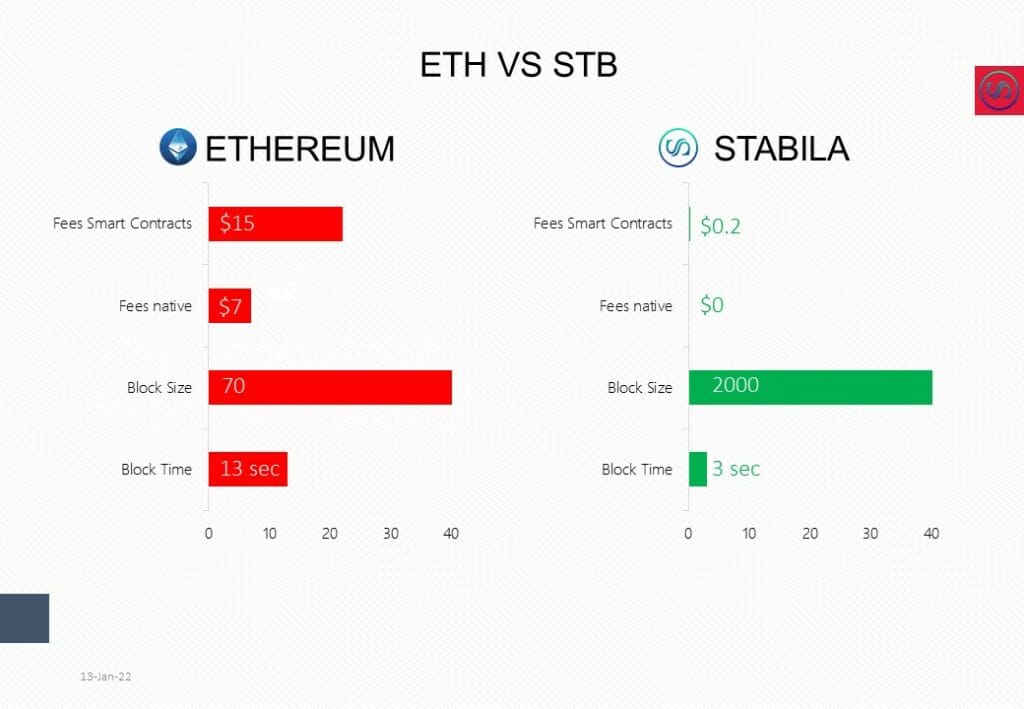
The table above shows that Stabila has superior block time and block size, which is why Stabila has drastically lower transaction fees than Ethereum. With stats like that, Stabila is able, in theory, to scale up to 5000 TPS without much trouble. However, the scaling is unnecessary as the record TPS for Visa was 2601. So high transactions per second are not that frequent, but transactions fees are essential for the final user.




