
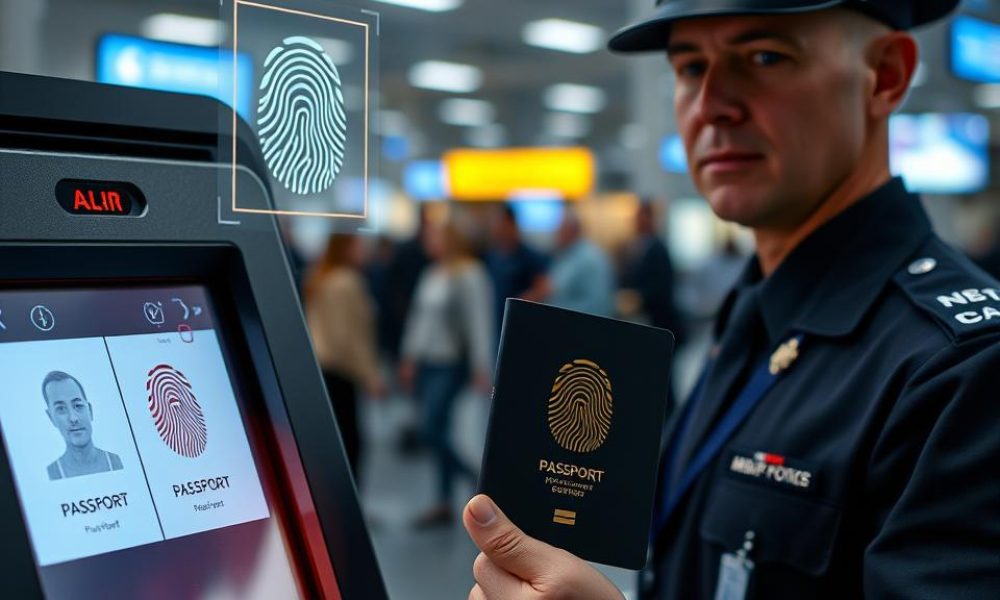
A document scan can produce an electronic match within seconds when national systems are connected. Still, the alert flags reported data that officers must verify before deciding whether the traveler is a fugitive, an innocent holder, or the subject of an administrative error.
WASHINGTON — The moment a traveler presents a passport at an international border increasingly marks the intersection of national immigration controls, biometric systems, airline data and Interpol’s global police-information network.
When the passport has been reported revoked by its Caribbean, Pacific or other issuing government, a connected border system can compare its identifying details with Interpol’s databases and return an electronic match within seconds.
I-24/7 makes that rapid response possible: a secure global police communications infrastructure linking Interpol’s member countries, National Central Bureaus, authorized law-enforcement units, and participating frontline border locations.
The process is frequently described as every immigration kiosk directly accessing Interpol. However, the actual architecture varies because national border platforms often serve as the user-facing system and relay authorized queries through an integrated connection.
An alert also does not, by itself, establish that the presenter is a fugitive, since the initial match may concern a revoked document, whose bearer faces no criminal warrant or may not know the cancellation occurred.
The border encounter becomes decisive only after officers confirm the record, establish the traveler’s identity, check separate wanted-person information, and apply the legal powers available within their jurisdiction.
I-24/7 Is the Secure Network Behind the Query
Interpol describes I-24/7 as its secure global police communications system, connecting law-enforcement authorities in all member countries with each other and with the organization’s General Secretariat.
Through that protected network, authorized users can exchange sensitive police messages and search Interpol databases containing information about wanted people, fingerprints, facial images, stolen vehicles, and invalid travel documents.
The official Interpol database overview explains that national police can perform searches through their National Central Bureau or directly from authorized frontline locations such as specialized units and border-control posts.
I-24/7 therefore functions as protected communications infrastructure rather than a single public database, while specific services and applications use the network to reach particular collections of international police information.
The Stolen and Lost Travel Documents database, known as SLTD, is the relevant repository when a passport has been reported stolen, lost, revoked, invalid, or stolen while still blank.
Red Notices, national police records, and biometric repositories perform separate functions, even though a properly configured border inspection system may search several international sources during the same traveler encounter.
Every Country Is Connected, but Not Every Kiosk Is
Each Interpol member country maintains a National Central Bureau that serves as the principal national connection with I-24/7, other member countries, and the organization’s international General Secretariat.
Frontline access requires the country to extend that capability beyond the central bureau through authorized users, network infrastructure, national integrations, security policies, and equipment deployed at designated airports or crossings.
Some border officers can query Interpol services from fixed or mobile tools. In contrast, others use domestic immigration software that sends an automated request through a protected national gateway without exposing I-24/7 directly.
An automated passport gate may capture the traveler’s document and biometric information. Still, the visible kiosk is only one component of a larger national inspection system that controls which databases it consults.
Other airports may reserve Interpol checks for staffed booths or secondary inspection, particularly when legacy infrastructure, network limitations, or national security policy prevents universal automated querying at every gate.
The accurate formulation is therefore that I-24/7 enables real-time frontline access where participating authorities have extended and integrated the network, not that every international kiosk worldwide possesses identical direct connectivity.
MIND and FIND Bring Interpol Data to the Front Line
Interpol has developed fixed and mobile technical solutions, commonly described through MIND and FIND deployments, to help member countries connect frontline police and border officials with international databases.
These tools can be integrated into national border environments or deployed for operational exercises, allowing an officer to scan identifying information and receive rapid responses without routing every request manually through headquarters.
The fixed approach supports permanent installations at busy airports, seaports or land crossings, while mobile capabilities can extend checks to remote checkpoints, temporary operations and locations lacking full conventional infrastructure.
Countries retain responsibility for determining authorized access, securing local equipment, training frontline officers and defining how international database results are combined with national immigration and law-enforcement information during inspections.
Real-time capability therefore depends upon more than Interpol’s central network, because the complete chain includes a working document reader, local software, national connectivity, authorized credentials and responsive international services.
When any part of that chain is unavailable, officers may need to conduct delayed, manual, or secondary checks rather than receiving the immediate electronic result expected under normal operations.
The Passport Scan Begins with Machine-Readable Data
At a staffed counter or automated gate, the inspection system generally reads the machine-readable zone, which contains standardized characters representing the traveler’s name, nationality, birth date, sex, and passport information.
The document number, issuing country, and document type provide the essential identifying fields for an SLTD query, allowing the system to look for an exact reported international travel-document record.
An electronic passport may also be opened through approved access protocols so that the system can read its chip, verify the issuing authority’s digital signature, and compare the stored portrait with a live facial image.
Those chip and biometric functions answer different questions from SLTD, because electronic authentication tests whether protected information is genuine while the database check tests whether the document was later reported unusable.
The inspection platform may simultaneously search national immigration records, visa information, entry prohibitions, passenger manifests, Interpol notices, and other security watchlists, depending on domestic law, operational policy, and system design.
What appears to the traveler as a single passport scan can therefore trigger multiple distinct checks whose responses are consolidated into a clearance, rejection, or referral instruction for the officer.
How a Revoked Secondary Passport Produces a Hit
The process begins before the traveler arrives, when the issuing country makes a domestic decision to revoke or invalidate the document under its own laws and procedures.
That country must transmit the relevant record through its National Central Bureau or another authorized law-enforcement agency, because Interpol does not independently revoke national passports or create SLTD entries from public allegations.
Once the accurate passport number, issuing state, and invalidity category are available internationally, a properly connected border query using matching details can return a positive electronic result within seconds.
The system response tells the receiving authority that the presented document corresponds to a passport reported as revoked or invalid, prompting additional verification and enforcement steps specified by established local procedures.
The fact that the passport represents a second citizenship does not alter the basic query, since SLTD matches the particular document rather than ranking it as the holder’s primary or secondary credential.
Whether the passport came from a Caribbean investment program, a Pacific citizenship scheme, or an ordinary naturalization process matters less to the electronic search than its issuer, number, and reported status.
The First Match Concerns the Document, Not the Fugitive
Calling every revoked-passport hit a fugitive match collapses two separate determinations that border officers must make carefully before considering detention, arrest, or extradition.
The SLTD match establishes that the document has been reported in a covered invalidity category, but it does not automatically establish that the person presenting it is internationally wanted.
The bearer could be an innocent citizen using a recovered passport previously reported lost, a traveler whose government canceled the document without effective notice, or an impostor carrying someone else’s passport.
Officers must compare the bearer with the photograph, inspect the chip and physical security features, question the traveler carefully, and search separate wanted-person systems to determine which explanation applies.
If a Red Notice, diffusion, or national warrant appears under the same identity, the encounter can become a fugitive investigation. However, any arrest still requires authority under the receiving country’s laws.
Information concerning Interpol notices and extradition procedures emphasizes that locating a wanted person, provisionally arresting that person, and ordering surrender remain legally distinct stages governed by national institutions.
A Valid Second Passport Can Produce No SLTD Match
A person lawfully holding two citizenships does not enter SLTD merely because another government, news organization, or private party considers the secondary nationality controversial or strategically motivated.
If the issuing country has not revoked or otherwise reported the passport, an SLTD query against that particular document should not produce a hit solely because it is secondary.
The traveler could still encounter a Red Notice, national watchlist, visa restriction, sanctions-related examination, or biometric link to another identity, but those results would originate from other data sources.
This distinction prevents the database from becoming a general international registry of dual nationals and preserves its specific operational function as a collection of reported travel and identity documents.
Analysis of legal second passports and citizenship documentation similarly distinguishes lawful government-issued credentials from counterfeit or invalid documents that cannot survive official examination and database screening.
The practical rule is that each passport has its own status, meaning one revoked document does not automatically prove that every other passport or citizenship held by the same person is invalid.
Border Systems Can Link Separate Passports Through Biometrics
Although SLTD searches the reported document, modern border platforms can use facial recognition, fingerprints, passenger data, and travel history to identify relationships among different passports presented by the same person.
A traveler who previously entered under one nationality may be connected with a new passport when a live facial image resembles an earlier border record or fingerprints match an existing enrollment.
Visa applications often collect prior names, citizenships, and passport numbers, creating another important documentary path for authorities to reconcile current credentials with earlier identities and recorded international travel.
Advance passenger information supplied by airlines can also allow governments to screen names and document details before arrival, giving specialized units time to review potential matches before the traveler reaches the inspection booth.
Biometric comparison remains probabilistic and requires careful human review, particularly when image quality, aging, transliteration or incomplete historical records create uncertainty about whether two profiles represent the same individual.
The strongest decision therefore combines the exact SLTD document hit with biometric continuity, biographical history, and separate criminal information, rather than assuming one data point answers every question.
Automated Gates Do Not Make the Final Legal Decision
An electronic gate can read a passport, perform facial comparison, and receive database responses. Still, the automated outcome ordinarily determines whether the traveler proceeds or receives a referral for human examination.
When a revoked-document match appears, the automated gate may remain closed and direct the traveler toward an immigration officer without publicly displaying the underlying international police information or alert category.
The officer can then verify the passport number, confirm the issuing state, review the alert category, and determine whether the system response reflects a true match rather than a scanning or transcription error.
Specialists may contact the National Central Bureau or issuing authority when the record requires confirmation, particularly if the traveler formally disputes the cancellation or presents another apparently valid identity or travel document.
National law and established operational policy govern whether officers seize the passport, deny boarding, refuse entry, continue questioning, or ultimately take custody of the traveler.
The automated gate speeds initial triage and promotes consistency, but authorized government personnel retain final legal responsibility to interpret the result accurately and exercise enforcement powers proportionately.
What Officers See After an Electronic Match
The exact information displayed depends on the country’s integration and user authorization, so a primary inspector may receive a simple referral instruction while secondary officers get more detailed record information.
At minimum, authorities need enough information to confirm that the scanned passport matches the reported issuer, document type, and number, rather than another credential with superficially similar details.
The electronic response may identify whether the document was lost, stolen, revoked, invalid, or stolen while blank, helping responsible officers evaluate the risk and select appropriate verification and enforcement steps.
A stolen blank passport suggests potentially fraudulent personalization, while a revoked passport may require deeper inquiry into citizenship status, judicial restrictions, or administrative action taken after lawful government issuance.
The frontline interface should not expose unrestricted international police data to every employee, because effective access controls must limit sensitive information based on official role, operational necessity, and national data-protection obligations.
Detailed operational follow-up may therefore move from the frontline booth to a secure secondary unit, the National Central Bureau, or a specialized command center that can communicate directly with the responsible source country.
Real Time Does Not Mean Continuous Tracking
The phrase real-time intersection describes a rapid query made when document information is submitted, rather than a system that continuously broadcasts the physical location of every passport holder.
An e-passport does not ordinarily transmit its identity over long distances, and I-24/7 does not follow a booklet unless an authorized system scans or enters its identifying details.
The network can return available information quickly, but that technical speed does not eliminate delays created before the record enters SLTD or after a match requires additional international confirmation.
If the issuing country waits days or weeks to report a revocation, the traveler may cross a fully connected international border during the reporting gap without receiving the expected document alert.
Likewise, slow follow-up from the source country can leave a receiving authority holding a traveler in extended secondary inspection. At the same time, officials may try to confirm whether the international record remains current.
Real-time screening is therefore best understood as rapid electronic access to reported information, not guaranteed real-time knowledge of every citizenship decision, criminal development, passport cancellation, or physical movement worldwide.
Network and Border Outages Still Matter
Global border systems rely on electricity, communications links, document readers, authentication services, and national databases, so technical resilience is essential when screening must continue during failures or cyber incidents.
In May 2024, a nationwide British Border Force systems outage disabled electronic gates and forced manual passport processing at several major airports, producing long queues before service was restored, Reuters reported.
That incident was not reported as an I-24/7 failure, but it illustrates the broader operational reality that an international data source becomes unreachable when the surrounding national inspection environment is unavailable.
Contingency procedures may include manual document examination, delayed passenger clearance, restricted admission, locally maintained watchlist copies, or referral to specialized officers possessing alternative secure government communications and database access.
Offline processing creates difficult operational trade-offs because authorities must preserve legitimate movement and avoid airport paralysis without allowing serious international security alerts to pass unchecked during a prolonged systems outage.
Resilient border systems therefore require redundant connections, regularly tested recovery plans, current local procedures, and clear rules for reviewing travelers processed while full international database access was temporarily unavailable.
A Match Requires Rapid International Confirmation
I-24/7 supports more than database queries because National Central Bureaus and authorized agencies also exchange urgent police messages needed to understand and act upon international results.
After a significant hit, the receiving country may request confirmation from the source country, ask whether to seize the document, and determine whether the traveler is connected to an investigation.
The responsible source country may need to explain whether revocation is final, subject to administrative appeal, limited by a court order, or related to a broader ongoing citizenship-cancellation proceeding.
Structured information and prompt official responses reduce the danger that receiving officers either release a genuinely wanted person or detain an innocent traveler because an obsolete record lacked sufficient context.
Interpol has acknowledged broader international messaging challenges, including manual categorization, connectivity problems, delayed responses, and data-input errors that can negatively affect the speed and quality of international hit follow-up.
Technology can produce the first electronic match within seconds, but effective enforcement still depends on authorized people across institutions, jurisdictions, and time zones exchanging accurate contextual information quickly.
Fugitive Detection Requires a Second Search Layer
If officers suspect that the bearer is internationally wanted, they must search identifiers connected with the person rather than relying exclusively on the revoked passport’s document number.
Officers can check names, birth dates, photographs, fingerprints, and previous identity documents against Interpol notices, diffusions, national police records, and national databases under applicable legal and operational access rules.
A Red Notice match can notify officers that another country seeks location and provisional arrest, while a Blue Notice may request information about a person’s identity, location, or activities.
The receiving country determines the legal effect of those international alerts domestically, because Interpol is not a supranational police force and does not automatically command national officers to arrest anyone.
When international extradition is contemplated, prosecutors and courts may require a valid domestic arrest basis, complete treaty documentation, and evidence that satisfies the requested state’s procedural, evidentiary, and human-rights standards.
The revoked secondary passport can reveal the traveler’s physical presence. Still, separate person-centered police information and valid national legal authority are required to transform that border encounter into a fugitive case.
False Matches and Outdated Records Need Safeguards
An exact document-number hit is generally stronger than a loose name similarity, but data-entry mistakes, reused formats, scanning defects, and obsolete records can still create operational confusion.
Officers should confirm the issuing country and document type, inspect the physical passport carefully, and compare the result with current national records before imposing serious legal or immigration consequences upon the traveler.
A person who believes the passport was wrongly reported should address the issue with the issuing authority, which controls the underlying national status and can correct an erroneous cancellation.
Where information processed within Interpol’s system is alleged to be inaccurate or noncompliant, formal access, correction, or deletion procedures may also be available through the Commission for the Control of Interpol’s Files.
That independent commission does not replace a domestic court reviewing the original passport or citizenship decision, making coordinated national and international legal remedies necessary in some complex disputed cases.
Accurate protected audit logs are equally important because authorities must be able to reconstruct when the record was submitted, which officer queried it, and what official action followed the match.
Smaller Issuing Nations Control the Critical First Step
Caribbean and Pacific governments running citizenship-by-investment programs remain responsible for accurately reporting revoked passports, no matter how sophisticated the receiving country’s border infrastructure becomes.
If a citizenship review ends with a final cancellation but the passport database, National Central Bureau, and civil register remain disconnected, international enforcement may lag behind the legal decision.
The country must also distinguish between revoking the physical passport and revoking citizenship, because canceling one document does not always terminate nationality or every other passport the person holds.
Clear status codes, validated document numbers, and immediate authorized transmission allow a foreign airport to interpret the alert without guessing what action the issuing government intended.
International credibility therefore depends not only on denying questionable applicants, but also on completing the entire administrative sequence that turns a domestic passport revocation into accurate and usable global border information.
I-24/7 can deliver the alert rapidly after proper submission, although it cannot compensate for a source government that delays, omits, or incorrectly records the underlying passport or citizenship cancellation.
The Border Intersection Is Powerful but Conditional
I-24/7 creates a secure global pathway through which authorized border authorities can reach Interpol databases and receive rapid information about revoked, invalid, stolen, or lost passports.
When properly integrated, the process can transform a routine document scan into an immediate referral, allowing officers to stop invalid travel and investigate a possible fugitive before admission.
The system’s effectiveness depends on prompt reporting by the issuer, accurate data, functioning national infrastructure, authorized frontline access, and disciplined international follow-up after the initial electronic response.
Not every immigration kiosk connects directly, not every SLTD database hit identifies a fugitive, and not every internationally wanted fugitive presents a passport already reported revoked.
The strongest international border architecture therefore combines document-status checks, electronic-passport authentication, biometric identity resolution, person-centered notices, national watchlists, and informed human legal Judgment within one fully coordinated inspection process.
That layered design makes the electronic match an important starting point rather than an unsupported conclusion, ensuring that technical speed strengthens border security without replacing accuracy, proportionality, or fundamental due process.




