
The Heavy Hauler Market occupies a vital position within the global transportation and logistics ecosystem, enabling the movement of oversized, overweight, and high-value cargo that cannot be transported using conventional freight solutions. Heavy haulers—also known as heavy-duty trailers or special transport vehicles—are designed to move extremely large loads such as construction equipment, mining machinery, wind turbine components, transformers, oil and gas modules, and industrial plant structures. As global infrastructure projects become larger and more complex, heavy haulers have become indispensable in ensuring timely, safe, and compliant transportation of critical assets across regions.
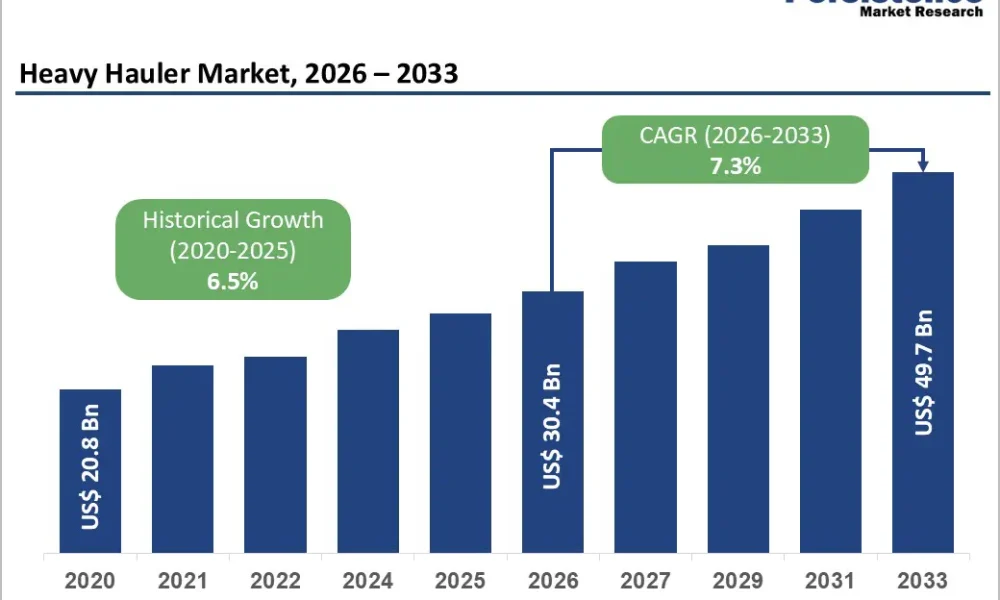
The global heavy hauler market size is anticipated at US$ 30.4 billion in 2026 and is projected to reach US$ 49.7 billion by 2033, expanding at a strong CAGR of 7.3% between 2026 and 2033. Market growth is driven by sustained infrastructure investment across construction, mining, energy, and industrial sectors, along with accelerating cross-border industrial trade and relocations in emerging Asian economies. Among product categories, multi-axle and modular heavy haulers represent the leading segment due to their flexibility, load-bearing capacity, and suitability for complex transport requirements. From a regional perspective, Asia Pacific dominates the market, supported by large-scale infrastructure development, mining expansion, and rapid industrialization in countries such as China, India, Indonesia, and Australia.
𝐃𝐨𝐰𝐧𝐥𝐨𝐚𝐝 𝐅𝐫𝐞𝐞 𝐒𝐚𝐦𝐩𝐥𝐞 & 𝐂𝐡𝐞𝐜𝐤 𝐭𝐡𝐞 𝐋𝐚𝐭𝐞𝐬𝐭 𝐌𝐚𝐫𝐤𝐞𝐭 𝐀𝐧𝐚𝐥𝐲𝐬𝐢𝐬: https://www.persistencemarketresearch.com/samples/32785
Key Highlights from the Report
• Global heavy hauler market is projected to grow at a CAGR of 7.3% through 2033.
• Infrastructure development and mining activities are major demand drivers.
• Modular and multi-axle trailers dominate due to versatility and high load capacity.
• Asia Pacific leads the market owing to industrial expansion and cross-border trade.
• Renewable energy projects are emerging as a key application area.
• Digital fleet monitoring and electrification are reshaping heavy haul operations.
Importance of Heavy Haulers in Modern Industrial Logistics
Heavy haulers play a strategic role in enabling industrial growth by facilitating the transportation of equipment and components that are too large or heavy for standard logistics solutions. From moving massive excavators to transporting wind turbine blades spanning over 80 meters, these vehicles ensure that infrastructure and energy projects remain on schedule. Their importance has grown as industries increasingly rely on prefabricated and modular construction approaches, which require transporting large assemblies rather than assembling components on-site.
The evolution of heavy haulers reflects broader changes in logistics and engineering. Earlier designs focused primarily on load capacity, often at the expense of maneuverability and efficiency. Modern heavy haulers, however, integrate advanced suspension systems, hydraulic steering, modular axle configurations, and digital monitoring tools. These innovations enhance stability, reduce road stress, improve safety, and enable operators to navigate complex routes with greater precision. As projects expand into remote and challenging terrains, the demand for technologically advanced heavy haulers continues to rise.
Market Segmentation Analysis
The heavy hauler market can be segmented based on product type, axle configuration, application, and end-user industry, each influencing purchasing decisions and market dynamics. By product type, the market includes flatbed heavy haulers, lowboy trailers, extendable trailers, and modular heavy haulers. Flatbed and lowboy trailers are widely used for transporting construction machinery and industrial equipment, offering simplicity and reliability. Extendable trailers cater to long loads such as beams and wind turbine blades, while modular heavy haulers represent the most advanced segment, enabling customized axle arrangements and load distribution for extremely heavy or irregular cargo.
Axle configuration further segments the market into single-axle, multi-axle, and hydraulic modular trailers. Multi-axle and hydraulic modular systems dominate due to their ability to distribute weight evenly and comply with road regulations while carrying ultra-heavy loads. These configurations are particularly critical in mining, energy, and infrastructure projects, where load weights often exceed standard limits.
Based on application, heavy haulers are used across construction, mining, oil and gas, renewable energy, industrial manufacturing, and defense sectors. Construction and mining account for a substantial share, driven by the movement of earthmoving equipment, crushers, and drilling machinery. Renewable energy is emerging as a fast-growing application area, as wind and solar projects require specialized transport for turbines, towers, and transformers.
From an end-user perspective, the market serves logistics service providers, construction companies, mining operators, energy developers, and government agencies. Logistics providers dominate the market, as many end users prefer outsourcing heavy transport to specialized firms with the expertise, permits, and equipment required for complex hauls.
Regional Insights and Market Trends
Regionally, the heavy hauler market demonstrates strong growth across both developed and emerging economies, shaped by infrastructure investment, industrial activity, and regulatory environments. Asia Pacific leads the global market, driven by rapid urbanization, large-scale infrastructure projects, and expanding mining and energy sectors. China and India are investing heavily in highways, railways, ports, and power plants, creating sustained demand for heavy haulage solutions. Cross-border trade within Southeast Asia further boosts demand for high-capacity trailers capable of long-distance transport.
North America represents a mature yet technologically advanced market, supported by ongoing investments in infrastructure modernization, renewable energy, and mining. The United States and Canada have a strong presence of heavy haulage service providers and equipment manufacturers, with increasing adoption of digital fleet management and safety technologies. Renewable energy projects, particularly wind farms, are a key growth driver in the region.
Europe holds a significant share of the market, characterized by stringent transport regulations and a strong emphasis on safety and environmental compliance. Countries such as Germany, the Netherlands, and the Nordic nations are leaders in modular transport solutions, particularly for offshore wind and industrial projects. Meanwhile, Latin America and the Middle East & Africa are emerging markets, benefiting from mining investments, oil and gas projects, and infrastructure expansion.
𝐆𝐞𝐭 𝐚 𝐂𝐮𝐬𝐭𝐨𝐦𝐢𝐳𝐞𝐝 𝐌𝐚𝐫𝐤𝐞𝐭 𝐕𝐢𝐞𝐰 𝐢𝐧 𝐎𝐧𝐞 𝐂𝐥𝐢𝐜𝐤 : https://www.persistencemarketresearch.com/request-customization/32785
Market Drivers
One of the primary drivers of the heavy hauler market is the surge in global infrastructure investment. Governments and private sector players are investing heavily in roads, bridges, ports, airports, and industrial facilities to support economic growth. These projects require the transportation of oversized equipment and prefabricated components, directly driving demand for heavy haulers.
Mining and energy sector expansion is another significant driver. Large-scale mining operations and renewable energy projects depend on heavy haulers to move machinery, turbines, and power equipment to remote sites. Additionally, increasing cross-border industrial trade and relocation of manufacturing facilities in emerging Asia are boosting demand for specialized transport solutions capable of handling complex logistics requirements.
Technological advancements also play a crucial role in market growth. Innovations in modular trailer design, hydraulic steering, digital fleet monitoring, and electrification are improving efficiency, safety, and sustainability. These advancements enable operators to reduce operating costs, comply with environmental regulations, and manage increasingly complex transport tasks.
Market Restraints
Despite strong growth prospects, the heavy hauler market faces several challenges that may restrain adoption. High capital costs associated with purchasing and maintaining heavy haulers can be a significant barrier, particularly for small and medium-sized logistics providers. Modular and multi-axle systems require substantial upfront investment, along with specialized maintenance and skilled operators.
Regulatory complexity also poses a challenge. Heavy haulage often involves navigating strict weight limits, route approvals, and permitting requirements that vary by region and country. Compliance with these regulations can increase project timelines and costs, particularly for cross-border transport. Additionally, infrastructure limitations such as narrow roads, weak bridges, and inadequate port facilities can restrict heavy haul operations in certain regions.
Market Opportunities
The heavy hauler market presents substantial opportunities driven by emerging trends and technological innovation. The global shift toward renewable energy is creating strong demand for heavy transport solutions capable of moving wind turbine components, large transformers, and energy storage systems. As countries accelerate investments in clean energy, heavy haulers will play a critical role in project execution.
Digitalization and automation represent another major opportunity. Integration of telematics, GPS tracking, and predictive maintenance tools enables operators to optimize routes, reduce downtime, and enhance safety. Electrification of heavy haul vehicles, although still in early stages, offers long-term potential to reduce emissions and operating costs, particularly in regions with strict environmental regulations.
Emerging economies also offer significant growth potential. As industrialization and infrastructure development accelerate in Asia, Africa, and Latin America, demand for heavy haulage solutions is expected to rise. Market players that establish local partnerships and invest in region-specific solutions will be well positioned to capture these opportunities.
𝐂𝐥𝐢𝐜𝐤 𝐭𝐨 𝐏𝐮𝐫𝐜𝐡𝐚𝐬𝐞 𝐭𝐡𝐞 𝐅𝐮𝐥𝐥 𝐑𝐞𝐩𝐨𝐫𝐭 & 𝐒𝐭𝐚𝐫𝐭 𝐄𝐱𝐩𝐥𝐨𝐫𝐢𝐧𝐠 : https://www.persistencemarketresearch.com/checkout/32785
Company Insights and Competitive Landscape
The global heavy hauler market is moderately competitive, with a mix of established manufacturers and specialized logistics providers focusing on innovation, customization, and geographic expansion. Companies are investing in modular designs, digital technologies, and sustainable solutions to strengthen their market position.
Key Players Operating in the Market:
• Goldhofer AG
• Scheuerle Fahrzeugfabrik
• Faymonville Group
• Nicolas Industrie
• Mammoet
• Sarens
Recent developments in the market include the introduction of next-generation modular trailers with higher payload capacity and enhanced steering control, as well as increased adoption of digital fleet monitoring platforms to improve safety and efficiency. Several leading players have also expanded their operations in Asia Pacific to support large-scale infrastructure and renewable energy projects.
Future Outlook of the Heavy Hauler Market
The future of the heavy hauler market is closely linked to global trends in infrastructure development, energy transition, and industrial logistics. As projects become larger and more geographically dispersed, the need for reliable and flexible heavy transport solutions will continue to grow. Advances in materials, digitalization, and electrification are expected to further enhance vehicle performance and sustainability.
At the same time, regulatory pressures related to safety, emissions, and road infrastructure will shape market dynamics. Heavy haulers that offer compliance, efficiency, and adaptability will gain a competitive edge. Collaboration between manufacturers, logistics providers, and infrastructure planners will also play a key role in addressing challenges and unlocking new growth opportunities.
Conclusion
The global heavy hauler market is set for robust growth, expanding from US$ 30.4 billion in 2026 to US$ 49.7 billion by 2033 at a CAGR of 7.3%. Driven by infrastructure investment, mining and energy sector expansion, and technological advancements, heavy haulers are becoming increasingly critical to modern industrial logistics. While challenges such as high capital costs and regulatory complexity persist, emerging opportunities in renewable energy, digitalization, and emerging markets present strong growth potential. As industries worldwide continue to scale and modernize, heavy haulers will remain indispensable enablers of economic and industrial progress.




