

Overview
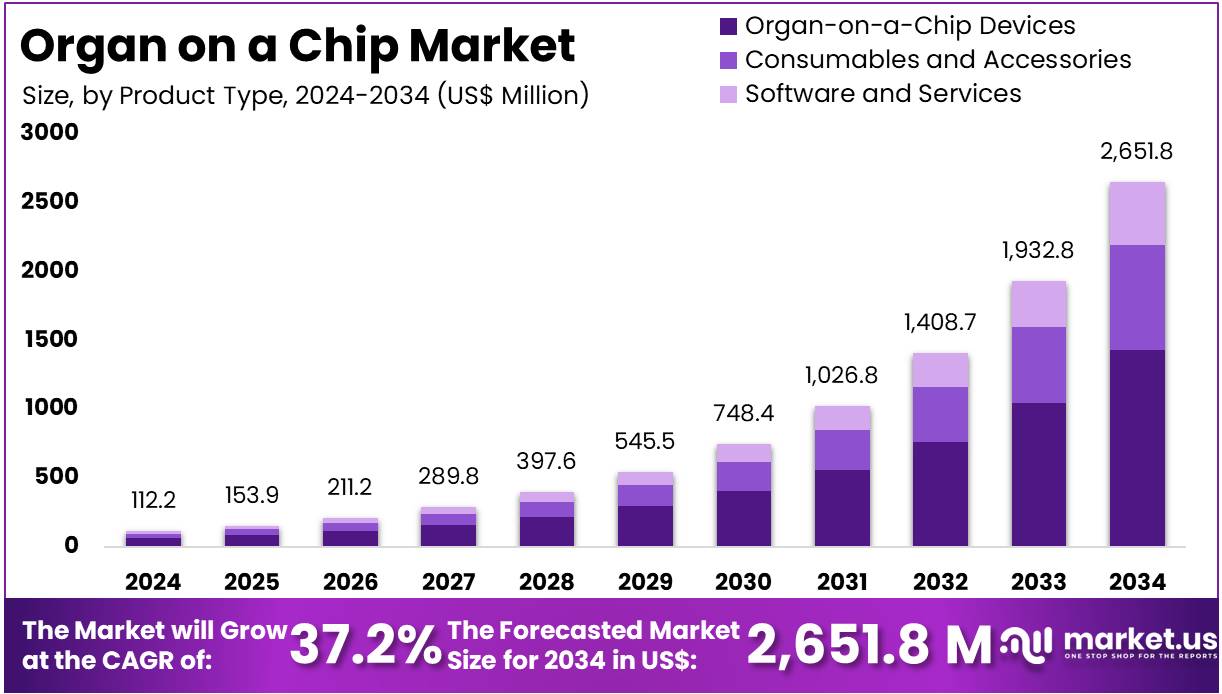
The Global Organ-On-A-Chip Market is projected to grow significantly. It is expected to reach approximately USD 2,651.8 million by 2034, up from USD 112.2 million in 2024. This represents a strong CAGR of 37.7% between 2025 and 2034. North America held a dominant position with a market share of 54.6% and a value of USD 61.26 million in 2024. Growth is driven by increasing demand for alternatives to animal testing and the need for more accurate preclinical models in drug development.
The high failure rate of clinical trials—nearly 90%—is prompting a shift toward more reliable human-relevant models. Around 30% of these failures are due to toxicity issues, highlighting the need for better predictive tools. Organ-on-a-Chip technology offers enhanced physiological accuracy. For instance, Liver-on-a-Chip models show 87% sensitivity and 100% specificity in detecting drug-induced liver injury. This is significantly higher than the 40% success rate of traditional animal models. Such results underline the growing confidence in OoC platforms.
Technological innovations are propelling the market forward. Advances in microfluidics, biomaterials, and tissue engineering now allow researchers to mimic complex organ systems on microchips. These chips simulate human biological responses at the microenvironmental level. They enable precise control over experimental conditions, offering greater predictive accuracy. Integration of these technologies supports applications in disease modeling and personalized drug testing. Continued R&D in this area is expected to refine organ-on-a-chip systems and expand their usability across healthcare and pharmaceutical sectors.
Government support is also playing a crucial role in market expansion. Agencies like the U.S. National Institutes of Health (NIH) and NCATS are promoting the adoption of OoC technologies. Their initiatives aim to create standardized validation protocols and promote regulatory acceptance. This support helps ease the transition from animal models to more ethical, human-based testing platforms. Favorable policies and funding from these bodies are accelerating the integration of OoC models into preclinical research pipelines.
Emerging economies such as China, India, and Japan are becoming vital players in the Organ-On-A-Chip Market. These countries are increasing investments in healthcare innovation and biotechnology. Government initiatives are encouraging local development and adoption of organ-on-a-chip technologies. In parallel, companies in various industries, including cosmetics and pharmaceuticals, are entering partnerships to develop ethical testing solutions. These trends are helping diversify the global market and drive sustained growth. As awareness grows, organ-on-a-chip systems are expected to become standard tools in biomedical research.
Key Takeaways
- The Organ-On-A-Chip Market is expected to grow significantly, reaching around US$ 2,651.8 million by 2034, from US$ 112.2 million in 2024.
- Between 2025 and 2034, the market is projected to expand at a robust compound annual growth rate (CAGR) of 37.7%.
- In 2024, Organ-on-a-Chip Devices held the largest share by product type, accounting for more than 54.1% of the global market.
- Heart-on-a-Chip dominated the organ type segment in 2024, securing over 28.5% of the total market share.
- Drug Discovery & Development applications led in 2024, with more than 44.2% of market share attributed to this use case.
- Pharmaceutical and Biotechnology Companies represented the top end users in 2024, contributing over 51.3% of total global demand.
- North America emerged as the regional leader in 2024, commanding more than 54.6% of the market, equal to US$ 61.26 million in value.
Get Sample: https://market.us/report/organ-on-a-chip-market/request-sample/
Segmentation Analysis
In 2024, Organ-on-a-Chip Devices led the product type segment with over 54.1% market share. Their precise simulation of organ-level functions made them a preferred choice in drug development and disease research. These devices outperformed traditional in vitro models in predictive accuracy. Researchers from both academic and commercial sectors increasingly favored them. This adoption trend was driven by the need for more reliable preclinical testing tools. The segment’s growth reflects the rising shift toward advanced microphysiological systems in the biomedical field.
Consumables and Accessories ranked second in the product category. This segment included items like microfluidic chips, reagents, and culture media. These tools were used regularly, creating consistent demand. Their consumption rose alongside the expansion of organ-on-a-chip research. More contract research organizations and institutions integrated these consumables into routine workflows. The recurring nature of use provided a steady revenue stream. As organ-on-chip systems gain more traction, the supporting consumables market is also expected to grow steadily.
Software and Services remained the smallest segment but showed rapid growth. Advanced software enabled real-time monitoring and data interpretation. Tools using artificial intelligence and image analysis improved experiment precision. Customized services such as chip design and results analysis became more popular. These enhanced the usability of chip platforms. As more researchers adopt digital solutions, demand for support services will likely rise. The segment is projected to expand with increasing technology integration in laboratory processes.
Heart-on-a-Chip held a leading position in the organ type segment, securing over 28.5% share. It gained popularity for its accurate simulation of cardiac rhythms and tissue. Its application in cardiovascular drug screening drove demand. Liver-on-a-Chip followed due to its role in drug metabolism and toxicity studies. Lung-on-a-Chip saw strong growth from its utility in respiratory research. Meanwhile, Kidney-on-a-Chip and Brain-on-a-Chip are emerging segments. These innovations reflect the expanding potential of organ-on-a-chip technology across various therapeutic areas.
By Product Type
- Organ-on-a-Chip Devices
- Consumables and Accessories
- Software and Services
By Organ Type
- Heart-on-a-Chip
- Liver-on-a-Chip
- Lung-on-a-Chip
- Kidney-on-a-Chip
- Brain-on-a-Chip
- Others
By Application
- Drug Discovery & Development
- Toxicology Research
- Disease Modeling
- Regenerative Medicine
- Others
By End User
- Academic & Research Institutes
- Pharmaceutical & Biotechnology Companies
- Others
Key Players Analysis
The Organ-On-A-Chip Market is witnessing strong growth driven by leading players focused on advanced technologies. Emulate Inc. has emerged as a pioneer with its proprietary Human Emulation System used in pharmaceutical research and toxicology testing. The company’s collaborations with pharmaceutical companies and academic institutions have expanded the adoption of its systems. Similarly, MIMETAS B.V. has gained recognition with its OrganoPlate® platform, which supports high-throughput 3D tissue modeling for nephrotoxicity and oncology studies, making it suitable for large-scale drug screening applications.
Tissue Dynamics has positioned itself as a key developer of physiologically relevant in-vitro models. The company utilizes stem cell-derived liver and cardiac tissues, integrating real-time biosensing for accurate drug development analysis. Organovo Holdings, Inc., initially known for 3D bioprinting, now focuses on liver tissue modeling for disease research. Its integration of biofabrication and microfluidic systems allows for the replication of complex biological functions, increasing its relevance in preclinical testing and drug discovery applications.
AxoSim Technologies offers CNS-focused OoC solutions that support predictive neurotoxicity studies. Its Nerve-on-a-Chip® and BrainSim® platforms are used in neurological disease research. The company collaborates with pharmaceutical firms to enhance neurodrug development accuracy. Other notable companies such as TissUse GmbH and CN Bio Innovations focus on multi-organ models and disease-specific platforms. These solutions contribute to personalized medicine and complex disease modeling, further expanding the application scope of OoC systems.
Additional key players include Nortis Inc., Hesperos Inc., ChipSights, and Allevi (3D Bioprinting Solutions). These firms contribute to innovation through microfluidic technologies and organ-specific modeling. Bio-Techne (ACEA Biosciences), SynVivo, and Fluicell focus on biosensor integration and tissue viability solutions. Other contributors such as Haplogen GmbH, Biogelx, Xona Microfluidics, and Kirkstall Ltd. offer unique solutions that support various research domains. Their growing partnerships and advanced offerings are driving global competition and accelerating technological progress in the Organ-on-a-Chip market.
Buy Directly: https://market.us/purchase-report/?report_id=145944
Conclusion
In conclusion, the Organ-On-A-Chip Market is growing rapidly as researchers and companies look for better alternatives to animal testing. These systems offer more accurate, human-like results, making them valuable tools for drug development and disease studies. The technology is supported by strong government initiatives, especially in countries like the United States, China, and India. Companies are investing in innovation and forming partnerships to create advanced models for different organs. As more industries adopt these tools, the market is expected to expand further. With ongoing research and wider acceptance, Organ-on-a-Chip systems are becoming essential in modern biomedical science and pharmaceutical testing. Their use will continue to grow in the coming years.
Get in Touch with Us:
Market.us (Powered By Prudour Pvt. Ltd.)
Address: 420 Lexington Avenue, Suite 300, New York City, NY 10170, United States.
Contact No: +1 718 874 1545 (International), +91 78878 22626 (Asia).
Email: [email protected]
View More
Drug Discovery Informatics Market
Medical Image Analysis Software Market



