
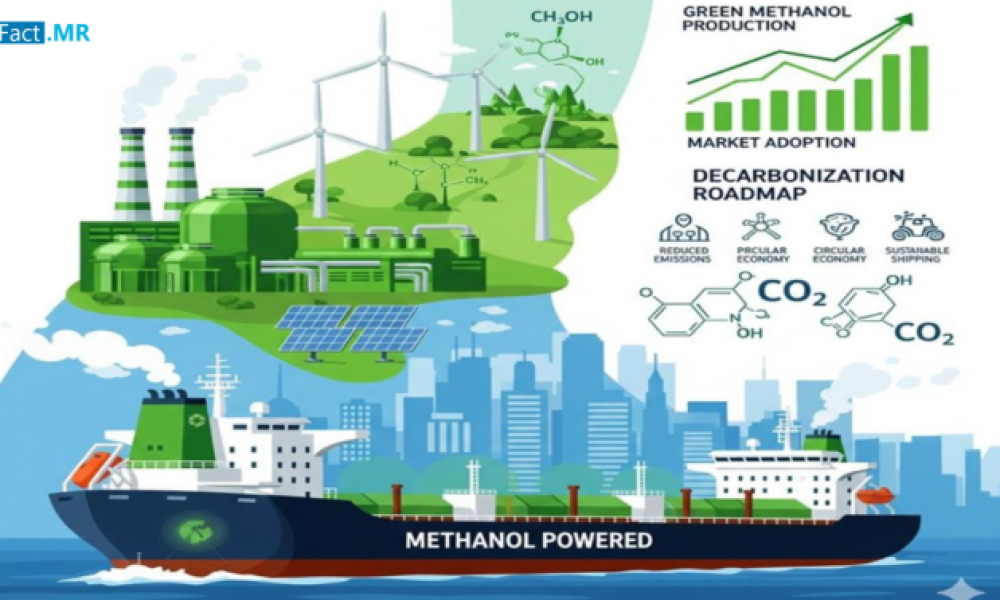
Driven by the urgent mandate to decarbonize the global shipping industry and a systemic shift toward “Power-to-X” (PtX) technologies, the global green methanol market is entering a decisive phase of industrialization. New market data released today estimates the sector’s value at $4.95 billion in 2026, up from $4.57 billion in 2025. This specialized energy market is projected to reach $8.64 billion by 2032, maintaining a robust compound annual growth rate (CAGR) of 9.53%.
The market’s momentum is primarily anchored in the maritime sector’s “methanol-ready” revolution. As the International Maritime Organization (IMO) and the European Union tighten emission standards, green methanol—produced from renewable hydrogen and captured carbon—has emerged as a leading “drop-in” alternative to fossil-based bunker fuels. This transition is no longer theoretical; with hundreds of dual-fuel vessels scheduled for delivery starting in 2026, the industry is moving from pilot demonstrations to high-volume commercial reality.
Request for Sample Report | Customize Report | Purchase Full Report – https://www.factmr.com/connectus/sample?flag=S&rep_id=10838
Decarbonizing the High Seas: Addressing the “Who, What, and Why”
Green methanol (including bio-methanol and e-methanol) serves as a liquid energy carrier that reduces lifecycle CO₂ emissions by up to 90% compared to traditional marine fuels. The “how” of this market’s evolution is defined by three core industry catalysts:
- The Maritime “Switch” and Orderbook Surge: In 2026, the fuel segment is the fastest-growing application. Major shipping lines, including Maersk and Evergreen, have billions of dollars in “methanol-driven” vessels currently entering service. This is driving a massive scale-up of bunkering infrastructure at global hubs like Shanghai, Rotterdam, and Busan.
- The Dominance of E-Methanol: While bio-methanol currently holds a significant volume share due to established biomass gasification, e-methanol is projected to grow at the fastest rate. By utilizing renewable power and carbon capture, e-methanol provides a scalable, land-neutral solution for hard-to-abate heavy industries.
- Regulatory Compliance (IMO & EU ETS): The 2026 implementation of stricter carbon pricing and the FuelEU Maritime initiative is effectively closing the cost gap between grey and green methanol. Producers are now securing long-term offtake agreements as shipowners prioritize compliance to avoid heavy non-performance penalties.
Market Context: Regional Leadership and Distribution Dynamics
The 2026 landscape is characterized by the dominance of the Asia-Pacific region and a surge in domestic production within North America and Europe.
- Asia-Pacific: Accounting for over 57% of the market share in the shipping segment, APAC is the global engine of green methanol growth. China has established itself as the leader in production capacity, leveraging domestic CO₂ from industrial waste and state-backed green hydrogen projects to secure its supply chain.
- North America: Driven by the Inflation Reduction Act (IRA), the U.S. has seen a surge in e-methanol facility investments, particularly along the Gulf Coast. North America currently leads in high-value technological innovation, focusing on modular synthesis and AI-optimized carbon capture.
- Europe: As a regulatory vanguard, Europe is the primary market for premium bio-methanol. The region’s focus is on “circularity,” utilizing forest residues and municipal solid waste (MSW) to create a closed-loop fuel cycle for its chemical and transport sectors.
Technological Frontiers: AI Optimization and Advanced Electrolyzers
The technological narrative of 2026 is defined by the integration of digital intelligence and high-efficiency electrolysis.
- AI-Driven Catalyst Discovery: 2026 marks a breakthrough in catalyst efficiency. Manufacturers are utilizing AI algorithms to simulate and monitor chemical reactions in real-time, reducing the discovery time for low-cost catalysts and significantly lowering the operational expenses of e-methanol synthesis.
- Next-Generation Electrolyzers: The market is benefiting from the deployment of high-capacity PEM and SOEC electrolyzers. These units offer higher conversion rates and are better equipped to handle the variable power loads of wind and solar energy, a critical factor for the commercial viability of “Power-to-Methanol” projects.
- Modular Production Units: To solve logistics challenges, the industry is moving toward decentralized, modular plants. These containerized units can be co-located with renewable energy sources or industrial CO₂ emitters, minimizing the need for expensive hydrogen transport and enabling localized “green bunkering” networks.
Competitive Landscape: The Shift to Integrated Value Chains
The competitive environment is shifting from standalone production to vertically integrated energy alliances. Key market leaders include:
- Methanex Corporation & OCI Global: Leading the market in global distribution and high-volume capacity expansion, particularly for bio-based and low-carbon variants.
- Carbon Recycling International (CRI) & Enerkem: Pioneering the commercial-scale conversion of CO₂ and waste-to-methanol, providing the technological blueprints for global e-methanol facilities.
- Proman & Södra: Focusing on high-purity bio-methanol derived from agricultural and forestry waste, catering to the premium chemical feedstock segment.
- Strategic Partnerships (Maersk, Mitsui, BASF): The 2026 market is defined by “Value Chain Partnerships,” where energy giants, shipyards, and logistics firms co-invest in production to guarantee fuel security and carbon neutrality goals.
The Path Toward 2032: Toward a Global Methanol Economy
As the industry moves toward 2032, the green methanol market is expected to transcend its role as a “niche fuel.” Analysts anticipate a surge in “Multi-Sector Utilization,” where green methanol serves as a primary feedstock for the production of sustainable plastics, textiles, and aviation fuels. For investors and industry leaders, the strategic priority remains the mastery of “Cost-Efficiency at Scale”—where the ability to produce green hydrogen and capture carbon at industrial volumes will define the competitive edge in the global energy transition.
About Fact.MR
Fact.MR is a global market research and consulting firm, trusted by Fortune 500 companies and emerging businesses for reliable insights and strategic intelligence. With a presence across the U.S., UK, India, and Dubai, we deliver data-driven research and tailored consulting solutions across 30+ industries and 1,000+ markets. Backed by deep expertise and advanced analytics, Fact.MR helps organizations uncover opportunities, reduce risks, and make informed decisions for sustainable growth.



