Definition
Water-based polyester resins are advanced polymer solutions designed to replace traditional solvent-based resins, offering a significantly lower environmental impact. These resins are formulated to be water-dispersible, eliminating the need for volatile organic compounds (VOCs) commonly found in conventional resins. By minimizing VOC emissions, water-based polyester resins contribute to cleaner air quality and align with global sustainability initiatives.
Primarily, these resins serve as surface modification agents for polyethylene terephthalate (PET) films, enhancing adhesion and improving the functional performance of coatings. Their applications span across multiple industries, including construction, automotive, packaging, textiles, adhesives, inks, and furniture manufacturing. They are particularly favored in industrial and architectural coatings, where environmental regulations and performance requirements intersect.
The water-based nature of these resins enables them to support the growing demand for eco-friendly materials in green construction, electric vehicles, and sustainable packaging. Additionally, ongoing research and development efforts focus on enhancing performance properties—such as durability, scratch resistance, and chemical stability—making these resins increasingly competitive with solvent-based alternatives.
In essence, water-based polyester resins represent a transition toward sustainable polymer solutions that meet both regulatory and consumer-driven demands for environmentally responsible industrial materials.
Market Size
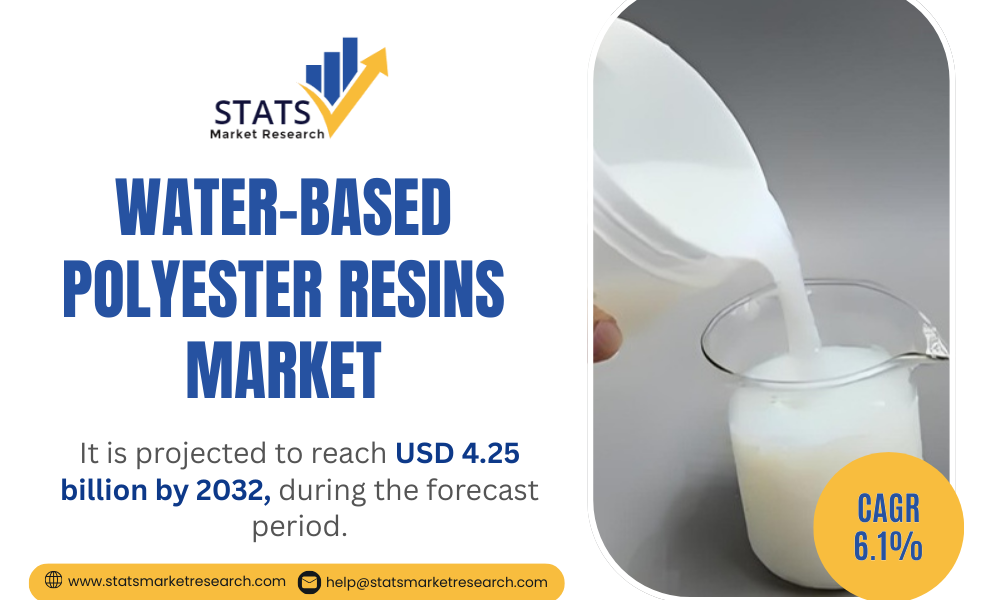
Global water-based polyester resins market was valued at USD 2.9 billion in 2023. Driven by rising environmental awareness, regulatory pressures, and industrial adoption, the market is projected to grow from USD 3.1 billion in 2024 to USD 4.25 billion by 2030, representing a CAGR of 6.1% during the forecast period.
This growth is supported by several factors:
- Regulatory Compliance: North America and Europe are leading in adoption due to strict VOC emission limits, prompting industrial users to transition to water-based formulations.
- Sustainability Trends: Corporations adopting ESG targets increasingly prefer low-VOC, eco-friendly resins in coatings, adhesives, and packaging.
- Technological Advancements: Innovations in nanotechnology, conductive coatings, and modified molecular formulations have improved performance, reducing the gap with solvent-based alternatives.
Historically, the market has grown steadily, with adoption rising in industries prioritizing green construction, automotive coatings, and textile finishing. Industrial coatings currently account for the largest segment of revenue, reflecting the widespread replacement of solvent-based systems.
Key statistics include:
- Water-based polyester resins now constitute 42% of the industrial coatings market, up from 28% five years ago.
- The construction sector is responsible for over 35% of resin demand, driven by LEED-certified projects and sustainable building initiatives.
- EV-specific coatings are projected to grow at a CAGR of 8.7% through 2030, signaling emerging niche opportunities.
Download FREE Sample of this Report @ https://www.statsmarketresearch.com/download-free-sample/8059896/global-waterbased-polyester-resins-forecast-market
Recent Developments
The water-based polyester resins market is seeing significant growth driven by a global push for sustainable and eco-friendly solutions. Recent developments are centered on improving the performance of these resins to match or even surpass their solvent-based counterparts. This includes innovations in resin chemistry to enhance properties like water resistance, durability, and UV stability. Manufacturers are also increasingly focusing on the use of bio-based and renewable raw materials, which not only reduces the environmental footprint but also appeals to industries with strong sustainability goals. Furthermore, advancements are being made to develop formulations with lower volatile organic compound (VOC) content, aligning with stricter environmental regulations, particularly in the construction, automotive, and packaging sectors.
Major Distribution
The distribution of water-based polyester resins primarily involves a business-to-business (B2B) model, with a focus on supplying to industrial end-users rather than retail consumers. The main distribution channels are direct sales from major chemical manufacturers to large-scale customers, such as paint and coatings companies, adhesives producers, and textile manufacturers. For smaller clients or those in different geographical regions, a network of specialized chemical distributors plays a crucial role. These distributors handle the logistics, warehousing, and local delivery of the resins, providing an essential link between the producers and a diverse range of industries that utilize these materials.
Market Dynamics (Drivers, Restraints, Opportunities, and Challenges)
Drivers
Stringent Environmental Regulations
Global regulations limiting VOC emissions are a primary growth driver. For example, EU VOC limits have decreased by over 30% since 2018, compelling industries to switch to water-based alternatives. Coatings, adhesives, and packaging applications have been the largest beneficiaries, particularly in Europe and North America.
Corporate Sustainability Initiatives
Companies with ESG commitments are actively seeking materials with lower carbon footprints. For instance, over 60% of Fortune 500 companies now include low-VOC materials in supply chain procurement policies. Green construction and circular economy models further reinforce adoption.
Emerging Industrial Applications
The rise of electric vehicles, green packaging, and sustainable textiles presents new avenues for water-based polyester resins. EV battery components, lightweight automotive panels, and recyclable packaging solutions increasingly rely on these eco-friendly resins.
Restraints
Performance Limitations
Water-based polyester resins may underperform in extreme conditions, offering 15-20% lower chemical resistance and up to 30% shorter durability compared to solvent-based alternatives. High-end applications like aerospace and marine sectors remain cautious.
Higher Production Costs
Manufacturing water-based polyester resins requires specialized processes, increasing production costs by 20-25%. Raw material price volatility, particularly for purified terephthalic acid, further exacerbates cost pressures, affecting price-sensitive markets.
Opportunities
Expansion in Electric Vehicle Applications
Water-based resins are gaining traction in EV production for interior and exterior coatings, offering safety and sustainability advantages. Recent development budgets for EV-specific coatings have increased 35% annually since 2021.
Advancements in Nanotechnology
Nano-enhanced water-based resins demonstrate 40% higher hardness and 35% improved adhesion, narrowing the performance gap with solvent-based systems. Over 120 patents filed in the past three years highlight the sector’s innovative momentum.
Challenges
Technical Limitations in Application Processes
Switching to water-based systems requires equipment adjustments, extended drying times (30-50% longer), and climate-controlled environments for cold-weather applications, raising initial investment requirements up to $250,000 for medium-scale operations.
Regulatory Complexity and Supply Chain Vulnerabilities
Diverging international standards necessitate multiple formulations, increasing R&D costs by up to 20%, while limited supplier availability leads to lead times exceeding 12 weeks for specialty additives.
Regional Analysis
North America
Dominates due to stringent environmental regulations and early adoption of low-VOC coatings. The U.S. remains a key market for automotive and industrial applications.
Europe
Regulatory pressure in EU countries drives widespread adoption in construction and coatings, with green building projects accounting for a significant portion of demand.
Asia-Pacific
Rapid industrialization and infrastructure growth, particularly in China, Japan, and South Korea, create a high growth potential. The focus is on cost-competitive production and textile/packaging applications.
Latin America and Middle East & Africa
Adoption is slower due to cost sensitivity, but emerging sustainable construction projects and urbanization trends offer incremental growth opportunities.
Get the Complete Report & TOC @ https://www.statsmarketresearch.com/global-waterbased-polyester-resins-forecast-market-8059896
Competitor Analysis
The global market is moderately consolidated with the top five players accounting for 35-40% of total revenue in 2023. Competition revolves around performance, sustainability, and regional supply chain advantages.
Major Players:
- BASF SE – Germany: Leading in low-VOC coatings with extensive R&D investments.
- Eastman Chemical Company – U.S.: Strong presence in automotive and industrial coatings.
- SK Chemicals – South Korea: Cost-competitive solutions for textile and packaging applications.
- Mitsubishi Chemical Corporation – Japan: Focused on Asia-Pacific growth.
- DIC Corporation – Japan: Expanded portfolio via strategic acquisitions.
Smaller Niche Players:
- GOO Chemical – Japan: Bio-based alternatives.
- Macroocean – China: Sustainable polyester resin solutions.
Global Water-Based Polyester Resins: Market Segmentation Analysis
This report provides a deep insight into the global water-based polyester resins market, covering all its essential aspects. This ranges from a macro overview of the market to micro details of the market size, competitive landscape, development trend, niche market, key market drivers and challenges, SWOT analysis, value chain analysis, etc.
The analysis helps the reader to shape the competition within the industries and strategies for the competitive environment to enhance the potential profit. Furthermore, it provides a simple framework for evaluating and assessing the position of the business organization. The report structure also focuses on the competitive landscape of the Global Water-Based Polyester Resins. This report introduces in detail the market share, market performance, product situation, operation situation, etc., of the main players, which helps the readers in the industry to identify the main competitors and deeply understand the competition pattern of the market.
In a word, this report is a must-read for industry players, investors, researchers, consultants, business strategists, and all those who have any kind of stake or are planning to foray into the Water-Based Polyester Resins market in any manner.
Market Segmentation (by Application)
- Coatings
- Architectural coatings
- Industrial coatings
- Automotive coatings
- Adhesives
- Inks
- Textile Sizing Agent
- Other Industrial Applications
Market Segmentation (by Type)
- High Molecular Weight Polyester Resins
- Pre-polymerized
- Modified
- Other variants
- Medium Molecular Weight Polyester Resins
- Low Molecular Weight Polyester Resins
- Water-dispersible
- Self-crosslinking
- Others
Key Company
- BASF SE (Germany)
- Eastman Chemical Company (U.S.)
- SK Chemicals (South Korea)
- Mitsubishi Chemical Corporation (Japan)
- DIC Corporation (Japan)
- Bostik (France)
- Toyobo Co., Ltd. (Japan)
- GOO Chemical Co. (Japan)
- Macroocean (China)
- Chengdu Jiesheng Shubang New Material Technology (China)
Geographic Segmentation
- North America
- Europe
- Asia-Pacific
- Latin America
- Middle East & Africa
FAQ
- What is the current market size of the Water-Based Polyester Resins market?
- The market was valued at USD 2.9 billion in 2023 and is projected to reach USD 4.25 billion by 2030
About Us
☎️ International: +1 (332) 2424 294
📄 Website: www.statsmarketresearch.com
Join us on LinkedIn:- https://www.linkedin.com/company/statsmarketresearch




