
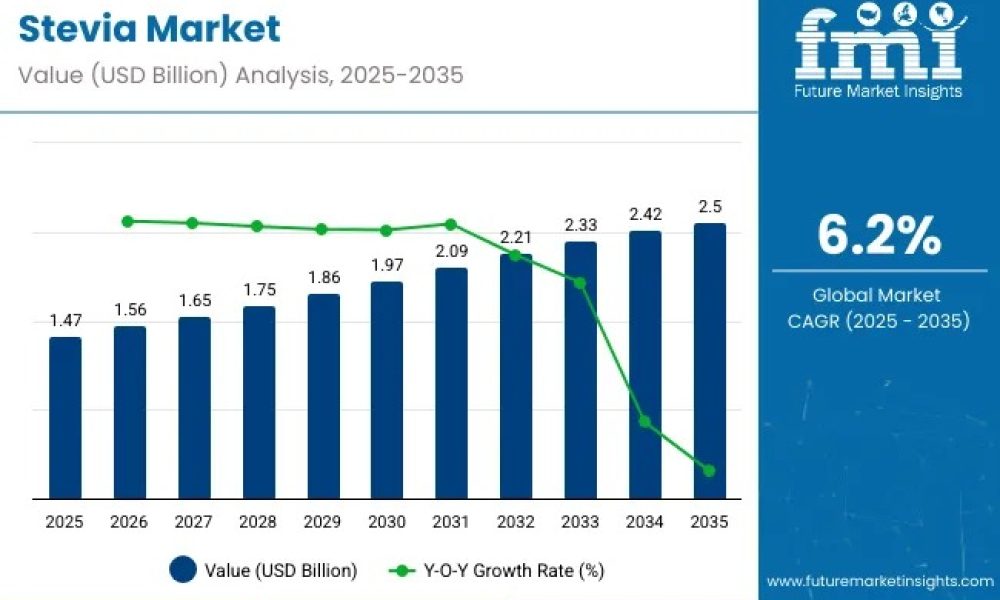
The global stevia market is on a strong growth trajectory, projected to reach a valuation of USD 1.47 billion in 2025 and expand to USD 2.5 billion by 2035, registering a CAGR of 6.2% over the forecast period. This expansion reflects a structural shift in global sweetening systems as governments, manufacturers, and consumers converge on sugar reduction as a health and policy priority.
Rising incidences of obesity, diabetes, and metabolic disorders, coupled with sugar taxation policies across North America, Europe, and parts of Asia-Pacific, are accelerating the transition toward natural, zero-calorie sweeteners. As a plant-derived alternative with non-glycemic properties, stevia has moved from niche positioning to mainstream formulation strategies across food, beverage, nutraceutical, and pharmaceutical applications.
Get Exclusive Access To Data Tables, Market Sizing Dashboards, And Analyst Insights. Request Sample Report!
Conventional Glycosides and Powdered Formats Anchor Market Stability
Conventional stevia extracts—particularly Rebaudioside A and B—continue to dominate commercial usage due to their proven efficacy, regulatory acceptance, and formulation flexibility. Among product forms, powdered stevia extracts are expected to retain nearly 60% market share in 2025, supported by longer shelf life, cost-efficient transportation, and compatibility with dry blends.
Powder formats are increasingly favored for applications in beverages, tabletop sweeteners, snack coatings, supplements, and bakery mixes. Manufacturers benefit from precise glycoside standardization, enabling region-specific sweetness profiles while complying with local regulatory limits. Ongoing R&D is focused on refining high-purity blends such as Reb M and Reb D in powdered form to minimize bitterness and improve taste parity with sugar.
Asia-Pacific Leads Supply, While Western Markets Drive Consumption
From a supply standpoint, Asia-Pacific—led by China—accounts for the majority of global stevia cultivation and extraction, benefiting from favorable agro-climatic conditions and vertically integrated production models. China remains the world’s largest exporter of stevia leaves and refined extracts, supplying North America, Europe, and Japan.
On the demand side, North America and Western Europe exhibit the highest penetration, driven by clean-label reformulation, sugar tax compliance, and consumer demand for natural ingredients. Advanced taste-modulation technologies, fermentation-based glycoside production, and hybrid sweetener systems are improving sensory acceptance and accelerating adoption in mass-market products.
Beverages Emerge as the Primary Growth Engine
The beverage segment is projected to account for over 35% of total stevia demand by 2025, expanding at a CAGR of 6.8% through 2035. Carbonated soft drinks, flavored waters, sports beverages, and ready-to-drink teas are undergoing rapid reformulation as brands eliminate sugar without compromising taste.
High-purity glycosides such as Reb M are increasingly deployed to address challenges related to aftertaste and solubility in low-pH environments. Ingredient suppliers are partnering closely with global beverage brands to co-develop customized sweetness systems aligned with regional taste preferences and regulatory frameworks.
Per Capita Consumption Reflects Health Awareness Gaps
Per capita stevia consumption remains highest in developed markets such as the United States, Japan, and Western Europe, where health literacy, product availability, and sugar-reduction awareness are well established. In contrast, emerging markets across Asia-Pacific, Latin America, and Africa are witnessing steady growth as middle-class expansion and diabetes prevalence drive demand for healthier alternatives.
India and China Emerge as High-Growth Markets
Among country-level markets, India is the fastest-growing stevia market, supported by a 6.3% CAGR, government-led initiatives such as the FSSAI Eat Right Movement, and rising demand for sugar-free traditional foods and beverages. China follows closely, with strong policy backing under the Healthy China 2030 framework and a robust export-oriented production base.
Mature markets including the United States, United Kingdom, Germany, France, Italy, Japan, South Korea, and Australia–New Zealand continue to expand steadily, driven by clean-label trends, regulatory pressure on sugar, and innovation in functional and plant-based foods.
Competitive Landscape Balances Consolidation and Innovation
The stevia market features a moderately consolidated competitive structure, led by Tier 1 players such as Cargill, Ingredion (PureCircle), and Tate & Lyle, supported by Tier 2 and Tier 3 producers targeting regional and application-specific opportunities. Strategic priorities across the industry include:
- Vertical integration from cultivation to purification
- Investment in fermentation-based and enzymatic glycoside production
- Partnerships with global food and beverage brands
- Sustainability-driven sourcing and low-carbon manufacturing
Cargill’s leadership in fermentation-derived Reb M, Ingredion’s tailored sweetness platforms, and Tate & Lyle’s clean-label innovation strategies continue to shape competitive dynamics.
Buy Report Now – Click Here to Purchase the Report
Outlook: Innovation, Regulation, and Sustainability Define the Next Phase
Looking ahead, the stevia market’s growth will hinge on continued advances in taste optimization, regulatory harmonization, and sustainable production practices. As competition from other natural sweeteners intensifies, players that combine sensory performance, compliance expertise, and application support are best positioned to capture long-term value.
About Future Market Insights (FMI)
Future Market Insights, Inc. (FMI) is an ESOMAR-certified, ISO 9001:2015 market research and consulting organization, trusted by Fortune 500 clients and global enterprises. With operations in the U.S., UK, India, and Dubai, FMI delivers data-backed insights and strategic intelligence across 30+ industries and 1,200+ markets worldwide, enabling clients to make confident, future-ready decisions.



