
Definition
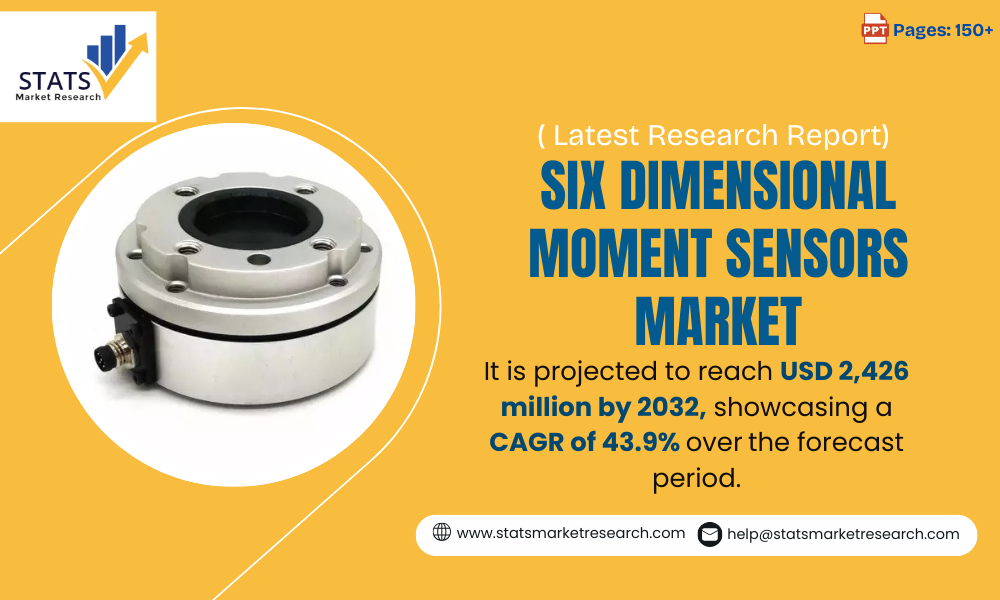
Six-Dimensional Moment Sensors (6D sensors) are advanced force-torque sensing devices that measure three translational forces (X, Y, Z axes) and three rotational moments (Mx, My, Mz). These sensors convert mechanical loads into precise electrical signals, enabling high-accuracy monitoring and control in robotics, aerospace, automotive testing, and medical robotics.
Originally developed for aerospace testing, they are now widely integrated into humanoid robots, industrial robots, automotive crash testing systems, and surgical robotics. Their ability to capture complex multidirectional forces in real-time makes them indispensable for applications requiring precision, safety, and adaptability.
Recent Developments in the Six-Dimensional Moment Sensors Market
The six-dimensional (6D) moment sensors market is undergoing rapid expansion, driven by a surge in demand for automation and advanced robotics. A key development is the increasing miniaturization of these sensors, allowing for their integration into smaller, more dexterous robotic end-effectors and haptic feedback systems, particularly in medical robotics and humanoid robots. There’s also a significant focus on improving sensor accuracy, sensitivity, and durability to meet the stringent demands of applications like precision assembly and crash testing in the automotive industry. Additionally, the market is seeing a rise in the development of more advanced software and algorithms for better signal processing and data decoupling, which reduces cross-coupling errors and enhances overall performance, making these sensors more reliable for complex tasks and real-time control.
Major Distribution for Six-Dimensional Moment Sensors
The distribution of six-dimensional moment sensors is highly specialized, primarily targeting B2B (business-to-business) channels due to their high cost and technical complexity. Direct sales from manufacturers to large-scale clients, such as major automotive manufacturers, aerospace companies, and robotics firms, are a common distribution method. This allows for customized solutions and direct technical support. A significant portion of the market is also served by a network of specialized industrial equipment distributors and system integrators. These partners often provide value-added services like sensor calibration, installation, and integration into existing robotic systems. Online platforms and specialized e-commerce sites are also gaining traction, particularly for smaller orders and for reaching a broader, global clientele of researchers and R&D departments.
Market Size
Global Six-Dimensional Moment Sensors market size was valued at USD 205 million in 2023 and is projected to grow from USD 279 million in 2024 to USD 2,426 million by 2030, exhibiting a CAGR of 43.9% during the forecast period.
- In 2024, global unit sales surpassed 60,000 units, with China accounting for 17,000 units, a 40% YoY increase.
- Strain-based sensors dominate, representing more than 80% of market share.
- By 2028, humanoid robots are expected to account for 45% of sensor demand, creating a $1.2 billion revenue stream.
This rapid growth reflects the synergy between robotics, automation, and Industry 4.0 adoption across industries.
Download FREE Sample of this Report @ https://www.statsmarketresearch.com/download-free-sample/8059967/global-six-dimensional-moment-sensors-forecast-market
Market Dynamics (Drivers, Restraints, Opportunities, and Challenges)
Drivers
- Exponential Growth of Humanoid Robotics
Global humanoid robot installations are forecast to grow at a 104% CAGR through 2030, fueling demand for six-dimensional sensors in robotic wrists, ankles, and balance control. - Automotive Testing & EV Development
Automakers deploy these sensors for crash tests, fatigue analysis, and EV battery pack validation, reducing development cycles by 30%. - Medical Robotics Expansion
Surgical robot adoption is rising at 23% annually, requiring miniaturized six-dimensional sensors for haptic feedback in minimally invasive surgery.
Restraints
- High Costs: Industrial-grade sensors exceed $15,000 per unit, with calibration adding 25–30% ownership costs.
- Technical Complexity: Multi-axis calibration increases operational expenses, accounting for 40% of total application costs.
- Supply Chain Risks: Rare earth element shortages and MEMS sourcing constraints create bottlenecks with 12+ month lead times.
Opportunities
- Industrial IoT & Predictive Maintenance: Integration with IoT enables predictive failure detection with 92% accuracy, creating a $380M opportunity by 2027.
- AI-driven Sensor Fusion: Machine learning enhances robotic grasping accuracy by 40% when six-dimensional data is fused with vision sensors.
Challenges
- Standardization Gaps: Lack of universal protocols increases integration costs by 35% in multi-vendor setups.
- Workforce Shortages: Global shortfall of 45,000 skilled engineers projected by 2025 in calibration and multidimensional data processing.
Regional Analysis
- North America: Leads in adoption for aerospace testing and automotive R&D, accounting for nearly 28% market share in 2024.
- Europe: Strong demand in industrial automation and medical robotics, with Germany and Switzerland driving innovation.
- Asia-Pacific: Fastest-growing region (CAGR >55%), led by China, Japan, and South Korea due to robotics manufacturing and government support.
- Latin America & Middle East: Emerging adoption in automotive and defense applications, though still under 5% market share.
Competitor Analysis
The market features semi-consolidated competition with leading players investing in R&D, partnerships, and acquisitions.
- ATI Industrial Automation (U.S.) – Market leader with ~22% share, strong in robotics and aerospace.
- Schunk GmbH (Germany) – Holds ~18% share, known for automation integration.
- AMTI (U.S.) – Focused on biomechanics and medical robotics.
- Sunrise Instruments & Kunwei Technology (China) – Growing >40% annually through cost-efficient sensors.
- Robotiq (Canada) – Acquired Bota Systems (Switzerland) in 2023, expanding into integrated robotic perception.
Together, top players control 60%+ of premium market share, while Chinese firms rapidly expand domestically with subsidies and aggressive pricing.
Get the Complete Report & TOC @ https://www.statsmarketresearch.com/global-six-dimensional-moment-sensors-forecast-market-8059967
Global Six-Dimensional Moment Sensors: Market Segmentation Analysis
This report provides a deep insight into the global Six-Dimensional Moment Sensors, covering all its essential aspects. This ranges from a macro overview of the market to micro details of the market size, competitive landscape, development trend, niche market, key market drivers and challenges, SWOT analysis, value chain analysis, etc.
The analysis helps the reader to shape the competition within the industries and strategies for the competitive environment to enhance the potential profit. Furthermore, it provides a simple framework for evaluating and assessing the position of the business organization. The report structure also focuses on the competitive landscape of the Global Six-Dimensional Moment Sensors. This report introduces in detail the market share, market performance, product situation, operation situation, etc., of the main players, which helps the readers in the industry to identify the main competitors and deeply understand the competition pattern of the market.
In a word, this report is a must-read for industry players, investors, researchers, consultants, business strategists, and all those who have any kind of stake or are planning to foray into the Six-Dimensional Moment Sensors in any manner.
Market Segmentation (by Application)
- Industrial Robots – Leading application, adopted widely in automation and manufacturing.
- Medical Robots – Fastest-growing segment driven by surgical robotics demand.
- Automotive Testing – Used in crash simulations, EV battery testing, and calibration.
- Humanoid Robots – Emerging application, projected to account for 45% of demand by 2028.
- Others – Aerospace, biomechanics, and research.
Market Segmentation (by Type)
- Resistance Strain Sensors – Dominant type, adaptable for high mechanical loads.
- Capacitive / Piezoelectric Sensors – Gaining share in high-precision applications.
- Others (Photoelectric, Hybrid Types) – Specialized solutions for niche applications.
Key Company
- ATI Industrial Automation (U.S.)
- Schunk GmbH (Germany)
- Advanced Mechanical Technology, Inc. (U.S.)
- Sunrise Instruments (China)
- Kistler Group (Switzerland)
- Robotiq (Canada)
- Epson Robots (Japan)
- ME-Mesysteme (Germany)
- Wacoh-Tech (Japan)
- Kunwei Technology (China)
- XJCSENSOR (China)
- FUTEK Advanced Sensor Technology (U.S.)
- Bota Systems AG (Switzerland)
Geographic Segmentation
- North America
- Europe
- Asia Pacific
- Latin America
- Middle East & Africa
FAQ Section
Q1. What is the current market size of the Six-Dimensional Moment Sensors market?
The market was valued at USD 205 million in 2023 and is projected to reach USD 2,426 million by 2030, at a CAGR of 43.9%.
Q2. Which are the key companies operating in the Six-Dimensional Moment Sensors market?
Major players include ATI Industrial Automation, Schunk GmbH, AMTI, Sunrise Instruments, Kistler Group, Robotiq, Epson Robots, Kunwei Technology, XJCSENSOR, and Bota Systems.
Q3. What are the key growth drivers in the Six-Dimensional Moment Sensors market?
The primary drivers are humanoid robotics adoption, automotive testing demand, expansion of surgical robotics, and Industry 4.0 IoT integration.
Q4. Which regions dominate the Six-Dimensional Moment Sensors market?
North America and Europe dominate in innovation and adoption, while Asia-Pacific is the fastest-growing region with >55% CAGR.
Q5. What are the emerging trends in the Six-Dimensional Moment Sensors market?
Key trends include AI-driven sensor fusion, predictive maintenance integration, miniaturized medical sensors, and government-backed robotics expansion in Asia-Pacific.
About Us
☎️ International: +1 (332) 2424 294
📄 Website: www.statsmarketresearch.com
Join us on LinkedIn:- https://www.linkedin.com/company/statsmarketresearch




