
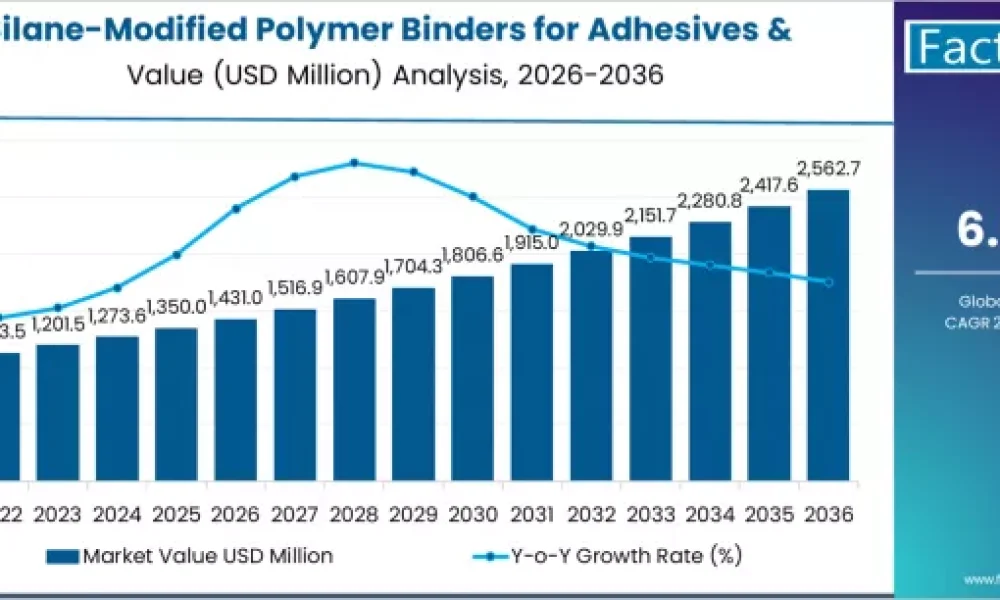
The global silane-modified polymer (SMP) binders for adhesives and sealants market is set to witness robust growth between 2026 and 2036, driven by increasing demand for high-performance, environmentally friendly bonding solutions across construction, automotive, industrial, and consumer applications. Silane-modified polymer binders—also referred to as hybrid polymers—combine the flexibility of polyurethanes with the durability and weather resistance of silicones, making them a preferred choice in modern adhesive and sealant formulations.
Market Overview
Silane-modified polymer binders are increasingly replacing conventional solvent-based and isocyanate-based systems due to their low VOC emissions, superior adhesion to diverse substrates, excellent elasticity, and resistance to moisture, UV radiation, and chemicals. These properties align well with tightening environmental regulations and the global shift toward sustainable materials. As industries prioritize safer and more durable bonding technologies, SMP-based adhesives and sealants are gaining widespread adoption.
To access the complete data tables and in-depth insights, request a Discount On The Report here: https://www.factmr.com/connectus/sample?flag=S&rep_id=12657
Market Size and Growth Outlook (2026–2036)
From 2026 to 2036, the global SMP binders market is expected to register steady, value-driven growth. Expansion will be supported by rising construction activity, infrastructure development, and increasing use of advanced adhesives in lightweight automotive manufacturing and industrial assembly. While growth rates are moderate compared to emerging specialty chemicals, the market benefits from high entry barriers, long product lifecycles, and strong customer stickiness, ensuring long-term revenue stability for manufacturers.
Key Growth Drivers
- Sustainability and Regulatory Compliance
Stringent regulations on VOC emissions in Europe, North America, and parts of Asia-Pacific are accelerating the shift toward silane-modified polymer technologies. SMP binders are solvent-free and isocyanate-free, supporting green building standards and sustainable manufacturing goals. - Construction and Infrastructure Demand
The construction sector remains the largest end-use industry, with SMP binders widely used in façade bonding, flooring, roofing, glazing, and expansion joints. Growth in urbanization, renovation projects, and energy-efficient buildings is directly boosting demand for high-performance sealants. - Automotive and Transportation Applications
Automakers are increasingly using SMP-based adhesives for structural bonding, interior assembly, and sealing applications. These binders support lightweight designs, vibration damping, and improved durability, which are critical for electric vehicles and next-generation mobility solutions. - Performance Advantages Over Traditional Systems
Superior elasticity, paintability, and adhesion to metals, plastics, glass, and concrete give SMP binders a competitive edge over silicones and polyurethanes, especially in demanding environments.
Regional Insights
- Europe leads the market due to strict environmental norms, strong construction activity, and early adoption of sustainable materials.
- Asia-Pacific is expected to be the fastest-growing region, driven by rapid infrastructure development in China, India, and Southeast Asia, along with expanding automotive production.
- North America shows stable growth, supported by renovation projects, industrial manufacturing, and preference for high-performance sealants.
Technology Trends and Competitive Landscape
Key manufacturers are focusing on advanced SMP formulations, including faster curing systems, improved adhesion promoters, and enhanced durability. Innovation is also centered on multi-purpose binders suitable for both adhesives and sealants, reducing formulation complexity for end users. Strategic partnerships, capacity expansions, and R&D investments remain central to competitive positioning.
Challenges
Despite favorable trends, the market faces challenges such as higher raw material costs, price sensitivity in developing regions, and competition from established silicone and polyurethane systems. Technical expertise required for formulation and application can also limit adoption among smaller manufacturers.
Strategic Implications
- Manufacturers should invest in sustainable innovation and region-specific product development.
- Adhesive and sealant formulators can leverage SMP binders to meet regulatory compliance while enhancing performance.
- Investors can view the market as a stable, long-term opportunity aligned with sustainability and infrastructure growth.
Outlook Summary
Between 2026 and 2036, the global silane-modified polymer binders market for adhesives and sealants is expected to grow steadily, supported by sustainability mandates, construction expansion, and performance-driven material innovation. While challenges remain, the market offers strong opportunities for stakeholders focused on advanced, eco-friendly bonding technologies and long-term value creation.
Have a specific Requirements and Need Assistant on Report Pricing or Limited Budget please contact us – [email protected]
About Fact.MR
Fact.MR is a global market research and consulting firm, trusted by Fortune 500 companies and emerging businesses for reliable insights and strategic intelligence. With a presence across the U.S., UK, India, and Dubai, we deliver data-driven research and tailored consulting solutions across 30+ industries and 1,000+ markets. Backed by deep expertise and advanced analytics, Fact.MR helps organizations uncover opportunities, reduce risks, and make informed decisions for sustainable growth.



