
Quantum Computing Hits Industrial Scale: The 2026 Quantum Catalyst Market Reaches Critical Mass
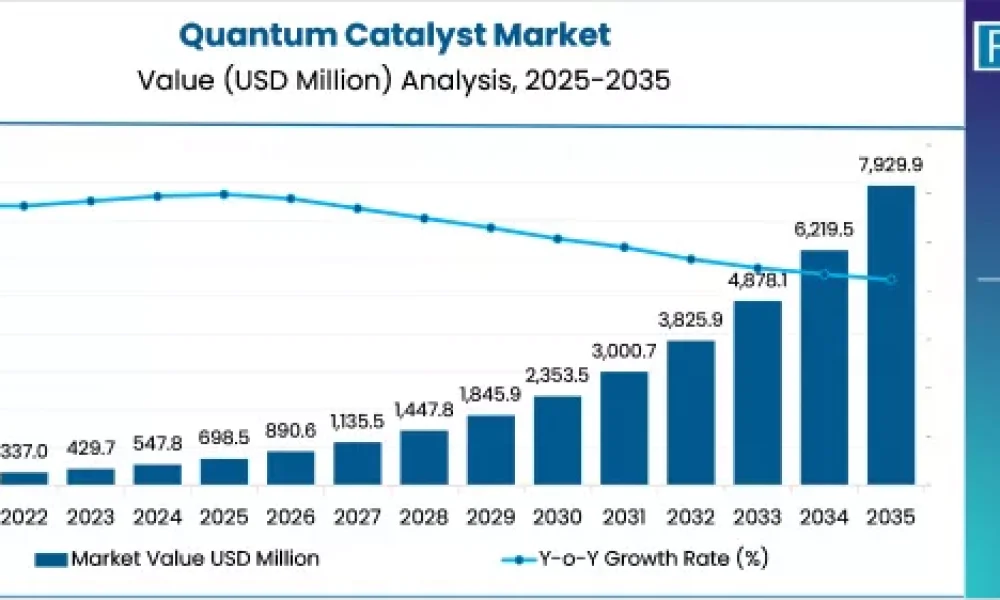
The global industrial landscape is witnessing a fundamental shift in molecular engineering as the Quantum Catalyst Market transitions from theoretical research to high-value industrial application. By integrating quantum-classical hybrid computing, major chemical and energy players are now bypassing decades of traditional trial-and-error R&D, signaling a new era for sustainable fuel production and carbon sequestration.
In the opening weeks of 2026, the convergence of high-fidelity quantum hardware and advanced AI-driven simulation has transformed how catalysts—the molecular workhorses of modern industry—are discovered. This shift is driven by a collaborative effort between quantum hardware leaders like IonQ and IBM, and chemical giants such as Dow, aiming to optimize industrial processes that currently account for significant global energy consumption.
The 5Ws of the Quantum Catalyst Evolution
- Who: Leading chemical conglomerates, quantum hardware providers (IBM, Microsoft, IonQ), and specialized AI-quantum software firms (SandboxAQ).
- What: The deployment of Quantum-Classical Hybrid Systems to simulate complex organometallic compounds and catalyst behaviors at a molecular level.
- When: 2026 is marking the “”year of default hybridization,”” where the industry moves past the “”quantum hype”” of 2024–2025 into regime-specific industrial utility.
- Where: Primary innovation hubs are concentrated in North America and Europe, with rapid infrastructure scaling in the Asia-Pacific region, particularly China and India.
- Why: To solve the “”Great Molecular Challenge””—designing catalysts for green hydrogen and carbon capture that are too complex for even the world’s most powerful classical supercomputers.
- How: By utilizing “”noise-resilient”” algorithms and GPU-accelerated classical pre-processing to lighten the computational load on 40-to-100-qubit quantum models.
Market Context: Beyond the “”Quantum Bubble””
While 2025 saw a recalibration of “”pure-play”” quantum stocks, the underlying Quantum Catalyst Market has benefited from a more sober, utility-focused investment environment. Industry analysts note that while the broader quantum computing market is projected to reach approximately $7.3 billion by 2030, the specific niche of Catalyst Discovery is emerging as its most immediate “”killer app.””
The traditional catalyst market, valued at over $35 billion in 2026, is under immense pressure to meet global net-zero targets. “”We aren’t just looking for incremental improvements anymore,”” says one lead analyst. “”We are looking for the ‘Holy Grail’ of chemistry—efficient nitrogen fixation and low-cost water splitting—and 2026 is the year we finally have the hardware to see the path.””
Request for Sample Report | Customize Report |purchase Full Report – https://www.factmr.com/connectus/sample?flag=S&rep_id=10861
Data-Backed Insights and Technical Breakthroughs
Recent breakthroughs in early 2026 have redefined the sector’s roadmap:
- Barium-Based Qubits: The successful migration to Barium-based systems has allowed for easier networking of quantum chips, solving the scaling bottleneck that previously limited complex chemical simulations.
- Noise-Resilient Pathways: Research from SandboxAQ and IonQ has demonstrated that “”low-fidelity”” quantum states, previously discarded as noise, can now be “”purified”” to recover high-accuracy chemical data.
- Reduced R&D Timelines: Quantitative AI models (LQMs) are now reducing the discovery phase for novel catalysts from a standard 10-year cycle to less than 18 months in pilot programs.
Industry Relevance: The Shift to Sustainability
The primary growth driver for quantum catalysis in 2026 is the Circular Economy. Strict environmental regulations (such as EU REACH and updated EPA standards) are forcing manufacturers to adopt “”Green Catalysts”” that minimize waste and energy use. Quantum simulations are specifically targeting the replacement of expensive precious metals like Platinum and Palladium with more abundant, earth-friendly alternatives.
“”If 2025 was the year hybrid approaches became ‘interesting,’ 2026 is the year they became the default,”” notes a recent industry report. This sentiment is echoed by the rise in mid-range strategic investments (the $40M–$80M range) over the “”mega-rounds”” of the early 2020s.
Strategic Outlook for Investors and Analysts
As the industry matures, the stratification of “”Quantum Advantage”” is becoming clearer. Investors are moving away from speculative hardware bets and toward companies providing Integrated Quantum Solutions for the chemical, pharmaceutical, and energy sectors. The focus for the remainder of 2026 will be on “”utility-scale”” feasibility findings, particularly in the optimization of Fluid Catalytic Cracking (FCC) and Hydroprocessing units.
For editors and analysts, the narrative has shifted from when quantum will arrive to how it is currently being integrated into the global supply chain. The Quantum Catalyst Market is no longer a futuristic concept—it is a 2026 industrial reality.
To View Related Reports :
Related Reports



