
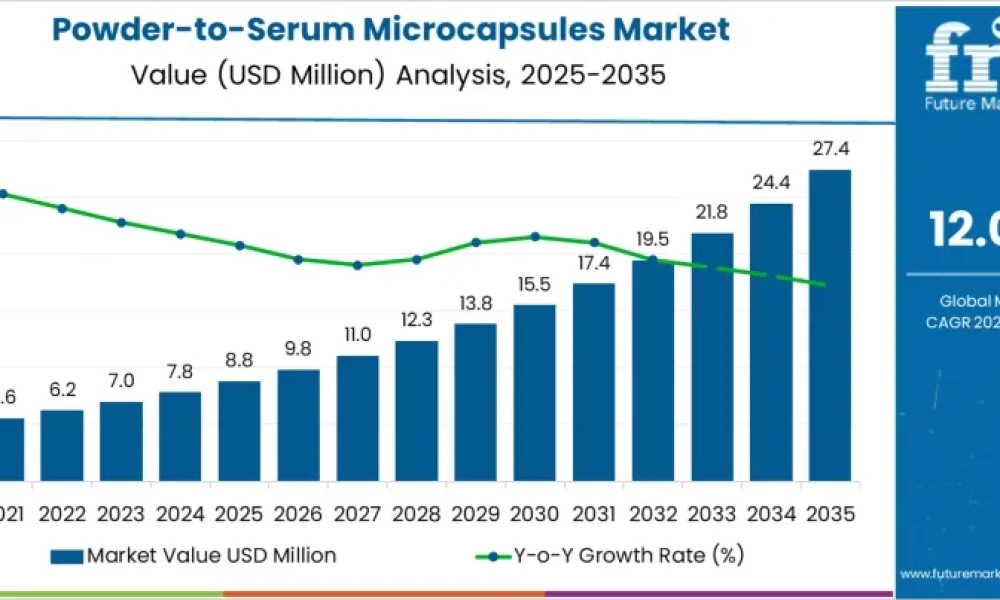
The global Powder-to-Serum Microcapsules Market is entering a high-growth phase, driven by rising consumer demand for advanced, high-performance skincare formulations. Valued at USD 8.8 million in 2025, the market is forecast to reach USD 27.4 million by 2035, registering a robust CAGR of 12.0% over the forecast period. This expansion represents an absolute growth opportunity of USD 18.6 million, with the market expected to grow nearly 3.1 times by 2035.
Powder-to-serum microcapsule technology is gaining rapid adoption across premium and professional skincare brands due to its ability to protect sensitive active ingredients, enable controlled release, and deliver superior efficacy at the point of use. Both established global manufacturers and emerging innovators are actively investing in this space to expand their product portfolios, enter new markets, and develop next-generation encapsulation technologies.
Subscribe for Year-Round Insights → Stay ahead with quarterly and annual data updates – https://www.futuremarketinsights.com/reports/sample/rep-gb-29377
Market Outlook and Growth Forecast (2025–2035)
- Market Size 2025: USD 8.8 million
- Market Size 2035: USD 27.4 million
- Forecast CAGR: 12.0%
- Key Growth Regions: Asia Pacific, Europe, North America
Between 2025 and 2030, the market is expected to grow to USD 13.8 million, supported by increasing demand for stable, non-invasive skincare solutions. From 2030 to 2035, the market will add USD 13.6 million, accounting for more than 53% of total forecast growth, fueled by technological innovation and personalized beauty trends.
Why the Powder-to-Serum Microcapsules Market Is Growing
- Rising demand for fresh, on-demand activated skincare formulations
- Increasing adoption of microencapsulation technology to protect antioxidants, vitamins, peptides, and actives
- Growing preference for clean beauty and personalized skincare
- Expansion of premium, dermocosmetic, and professional skincare brands
- Advancements in polymer-based and liposomal encapsulation systems
Despite challenges such as higher production costs and regulatory complexity, continuous R&D investments and collaboration between ingredient suppliers and cosmetic manufacturers are expected to sustain long-term market growth.
Key Market Trends Shaping the Industry
- Personalized skincare solutions tailored for anti-aging, acne, hydration, and skin rejuvenation
- Powder-to-liquid activation formats ensuring ingredient freshness and potency
- Development of sustainable and low-waste packaging solutions
- Integration of high-precision delivery systems for improved skin penetration
- Growing focus on clinical validation and regulatory compliance
Market Segmentation Highlights
By End Use Application:
- Skin Care
- Body Care
- Hair Care
- Sun Care
- Color Cosmetics
- Men’s Grooming
- Baby & Kids Care
- Dermocosmetic / Professional Care
Skin care leads with an 8.3% share, driven by demand for advanced serums, moisturizers, and toners.
By Product Form:
- Powder
- Granules / Agglomerates
- Flakes
- Pellets / Prills
- Liquid (Solution)
- High-Active Liquid Concentrates
- Dispersions / Suspensions
- Emulsions
- Pastes
- Gels
- Wax / Solid Blocks
- Oils
Powder form dominates with a 17.5% share due to superior stability, ease of handling, and global logistics advantages.
By Region:
- Asia Pacific
- Europe
- North America
- Latin America
- Middle East & Africa
- Eastern Europe
Country-Level Growth Outlook
- India: 16.2% CAGR – Fastest-growing market driven by urbanization, e-commerce, and premium skincare adoption
- China: 15.1% CAGR – Strong demand from beauty-conscious middle-class consumers
- Japan: 13.8% CAGR – High preference for science-backed, anti-aging skincare
- UK: 12.6% CAGR – Rising interest in personalized and clean beauty solutions
- Germany: 11.4% CAGR – Focus on high-efficacy, regulated skincare innovations
- USA: 10.2% CAGR – Steady demand for advanced and customizable skincare technologies
Competitive Landscape: Established Leaders and Emerging Innovators
The market features a mix of global leaders and specialized players focusing on innovation and expansion. Key companies profiled in the report include:
- BASF SE
- Croda International
- Evonik Industries
- Symrise (including IFF/Givaudan actives)
- Dow Inc.
- Ashland
- Clariant
- Seppic
These companies are leveraging proprietary microencapsulation platforms, expanding regional manufacturing capabilities, and forming strategic partnerships with skincare brands. At the same time, new and mid-sized manufacturers are entering the market with customized, niche-focused solutions, accelerating technology adoption and competition.
Future Outlook
With consumers increasingly prioritizing efficacy, freshness, and customization, the Powder-to-Serum Microcapsules Market is poised for sustained growth through 2035. As established players scale production and emerging manufacturers introduce innovative formulations, this technology is set to become a cornerstone of next-generation skincare and cosmetic products worldwide.
Have a specific Requirements and Need Assistant on Report Pricing or Limited Budget please contact us – [email protected]
About Future Market Insights (FMI)
Future Market Insights, Inc. (FMI) is an ESOMAR-certified, ISO 9001:2015 market research and consulting organization, trusted by Fortune 500 clients and global enterprises. With operations in the U.S., UK, India, and Dubai, FMI provides data-backed insights and strategic intelligence across 30+ industries and 1200 markets worldwide.



