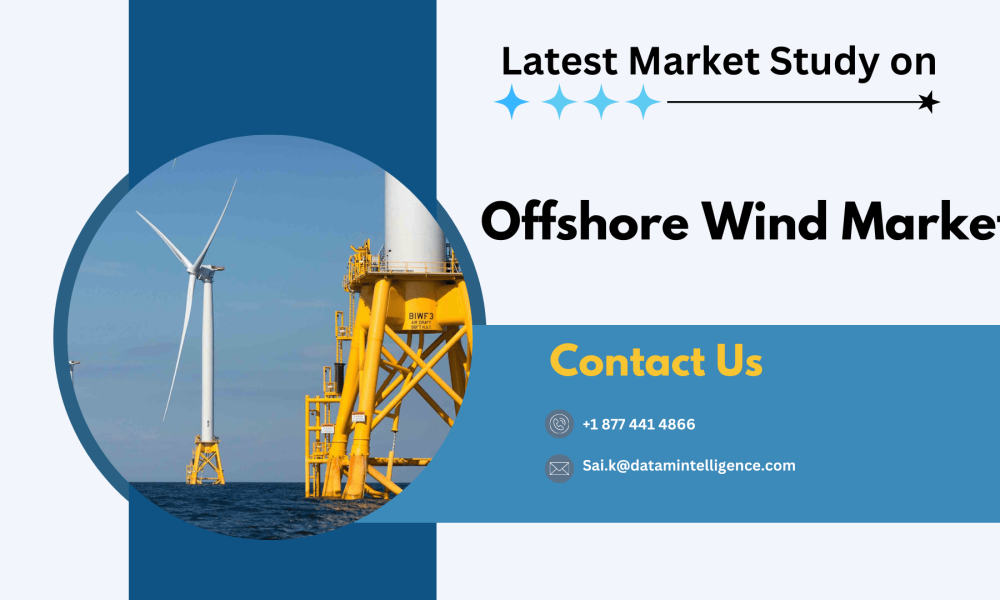
Latest Market Study on Offshore Wind Market
The Global Offshore Wind Market size is growing at a Significant CAGR during the forecast period (2024-2031).
Offshore Wind Market refers to the sector focused on the development and operation of wind farms located in bodies of water, typically off coastlines, to harness wind energy for electricity generation. Offshore wind turbines are often positioned in areas with stronger and more consistent wind resources, making them a powerful alternative to traditional energy sources.
The offshore wind industry has gained significant traction as a renewable energy solution, driven by the global shift towards sustainable energy sources. These projects have the potential to power millions of homes, reduce carbon emissions, and support energy diversification. Key drivers for market growth include advancements in turbine technology, supportive government policies, and a growing demand for clean energy. As more countries commit to decarbonizing their energy systems, the offshore wind market is poised for substantial growth in the coming years.
Download Free Sample PDF: https://www.datamintelligence.com/download-sample/offshore-wind-market
Market Growth Drivers:
Increasing global investment in renewable energy
The growing need to reduce carbon emissions, coupled with the rising demand for energy in developing countries, is driving the global push for renewable energy. To meet the targets set by the COP26 Glasgow Agreement, the share of renewables in global energy generation must increase from 25% to 86% by 2050, as per the International Renewable Energy Agency (IRENA).
To reach these ambitious goals, global investments in renewable energy will need to surge to US$ 2.5 trillion by 2050, up from an earlier estimate of US$ 1.2 trillion. As combating climate change becomes more critical, there will be a significant transition from fossil fuels to renewable energy. IRENA forecasts that US$ 3.3 trillion will be spent on new power generation assets between 2019 and 2050, with an expected 15,145 GW of carbon-free capacity. If these trends continue, wind and solar could provide half of the world’s electricity by 2050.
High capital costs and logistical issues associated with offshore wind
Offshore wind energy is widely regarded as one of the most promising and environmentally friendly energy sources. While it boasts a high capacity factor compared to other renewable energy sources like solar and onshore wind, its high upfront capital costs can make it challenging to deploy. Offshore wind turbines, which operate in harsh marine environments, are also vulnerable to erosion over time. Even favorable factors, like strong wind speeds, can sometimes work against offshore wind farms. For example, when wind speeds exceed 25 m/s, turbines typically shut down to prevent damage.
As offshore wind farms continue to grow in size, the challenges related to construction, transportation, installation, and operation have become more complex. These wind farms are often located far offshore, making them hard to access, especially during poor weather conditions. Consequently, even minor technical issues can be costly and difficult to address, adding to the logistical challenges faced by the industry.
Market Segments:
- By Component: Turbines, Electrical Infrastructure, Substructure, Others
- By Location: Shallow Water, Transitional Water, Deep Water
- By Region: North America, Latin America, Europe, Asia Pacific, Middle East and Africa
Top Key Players:
- Vestas Wind Systems A/S
- General Electric
- ABB
- GoldWind
- Nordex SE
- EEW Group
- Nexans
- Doosan Heavy Industries & Construction
- Siemens Gamesa Renewable Energy, S.A.
- Shanghai Electric Power Generation Equipment Co., Ltd
Customize Your Scope: https://www.datamintelligence.com/customize/offshore-wind-market
Regional Growth
Europe is at the forefront of the global offshore wind market, holding the largest market share due to significant investments in renewable energy and numerous major offshore wind projects underway. The region’s geography is highly advantageous for offshore wind generation, with shallow waters along the northern coastline and strong winds from the North Sea creating ideal conditions for energy production.
The European Commission (EC) is committed to boosting offshore wind capacity, investing nearly US$ 800 billion by 2050 to expand from the current 12GW to over 300GW. Key offshore wind projects are under construction in countries like Denmark, Norway, the UK, and Sweden. Notably, the Hornsea Project One in the UK is the largest offshore wind project currently in operation, with a capacity exceeding 1200 MW. More than 50 offshore wind projects are already operational in the Baltic and North Seas, and Europe is expected to maintain its leadership in the global offshore wind market for years to come.
Key Development
In March 2022, Vestas Wind Systems A/S secured a contract with a consortium consisting of Marhult Vind AB, Octopus Renewables, and OX2 to develop a 32 MW offshore wind farm for the Uppvidinge municipality in Växjö, Sweden. The agreement includes the construction and maintenance of seven 4.5 MW turbines. Construction is slated to begin in early 2022.




