
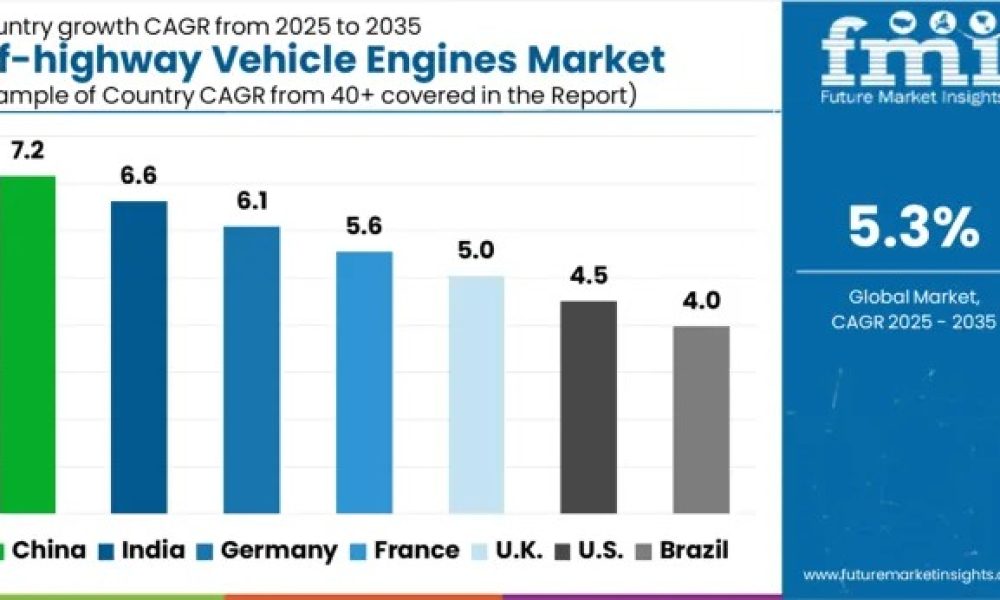
The global off-highway vehicle engines market is entering a decisive decade of structural expansion, projected to grow from USD 30.1 billion in 2025 to USD 50.5 billion by 2035, registering a compound annual growth rate (CAGR) of 5.3%. This growth trajectory reflects the transition of off-highway engines from selective deployment toward standardized integration across construction, agriculture, mining, and forestry equipment worldwide.
The market’s evolution is being shaped by infrastructure investment cycles, rising mechanization, replacement of aging equipment fleets, and ongoing advances in engine performance, durability, and emissions compliance. By 2035, off-highway vehicle engines are expected to represent a mature and stable segment within the global heavy equipment ecosystem, characterized by predictable demand and optimized production frameworks.
Market Evolution: From Early Adoption to Consolidation
Between 2020 and 2024, the off-highway vehicle engines market experienced gradual growth, as manufacturers focused on validating engine reliability and compatibility across niche applications. Adoption during this phase remained selective, largely concentrated in construction, agriculture, and mining equipment requiring proven durability under extreme operating conditions.
A clear inflection point emerges in 2025, when the market reaches USD 30.1 billion. This milestone marks the beginning of the scaling phase, defined by broader commercial adoption, rising production capacity, and geographic expansion across North America, Asia-Pacific, and Europe. From 2025 to 2030, market value is expected to climb steadily to approximately USD 37–39 billion, supported by expanding supply chains and growing confidence among OEMs and end-users.
A second breakpoint occurs between 2030 and 2032, as the market approaches USD 43–45 billion. During this period, growth moderates and the industry enters a consolidation phase, with major manufacturers strengthening their market positions and after-sales service networks becoming more standardized. By 2035, the market reaches USD 50.5 billion, reflecting full consolidation, mature logistics, and stable long-term demand patterns.
Get access to comprehensive data tables and detailed market insights — request your sample report today!
Demand Fundamentals Supporting Market Growth
Growth in the off-highway vehicle engines market is underpinned by rising global investment in infrastructure development, expanding mining operations, and increasing mechanization of agriculture. These sectors require engines capable of delivering high torque, fuel efficiency, and durability while operating continuously in harsh and variable environments.
Technological advancements are reinforcing adoption. Improvements in electronic engine controls, turbocharging, and fuel injection systems have enhanced performance while enabling compliance with increasingly stringent emission regulations. Replacement demand in developed markets, combined with new equipment deployment in emerging economies, continues to sustain momentum.
At the same time, manufacturers are investing in hybrid powertrains and alternative fuel technologies, positioning the market for long-term evolution as regulatory frameworks and sustainability priorities advance.
Key Market Metrics at a Glance
- Market Value (2025): USD 30.1 billion
- Forecast Value (2035): USD 50.5 billion
- Forecast CAGR (2025–2035): 5.3%
- Leading Power Segment: 101–200 HP (38% share)
- Dominant Fuel Type: Diesel (89.7% share)
- Largest Application: Construction equipment (45% share)
- Key Regions: North America, Asia-Pacific, Europe
Segment Insights Highlight Structural Demand Patterns
The 101–200 horsepower (HP) segment is projected to account for 38% of market revenue in 2025, making it the leading power output category. Engines in this range offer an optimal balance between power, fuel efficiency, and operating cost, making them suitable for a broad range of mid-sized construction, agricultural, and mining equipment. Advancements in torque delivery and extended service intervals continue to reinforce adoption in high-utilization environments.
From a fuel perspective, diesel engines dominate with nearly 90% market share, reflecting their superior torque characteristics, durability, and global fuel infrastructure availability. Continuous improvements in exhaust after-treatment and combustion efficiency have allowed diesel engines to remain compliant with evolving emission standards while retaining operational advantages.
By application, construction equipment leads with 45% share, driven by global urbanization, road development, and industrial construction activity. Integration of engines with telematics and monitoring systems is improving equipment productivity and lifecycle management, further supporting demand.
Regional Performance Highlights
The market demonstrates varied regional growth dynamics. China (7.2% CAGR) and India (6.6%) lead expansion among BRICS economies, supported by infrastructure projects, agricultural mechanization, and industrial modernization. In OECD markets, Germany (6.1%) maintains steady growth driven by industrial and construction activity, while the United States (4.5%) reflects mature but consistent demand across agriculture, mining, and construction sectors.
Across regions, adoption is increasingly influenced by emission regulations, lifecycle cost considerations, and the availability of advanced service and maintenance infrastructure.
Drive Your Business Growth Strategy: Checkout the Report for Key Insights
Competitive Landscape and Industry Positioning
The off-highway vehicle engines market remains highly competitive, led by established manufacturers including Cummins, Caterpillar, John Deere Power Systems, Kubota, Volvo Penta, Yanmar, and FPT Industrial, alongside regional players such as Weichai, Deutz, Isuzu, and Mahindra. Competitive differentiation centers on engine reliability, emissions compliance, power density, and integration flexibility across diverse equipment platforms.
As the market advances toward consolidation, manufacturers with broad product portfolios, strong OEM relationships, and investment in hybrid and low-emission technologies are best positioned to capture long-term value.
Outlook
With infrastructure expansion, mechanization, and regulatory transformation shaping demand, the off-highway vehicle engines market is transitioning into a phase of stable, predictable growth. While technical complexity and compliance costs remain challenges, continued innovation and supply chain optimization are expected to reinforce the market’s role as a foundational component of global heavy equipment and industrial operations through 2035.
Why Choose FMI: Empowering Decisions that Drive Real-World Outcomes: https://www.futuremarketinsights.com/why-fmi
About Future Market Insights (FMI)
Future Market Insights, Inc. (FMI) is an ESOMAR-certified, ISO 9001:2015 market research and consulting organization, trusted by Fortune 500 clients and global enterprises. With operations in the U.S., UK, India, and Dubai, FMI provides data-backed insights and strategic intelligence across 30+ industries and 1200 markets worldwide.



