
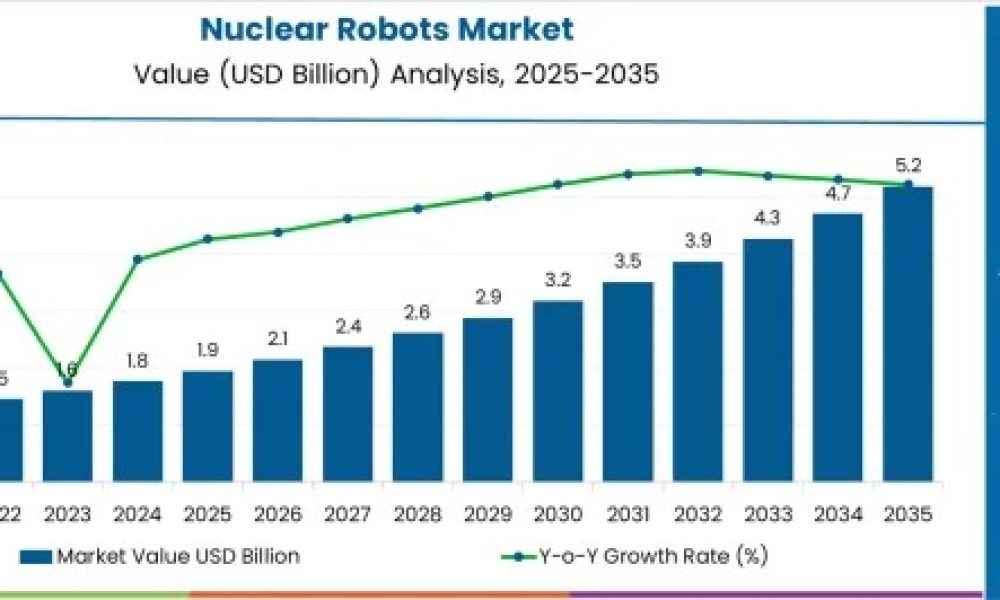
The Nuclear Robots Market is entering a decisive growth phase as global nuclear operators intensify investments in automation, worker safety, and long-term infrastructure resilience. Valued at USD 1.9 billion in 2025, the market is projected to reach USD 5.2 billion by 2035, expanding at a robust CAGR of 10.3%. This growth reflects the rising reliance on robots to perform inspection, maintenance, decommissioning, and waste-handling tasks in environments where human exposure is increasingly restricted.
Market expansion from USD 1.2 billion in 2021 to USD 1.9 billion in 2025 has been shaped by heightened safety regulations and the urgent need to manage aging nuclear assets. Remote-controlled and radiation-hardened robots are now central to operational continuity, particularly as decommissioning programs accelerate across North America, Europe, and parts of Asia-Pacific.
Subscribe for Year-Round Insights → Stay ahead with quarterly and annual data updates
Market Momentum Driven by Safety-Critical Automation
The nuclear sector remains the single largest contributor, accounting for roughly 40–45% of overall demand. Operators increasingly deploy robots for reactor inspection, structural maintenance, and dismantling activities, minimizing worker exposure to radiation while improving task precision.
Key growth contributors include:
- Rising decommissioning of legacy nuclear plants across developed economies
- Stricter global safety and radiation compliance standards
- Cost and risk reduction through remote and autonomous operations
Between 2026 and 2030, the market is expected to strengthen from USD 1.9 billion to USD 3.5 billion, supported by consistent annual gains and expanding use cases beyond power generation into defense, research, and industrial waste management.
Technology Advancements Reshaping Capabilities
Technological progress is redefining what nuclear robots can achieve. AI-driven navigation, enhanced dexterity, and radiation-resistant materials have significantly improved performance in hostile environments. Modern systems now support real-time monitoring, precision repairs, and autonomous diagnostics—functions that were previously impossible without human intervention.
Key technology trends include:
- AI-enabled automation for real-time decision-making
- Improved battery efficiency and long-duration operation
- Advanced sensors for radiation mapping and structural analysis
From 2031 to 2035, demand is expected to remain strong as facility upgrades, safety modernization, and environmental monitoring initiatives continue to expand globally.
Remote Manipulators Lead by Type
Remote manipulators represent the leading segment, accounting for approximately 31.6% of the market in 2025. Their dominance stems from their ability to execute complex, high-precision tasks in high-radiation zones where human presence is unsafe.
Segment strengths include:
- High dexterity for assembly, inspection, and maintenance
- Integration with teleoperation and secure control interfaces
- Reliability under extreme radiation and temperature conditions
These systems are widely used in both operational reactors and decommissioning sites, ensuring sustained demand through the forecast period.
Nuclear Waste Handling Emerges as Priority End Use
Nuclear waste handling is the largest end-use segment, holding an estimated 27.9% market share. Growing volumes of radioactive waste from power generation, medical applications, and research facilities are driving adoption of robotic solutions that ensure compliance with long-term environmental and safety mandates.
Growth drivers include:
- Automated sorting, packaging, and disposal of radioactive materials
- Reduced human exposure and lower operational risk
- Government-backed initiatives for sustainable waste management
As countries intensify oversight of nuclear waste containment, this segment is expected to remain a core investment focus.
Regional Growth Highlights
Asia-Pacific is emerging as a high-growth region, led by China and India. China is forecast to grow at a CAGR of 13.9%, driven by rapid nuclear capacity expansion and strong government support for industrial robotics. India follows at 12.9%, supported by clean energy goals and infrastructure modernization.
Europe remains a critical market, with Germany (11.8% CAGR), France, and the UK emphasizing robotic solutions for inspection, monitoring, and decommissioning. North America continues steady growth, underpinned by safety upgrades and investments from the U.S. Department of Energy.
Competitive Landscape Focused on Precision and Reliability
Competition in the nuclear robots market centers on performance in extreme conditions. Industry leaders such as Areva (Orano), Boston Dynamics, Hitachi, James Fisher Technologies, KUKA AG, Mitsubishi Heavy Industries, and QinetiQ are differentiating through mobility, AI integration, and radiation-hardened designs.
Strategic priorities across the competitive landscape include:
- Advanced sensing and autonomous control systems
- Long-duration operation in high-radiation environments
- Seamless integration with existing nuclear infrastructure
Get data that aligns with your strategic priorities — ask for report customization today:
Have a specific Requirements and Need Assistant on Report Pricing or Limited Budget please contact us – [email protected]
About Future Market Insights (FMI)
Future Market Insights, Inc. (FMI) is an ESOMAR-certified, ISO 9001:2015 market research and consulting organization, trusted by Fortune 500 clients and global enterprises. With operations in the U.S., UK, India, and Dubai, FMI provides data-backed insights and strategic intelligence across 30+ industries and 1200 markets worldwide.
Contact Us:
Future Market Insights Inc.
Christiana Corporate, 200 Continental Drive,
Suite 401, Newark, Delaware – 19713, USA
T: +1-347-918-3531



