
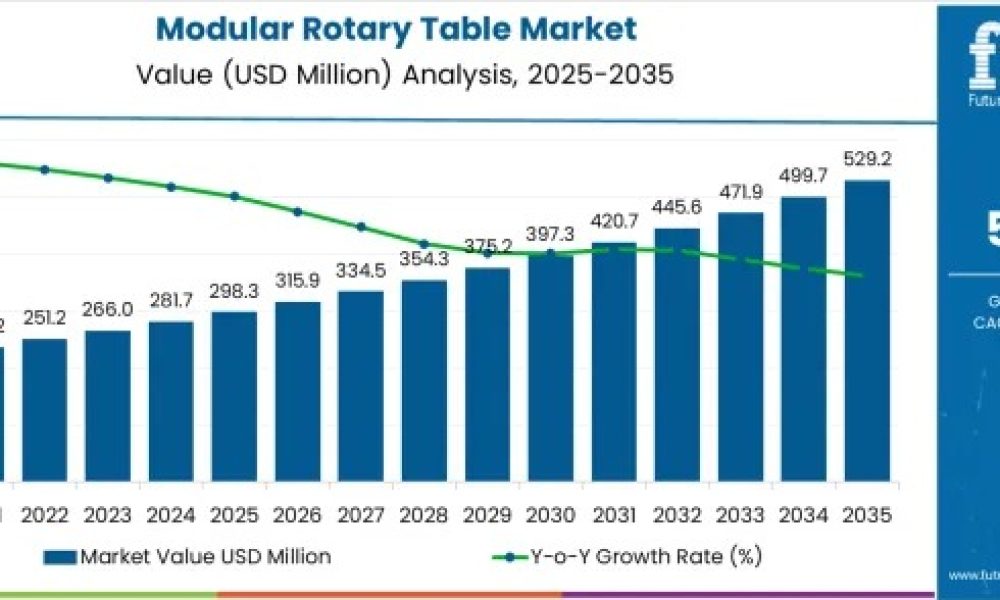
The Modular Rotary Table Market is entering a decisive growth phase as manufacturers worldwide prioritize precision, flexibility, and automation. Valued at USD 298.3 million in 2025, the market is projected to reach USD 529.2 million by 2035, reflecting a steady CAGR of 5.9%. This nearly 1.8x expansion underscores how modular rotary tables have evolved into mission-critical components across CNC machining centers, semiconductor manufacturing, robotics, and advanced industrial automation.
Growth is fundamentally tied to rising multi-axis machining demand, deeper penetration of Industry 4.0 practices, and the global push for productivity gains with minimal downtime. While high initial investment and technical integration complexity remain constraints, the long-term value proposition—precision, repeatability, and manufacturing agility—continues to outweigh these challenges.
Subscribe for Year-Round Insights → Stay ahead with quarterly and annual data updates
Growth Trajectory: Two Distinct Phases
Between 2025 and 2030, the market is expected to expand to USD 397.3 million, accounting for nearly 43% of total forecast growth. This phase is driven by accelerated automation in automotive and aerospace manufacturing, alongside product innovation in electric drive systems.
From 2030 to 2035, growth intensifies, adding USD 131.9 million in value. This period will be shaped by Industry 4.0–integrated rotary tables, multi-axis systems, and smart platforms designed for mass customization and flexible manufacturing cells.
Why the Modular Rotary Table Market Is Growing
The market’s momentum reflects clear manufacturing outcomes rather than abstract technology adoption. Modular rotary tables enable:
- Higher machining flexibility, allowing complex geometries to be completed in single setups
- Improved throughput and accuracy, critical for aerospace, medical, and semiconductor components
- Automation-ready architectures, supporting lights-out and unmanned production environments
China and India stand out as high-growth regions due to expanding manufacturing capacity and aggressive automation investments, while Germany, the U.S., and Japan sustain demand through advanced precision engineering ecosystems.
Opportunity Pathways Unlocking Long-Term Value
The market’s technology-driven evolution opens multiple revenue pathways beyond baseline growth:
- CNC Machining Center Leadership: Multi-axis manufacturing remains the largest opportunity pool, driven by aerospace and automotive demand.
- Electric Drive System Dominance: Accounting for 58% of market share, electric drives lead due to superior precision, programmability, and CNC integration.
- China & India Expansion: With CAGRs of 8.0% and 7.4%, these markets represent the fastest scaling opportunities globally.
- Semiconductor Applications: Wafer handling and advanced packaging drive demand for ultra-precise rotary positioning.
- Industry 4.0 & Robotics Integration: Smart connectivity, predictive maintenance, and robotic cells redefine premium positioning solutions.
Collectively, these pathways could unlock USD 720–920 million in incremental revenue opportunities by 2035.
Segmental Insights: Where Demand Is Concentrated
Electric drive modular rotary tables, holding 58% share, dominate due to arc-second positioning accuracy, programmable control, and seamless CNC integration. These systems are indispensable in aerospace, medical device manufacturing, and high-precision machining environments.
By application, CNC machining centers account for 52% of demand. Manufacturers increasingly rely on integrated rotary tables to reduce setups, improve dimensional accuracy, and maximize machine utilization—particularly in aerospace turbine components, EV powertrain parts, and precision automotive components.
Regional Outlook: Asia Leads, Europe Anchors Precision
- China leads global growth with an 8.0% CAGR, fueled by industrial automation policies, EV manufacturing, and semiconductor self-sufficiency initiatives.
- India follows at 7.4%, supported by Make in India programs, automotive expansion, and growing aerospace manufacturing.
- Germany maintains Europe’s leadership at 6.8%, leveraging its machine tool expertise and Industry 4.0 adoption.
- United States grows steadily at 5.6%, driven by reshoring, aerospace demand, and medical device manufacturing.
Competitive Landscape: Innovation Over Price
The market remains fragmented yet competitive, with the top five players controlling nearly half of global share. Companies such as Haas, HIWIN, and NORELEM compete through precision engineering, modular flexibility, and strong application support rather than price alone. Strategic partnerships with machine tool OEMs and automation integrators increasingly define competitive advantage.
Strategic Takeaway
The modular rotary table market is no longer optional infrastructure—it is a strategic asset for manufacturers navigating complexity, customization, and automation. As precision requirements tighten and production flexibility becomes non-negotiable, rotary positioning systems will sit at the heart of competitive manufacturing strategies.
Get data that aligns with your strategic priorities — ask for report customization today:
Have a specific Requirements and Need Assistant on Report Pricing or Limited Budget please contact us – [email protected]
About Future Market Insights (FMI)
Future Market Insights, Inc. (FMI) is an ESOMAR-certified, ISO 9001:2015 market research and consulting organization, trusted by Fortune 500 clients and global enterprises. With operations in the U.S., UK, India, and Dubai, FMI provides data-backed insights and strategic intelligence across 30+ industries and 1200 markets worldwide.
Contact Us:
Future Market Insights Inc.
Christiana Corporate, 200 Continental Drive,
Suite 401, Newark, Delaware – 19713, USA
T: +1-347-918-3531



