
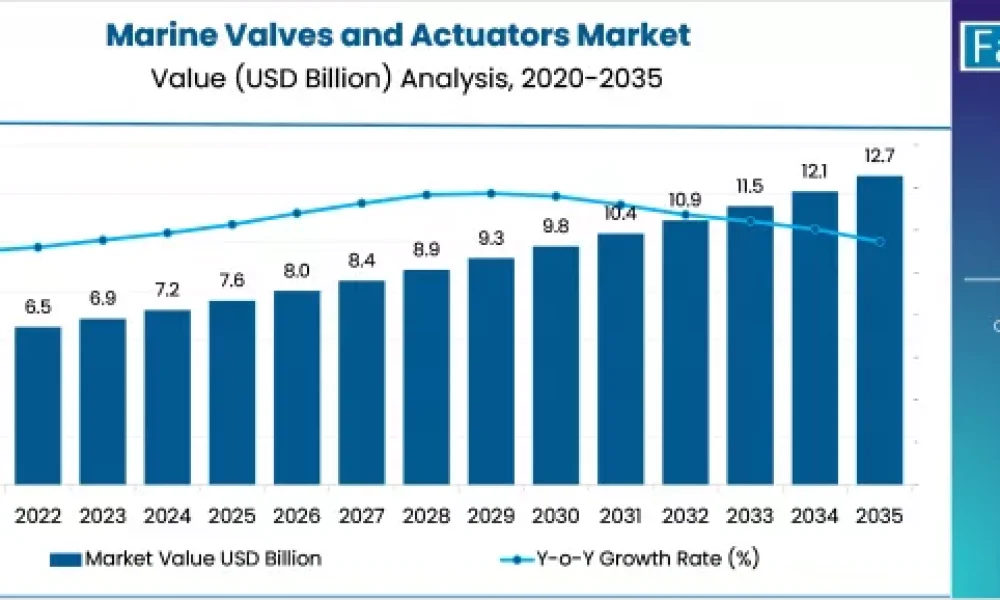
Global Marine Valves and Actuators Market Set for Decade of Digital Transformation; Forecast to Reach USD 7.87 Billion by 2036
The global maritime industry is entering a pivotal era of modernization as the Marine Valves and Actuators Market prepares for a projected expansion to USD 7.87 billion by 2036. Driven by a surge in autonomous vessel technology, stringent decarbonization mandates, and a 15% increase in global seaborne services trade, the market is transitioning from traditional mechanical hardware to smart integrated flow control systems.
Addressing the Maritime Shift: Who, What, When, and Why
As of early 2026, the maritime sector is navigating a complex landscape of regulatory compliance and operational efficiency.
Who: Key industry leaders—including Emerson Electric Co., Flowserve Corporation, Moog Inc., and Honeywell International—are spearheading the shift toward electrified and AI-enabled hardware.
What: The market encompasses high-precision valves (ball, butterfly, and check) and actuation mechanisms (pneumatic, hydraulic, and increasingly, electric) essential for propulsion, ballast water management, and fuel systems.
When: The forecast period of 2026-2036 marks a decade of rapid retrofitting and new-build construction, as operators race to meet International Maritime Organization (IMO) Tier III standards.
Where: While Europe currently holds a dominant 34.5% market share, the Asia-Pacific region—led by shipbuilding powerhouses in China and South Korea—is projected to witness the highest growth rate due to expanding merchant fleets.
Why: The necessity for real-time monitoring to prevent costly downtime and the global push for energy-efficient green vessels are the primary catalysts for this multi-billion dollar evolution.
Request for Sample Report | Customize Report |purchase Full Report – https://www.factmr.com/connectus/sample?flag=S&rep_id=7294
The Digitalization of Flow Control: Key Market Drivers
The core of the 2026-2036 forecast rests on the integration of Industrial Internet of Things (IIoT). Traditional valves are being replaced by sensor-equipped assemblies that feed performance data directly into shipboard automation platforms.
1. Electrification and Power Efficiency
Electric actuators are rapidly gaining ground, projected to grow at a 5.45% CAGR. Unlike legacy hydraulic systems, electric variants offer leak-free operation and consume significantly less power—a critical factor for the emerging fleet of hybrid and fully electric short-sea vessels.
2. Regulatory Compliance and Ballast Management
With the enforcement of the Ballast Water Management Convention, nearly 65% of new installations are now linked to essential environmental systems. Advanced valves featuring corrosion-resistant alloys (such as stainless steel and specialized aluminum) are becoming the industry standard to withstand the harsh saline environments of modern ballast treatment.
3. Predictive Maintenance via AI
Industry data indicates that approximately 40% of new marine actuators now feature connectivity options. These Smart Valves allow operators to transition from reactive repairs to predictive maintenance, identifying seat wear or actuator stalling before it leads to system failure.
Market Segmentation and Regional Outlook
| Segment | Leading Category | Projected Trend (2026-2036) |
| Valve Type | Quarter-turn (Ball/Butterfly) | Highest demand for compact, high-flow applications. |
| Actuator Type | Rotary Actuators | Preferred for high torque-to-weight ratios in tight engine rooms. |
| Material | Stainless Steel | Dominant due to superior corrosion resistance and durability. |
| End-User | OEM (New Shipbuilding) | Growth fueled by naval modernization and LNG carrier demand. |
Asia-Pacific is positioned as the primary engine of volume, supported by the world’s busiest shipping routes. Meanwhile, North America remains a hub for high-value naval defense contracts, focusing on specialized, Jones Act compliant valve components for military and offshore support vessels.
Overcoming Industry Challenges
Despite the robust outlook, the market faces headwinds from material cost volatility—particularly in stainless steel and special alloys—and the high capital expenditure required for automated retrofits. Smaller fleet operators continue to face a modernization gap, though modular valve architectures are beginning to lower the barrier to entry by streamlining field servicing.
The Decisive Decade Ahead
The 2026-2036 period will be defined by the smartening of the maritime infrastructure. As global navies prioritize advanced stealth and autonomous vessels, and commercial operators focus on the Blue Economy, the humble marine valve has evolved into a sophisticated data point in the global supply chain.
About the Industry Report This press release is based on current market intelligence regarding the Global Marine Valves and Actuators sector, highlighting the intersection of traditional heavy engineering and modern digital automation.
Related Reports
Marine Loading Arms Market
Marine Bunker Ultra-Low Carbon Methanol Market
Marine Propulsion Low-Carbon Ammonia Market
Marine Fender Industry Analysis in the USA
“



