
Definition
The Live IP Broadcast Equipment market refers to the ecosystem of tools, devices, and platforms that enable real-time audio and video transmission using Internet Protocol (IP) networks rather than traditional Serial Digital Interface (SDI) systems. This next-generation broadcasting infrastructure is transforming the media and entertainment industry by offering flexible, scalable, and cost-efficient solutions for live production, content distribution, and remote collaboration.
Key components of live IP broadcast systems include:
- Broadcast Switchers: Critical to managing real-time video production workflows, including production switchers, routing switchers, and master control switchers.
- IP Routers and Network Interfaces: Facilitate seamless connectivity and content routing across IP networks.
- Encoders and Decoders: Convert video signals for IP-based transport while ensuring ultra-low latency.
- Media Servers: Provide high-capacity content storage and delivery optimized for live streaming.
The adoption of live IP broadcast equipment is driven by the growing demand for 4K, 8K, and HDR content, as well as the shift toward cloud-based and remote production models. By leveraging IP networks, broadcasters can reduce costs, enhance flexibility, and distribute content across multiple platforms simultaneously.
Recent Developments in the Live IP Broadcast Equipment Market
The live IP broadcast equipment market is undergoing a rapid transformation driven by the shift from traditional SDI-based systems to more flexible, scalable, and cost-efficient IP workflows. A major development is the widespread adoption of remote production solutions, which allow broadcasters to produce live content from virtually anywhere, significantly reducing the need for large on-site crews and equipment. The integration of advanced technologies like 5G, artificial intelligence (AI), and machine learning (ML) is also a key trend, enabling ultra-low latency, automated camera control, and enhanced content delivery. As the demand for ultra-high-definition (UHD) and 4K/8K content grows, manufacturers are focusing on developing equipment that can handle these high-resolution formats efficiently. Cloud-based broadcasting is also gaining momentum, offering broadcasters greater agility, scalability, and security to meet the demands of an increasingly digital-first audience.
Major Distribution Channels
The distribution of live IP broadcast equipment is primarily conducted through a specialized network of channels that cater to the unique needs of the professional broadcasting industry. A significant portion of sales occurs through direct channels from major manufacturers, who often work closely with broadcasters and production houses to design and implement custom IP-based solutions. Another critical channel is through professional systems integrators and value-added resellers (VARs). These partners provide not only the equipment but also the expertise in complex system design, installation, and post-sale support. Additionally, with the rise of smaller-scale productions, online sales platforms and specialized B2B marketplaces are becoming more common for a range of products, particularly for accessory equipment and more standardized components. This multi-channel approach ensures that solutions are available for a wide range of customers, from major television networks to independent content creators.
Market Size
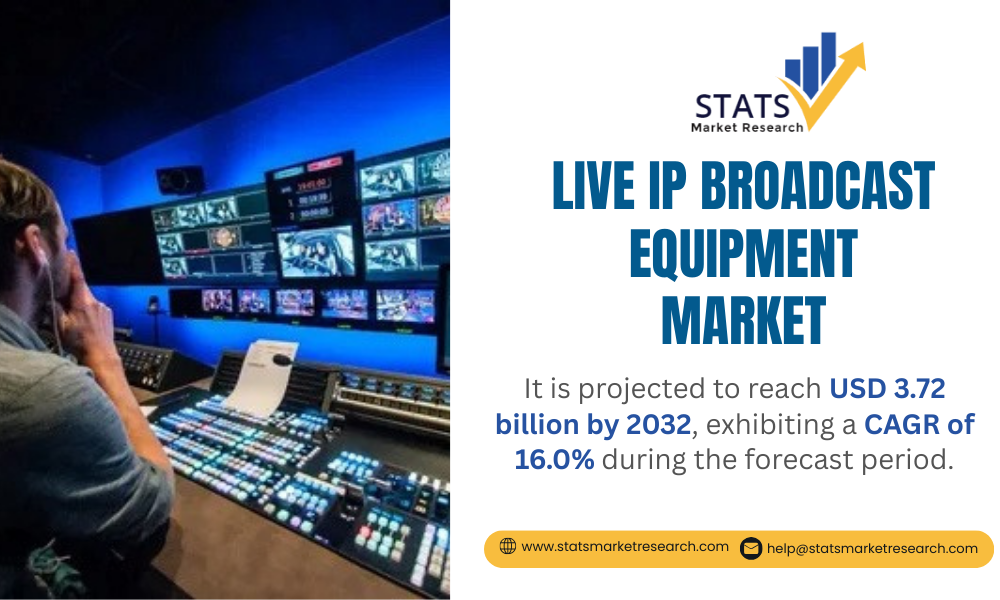
Global Live IP Broadcast Equipment market was valued at USD 1.34 billion in 2024 and is projected to grow from USD 1.56 billion in 2025 to USD 3.72 billion by 2032, registering a CAGR of 16.0% during the forecast period.
- Segment Performance:
- Broadcast Switchers hold the largest share (45%) due to their vital role in real-time content switching.
- IP routers and encoders/decoders are experiencing strong demand fueled by remote production workflows.
- Application Trends:
- Live sports streaming and news broadcasting represented 60% of total IP broadcast deployments in 2024.
- Increasing adoption in corporate, education, and eSports is expanding the addressable market.
- Regional Highlights:
- North America dominates with a 35% market share, driven by early adoption of SMPTE ST 2110 standards.
- Europe and China together account for nearly 40% of global revenue, fueled by strong investments in next-generation broadcasting.
Notably, in 2024, Sony launched IP extension modules supporting 8K HDR workflows, reflecting industry momentum towards higher resolution and immersive broadcasting standards.
Download FREE Sample of this Report @ https://www.statsmarketresearch.com/download-free-sample/8058168/global-live-ip-broadcast-equipment-forecast-market
Market Dynamics (Drivers, Restraints, Opportunities, and Challenges)
Drivers
- Rapid Growth of OTT Platforms & Live Streaming: OTT platforms have witnessed a 65% increase in live-stream viewership in the past three years, fueling demand for IP-based workflows that support multi-platform distribution.
- Adoption of 5G and Cloud Production: 5G enables ultra-low latency and high-bandwidth remote production, while cloud workflows reduce dependency on expensive OB vans.
- High-Quality Broadcasting Needs: The growing shift towards 4K, HDR, and 8K production requires advanced IP infrastructure.
Restraints
- High Implementation Costs: Transitioning from SDI to IP requires capital expenditures exceeding $10 million for large facilities.
- Integration Challenges: Hybrid environments, vendor compatibility issues, and staff retraining hinder adoption.
- Standardization Gaps: Despite SMPTE ST 2110, interoperability between different vendor solutions remains a challenge.
Opportunities
- Emerging Markets: Countries in Asia-Pacific and Latin America are investing heavily in next-gen broadcast infrastructure.
- Niche Applications: eSports, houses of worship, and corporate broadcasting present high-growth potential.
- Affordable IP Equipment: Entry-level modular solutions are making IP broadcasting accessible to mid-tier broadcasters.
Challenges
- Network Security Risks: Increased reliance on public internet exposes broadcasters to cybersecurity threats.
- Bandwidth Limitations: High-resolution live production requires stable multi-gigabit networks, which remain unavailable in many regions.
- Skills Gap: Engineers trained in SDI require significant retraining to handle IP workflows.
Regional Analysis
- North America: Leads the market with 35% share, driven by major broadcasters, early adoption of SMPTE ST 2110, and a strong presence of global vendors like Cisco and Grass Valley.
- Europe: A strong contributor with advanced adoption of cloud-based broadcasting, particularly in Germany, the UK, and France.
- Asia-Pacific: Witnessing rapid adoption in China, Japan, and South Korea due to government-led media modernization programs.
- Latin America: Emerging market with growing investments in broadcast infrastructure for sports and entertainment.
- Middle East & Africa: Adoption is accelerating in the UAE and Saudi Arabia, driven by government-backed initiatives for digital transformation.
Competitor Analysis (in brief)
The Live IP Broadcast Equipment market is moderately consolidated, with the top five players holding around 35% of market share in 2024.
- Cisco Systems and Evertz Microsystems: Market leaders focusing on IP networking expertise and end-to-end broadcast infrastructure.
- Grass Valley & Imagine Communications: Strengthening presence with AI-driven automation and software-defined broadcast platforms.
- Belden & Arista Networks: Gaining traction in low-latency IP routing and network switching solutions.
- Sony and Ross Video: Expanding product portfolios with 4K/8K and HDR-compatible IP production tools.
Strategic moves include partnerships with Tier-1 broadcasters, R&D investments in AI automation, and hybrid IP/SDI solutions for phased adoption.
Global Live IP Broadcast Equipment Market: Market Segmentation Analysis
This report provides a deep insight into the global Live IP Broadcast Equipment market, covering all its essential aspects. This ranges from a macro overview of the market to micro details of the market size, competitive landscape, development trend, niche market, key market drivers and challenges, SWOT analysis, value chain analysis, etc.
The analysis helps the reader to shape the competition within the industries and strategies for the competitive environment to enhance the potential profit. Furthermore, it provides a simple framework for evaluating and assessing the position of the business organization. The report structure also focuses on the competitive landscape of the Global Live IP Broadcast Equipment market. This report introduces in detail the market share, market performance, product situation, operation situation, etc., of the main players, which helps the readers in the industry to identify the main competitors and deeply understand the competition pattern of the market.
In a word, this report is a must-read for industry players, investors, researchers, consultants, business strategists, and all those who have any kind of stake or are planning to foray into the Live IP Broadcast Equipment market in any manner.
Get the Complete Report & TOC @ https://www.statsmarketresearch.com/global-live-ip-broadcast-equipment-forecast-market-8058168
Market Segmentation (by Application)
- Broadcast Production Centers
- In-Stadium Broadcast
- Outside Broadcast Vans
- Others
- Includes Corporate Events and Educational Institutions
Market Segmentation (by Type)
- Broadcast Switcher
- Subtypes: Production Switchers, Routing Switchers, Master Control Switchers
- Switches and Servers
- Infrastructure
- Subtypes: Encoders, Decoders, Gateways, Network Interfaces
- Others
- Includes Cameras, Monitors, and Audio Equipment
Key Company
- Cisco Systems (U.S.)
- Ross Video (Canada)
- Belden (U.S.)
- Arista Networks (U.S.)
- Grass Valley (U.S.)
- NewTek (Vizrt) (Norway)
- Evertz Microsystems (Canada)
- Sony (Japan)
- Ikegami Tsushinki (Japan)
- ETL Systems (U.K.)
- LAWO (Germany)
- Imagine Communication (U.S.)
- Harmonic (U.S.)
Geographic Segmentation
- North America: USA, Canada, Mexico
- Europe: Germany, UK, France, Russia, Italy, Rest of Europe
- Asia-Pacific: China, Japan, South Korea, India, Southeast Asia, Rest of Asia-Pacific
- South America: Brazil, Argentina, Columbia, Rest of South America
- The Middle East and Africa: Saudi Arabia, UAE, Egypt, Nigeria, South Africa, Rest of MEA
FAQ
- What is the current market size of Live IP Broadcast Equipment?
The market was valued at USD 1.34 billion in 2024 and is projected to reach USD 3.72 billion by 2032, growing at a CAGR of 16.0%. - Which are the key companies operating in the Live IP Broadcast Equipment market?
Key players include Cisco Systems, Evertz Microsystems, Grass Valley, Sony, Ross Video, Arista Networks, and Imagine Communications. - What are the key growth drivers in the Live IP Broadcast Equipment market?
The main drivers include OTT growth, demand for live streaming, 5G rollout, cloud-based workflows, and higher resolution broadcasting (4K/8K HDR). - Which regions dominate the Live IP Broadcast Equipment market?
North America leads with a 35% market share, followed by Europe and Asia-Pacific as fast-growing regions. - What are the emerging trends in the Live IP Broadcast Equipment market?
Trends include AI-driven automation, hybrid IP/SDI migration, eSports production, and adoption of affordable IP solutions in education, corporate, and government sectors.
About Us
☎️ International: +1 (332) 2424 294
📄 Website: www.statsmarketresearch.com
Join us on LinkedIn:- https://www.linkedin.com/company/statsmarketresearch




