
Global Flour Market Projected to Surpass USD 187 Billion by 2036 Amid Shift Toward Fortified and Alternative Grain Solutions
The global flour market is entering a decade of significant structural transformation, with valuations projected to rise from USD 114.23 billion in 2026 to over USD 187 billion by 2036. This growth, characterized by a steady Compound Annual Growth Rate (CAGR) of approximately 4.0% to 4.7% depending on the segment, is being driven by a fundamental shift in consumer dietary patterns, rapid urbanization in emerging economies, and a technological overhaul of traditional milling infrastructure.
Request for Sample Report | Customize Report |purchase Full Report – https://www.factmr.com/connectus/sample?flag=S&rep_id=2248
Strategic Market Overview: The Decadal Outlook (2026–2036)
As of early 2026, the industry is moving beyond its status as a stable commodity sector. While wheat flour maintains its dominance—accounting for the majority of global consumption volume—the most aggressive growth is currently being recorded in the specialty and alternative flour segments.
Industry analysts identify five core pillars supporting this upward trajectory:
Urbanization and Convenience: Rising demand for ready-to-eat (RTE) and bakery products in the Asia-Pacific and Middle East regions.
Health & Functional Premiumization: A surge in the adoption of fortified, high-protein, and multi-grain flours (including ragi, oats, and quinoa).
Gluten-Free Innovation: Rapid expansion of the pulse and root-based flour markets, including chickpea, lentil, and potato flours.
Milling Digitization: The integration of AI, IoT sensors, and Near-Infrared (NIR) spectroscopy to optimize yield and ensure food safety.
Clean-Label Initiatives: Increasing consumer preference for organic, non-GMO, and minimally processed ingredients.
Regional Dynamics and Leadership
Asia-Pacific remains the world’s largest and fastest-growing market, holding a share of approximately 43%. China and India continue to lead production and consumption, fueled by a burgeoning middle class and expanding food processing capacities.
Conversely, North America and Europe are pivoting toward value-added products. In these mature markets, growth is centered on functional flours—products engineered for specific health benefits, such as improved glycemic control and heart health. In the United States, retail sales of baked goods are expected to exceed USD 97 billion by 2027, creating a sustained pull effect for high-quality industrial flour supplies.
Technological Integration and Smart Milling
The 2026–2036 forecast period marks the era of the Smart Mill. Leading manufacturers, including Archer-Daniels-Midland (ADM), Cargill, and Ardent Mills, are aggressively deploying digital infrastructure to combat raw material price volatility.
Modern milling is no longer just about grinding grain; it is about data precision, says a market analyst. Real-time monitoring via SCADA systems and AI-driven predictive maintenance are reducing energy consumption by up to 30% while ensuring consistent protein and ash content levels that were previously unattainable.
Quick Stats of Flour Market
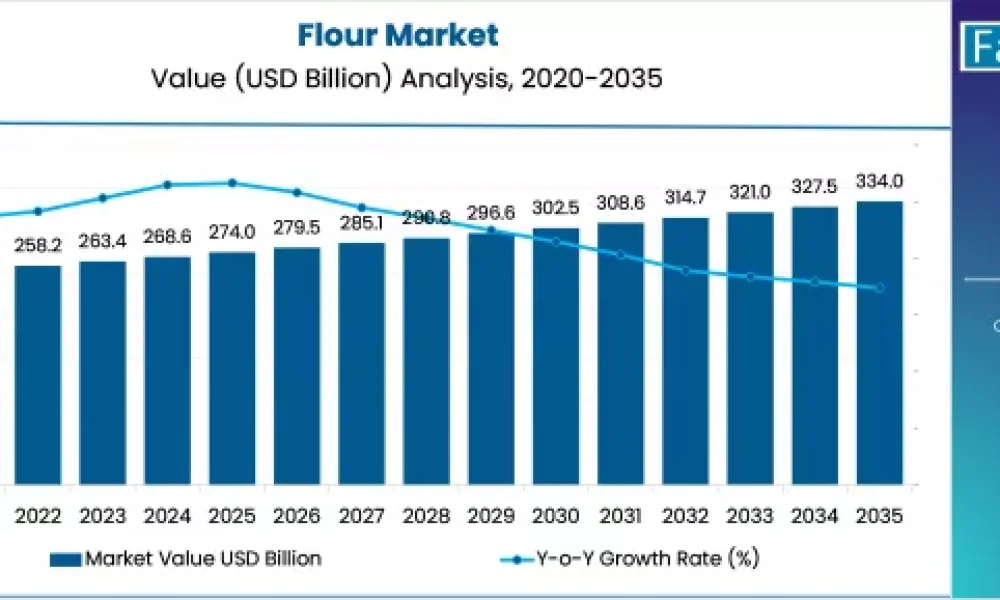
- Flour Market Size (2025): USD 274.0 billion
- Projected Flour Market Size (2035): USD 334.0 billion
- Forecast CAGR of Flour Market (2025 to 2035): 2.0%
- Leading Type Segment of Flour Market: Corn Flour
- Leading End-Use Segment of Flour Market: Household/Retail
- Key Growth Regions of Flour Market: Japan, India, France
- Prominent Players in the Flour Market: ABB Ltd, Accenture plc, ANSYS Inc., AT&T Inc., AVEVA Group plc, Bentley Systems, Others.
Market Segmentation and Opportunities
| Segment | Key Growth Driver | Forecast Trend |
| Wheat Flour | Staple food demand; Fortification programs | Steady volume growth; focus on whole wheat. |
| Pulse & Legume Flour | Plant-based diets; Gluten-free needs | High-margin, rapid CAGR segment. |
| Prepared Mixes | Home baking; QSR (Quick Service Restaurants) | 8–9% annual growth in convenience formulations. |
| Industrial/B2B | Large-scale food processing | Shift toward long-term direct supply contracts. |
Navigating Challenges: Volatility and Sustainability
Despite the optimistic forecast, the industry faces headwinds from climate-induced raw material volatility and geopolitical trade tensions. Fluctuations in wheat and maize yields have historically impacted margins by 15–30%. In response, the market is seeing a move toward regenerative agriculture and localized supply chains to mitigate the risks of global trade disruptions and environmental impact.
About the Flour Market Report
The Global Flour Market Forecast 2026–2036 provides a comprehensive analysis of the flour industry, covering production volumes, pricing trends, and competitive landscapes across 70+ countries. It serves as a critical resource for stakeholders in the food processing, retail, and investment sectors.
Related Reports
Flour Whiteners Market
Flour Treatment Agents Market
00 Flour Market
“



