
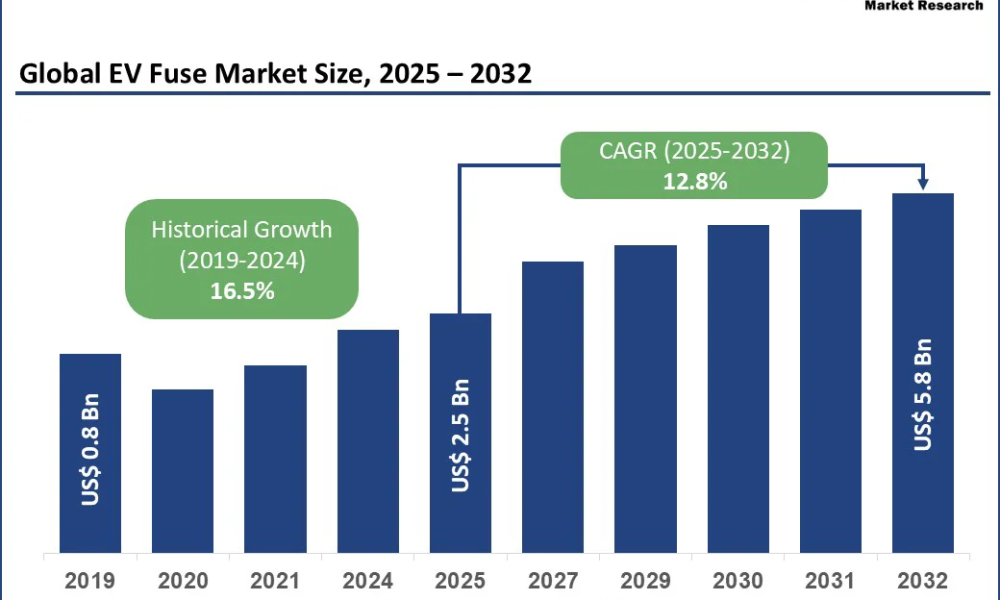
The global Electric Vehicle (EV) fuse market is entering a phase of accelerated growth, underpinned by the rapid electrification of the automotive industry, heightened safety requirements, and increasing investments in advanced power management systems. According to industry assessments aligned with insights from leading market research firms, the EV fuse market is likely to be valued at approximately US$2.5 billion in 2025 and is projected to reach US$5.8 billion by 2032, expanding at a strong compound annual growth rate (CAGR) of 12.8% during the forecast period from 2025 to 2032. This growth trajectory reflects the essential role of fuses in safeguarding critical EV electrical architectures as vehicles become more complex, connected, and power-intensive.
EV fuses are indispensable components designed to protect high-voltage and low-voltage circuits from overcurrent, short circuits, and thermal runaway conditions. With the increasing penetration of battery electric vehicles (BEVs), plug-in hybrid electric vehicles (PHEVs), and hybrid electric vehicles (HEVs), the demand for reliable and high-performance fuse solutions has risen substantially. Modern EVs integrate high-capacity battery packs, advanced power electronics, onboard chargers, DC-DC converters, inverters, and fast-charging interfaces, all of which require specialized fuse solutions capable of handling high voltages, rapid current interruptions, and extreme operating conditions.
Key factors driving market growth include the global push toward decarbonization, supportive government incentives for EV adoption, stringent automotive safety standards, and continuous innovation in battery and powertrain technologies. In addition, the expansion of EV charging infrastructure and the emergence of high-voltage architectures, particularly 800V systems, are amplifying the need for advanced fuse technologies with faster response times and higher breaking capacities. As a result, EV fuses are evolving from basic safety components into strategically critical elements of the electric mobility ecosystem.
Get Your FREE Sample Report Instantly Click Now: https://www.persistencemarketresearch.com/samples/32750
Market Segmentation
By Fuse Type
- High Voltage Fuses
- Low Voltage Fuses
- Medium Voltage Fuses
By Material
- Ceramic
- Plastic
- Glass
By Voltage Rating
- Up to 600V
- 601V to 1000V
- Above 1000V
- Others
By Application
- Electrical Vehicles
- Battery Management Systems
- Charging Stations
- Others
By Region
- North America
- Europe
- East Asia
- South Asia and Oceania
- Latin America
- Middle East and Africa
Get Your FREE Sample Report Instantly Click Now: https://www.persistencemarketresearch.com/request-customization/32750
Regional Insights
From a regional standpoint, Asia Pacific holds the leading position in the global EV fuse market. The region’s dominance is driven by high EV production volumes, strong government support for electric mobility, and the presence of major automotive and battery manufacturers. Countries such as China, Japan, and South Korea have established robust EV supply chains, creating sustained demand for advanced fuse solutions. China, in particular, continues to be a major contributor due to its aggressive EV adoption targets, large domestic market, and continuous investments in charging infrastructure.
Europe represents another significant market, supported by stringent emission regulations, ambitious climate targets, and a strong focus on vehicle safety standards. The region’s emphasis on premium EVs and high-voltage platforms is driving demand for technologically advanced fuses with superior performance characteristics.
North America is expected to witness steady growth, driven by increasing EV adoption, expanding charging infrastructure, and supportive federal and state-level incentives. The United States, in particular, is seeing rising investments in domestic EV manufacturing and battery production, which is positively impacting the EV fuse market.
Among all regions, Asia Pacific is also anticipated to be the fastest-growing market during the forecast period. Rapid urbanization, rising consumer awareness, declining battery costs, and proactive policy frameworks are accelerating EV penetration across emerging economies in the region, thereby fueling demand for EV fuse solutions.
Unique Features and Innovations in the Market
The EV fuse market is undergoing significant transformation, marked by continuous innovation in materials, design, and functionality. Modern EV fuses are differentiated by their ability to operate reliably under high temperatures, high voltages, and harsh automotive environments. Manufacturers are increasingly adopting advanced materials such as ceramic bodies, silver-plated elements, and high-performance arc-quenching technologies to enhance durability and safety.
Technological advancements are also reshaping fuse functionality. Smart fuses, integrated with sensors and communication capabilities, are enabling real-time monitoring of current, temperature, and fault conditions. When combined with vehicle control systems, these fuses support predictive maintenance, improved diagnostics, and faster fault isolation. The integration of IoT-enabled architectures allows data from fuse systems to be transmitted to centralized vehicle management platforms, enhancing overall system intelligence.
Artificial intelligence (AI) is playing an emerging role by enabling data-driven analysis of electrical performance and failure patterns. AI-powered analytics can help OEMs optimize fuse placement, improve system reliability, and reduce downtime. Additionally, the evolution of 5G connectivity is supporting faster and more reliable communication between vehicle components, indirectly enhancing the effectiveness of smart fuse solutions in connected and autonomous EVs.
Market Highlights
One of the key reasons for the widespread adoption of advanced EV fuse solutions is the growing emphasis on vehicle safety and regulatory compliance. Governments and regulatory bodies worldwide are enforcing stringent standards related to electrical safety, battery protection, and crash performance. Compliance with these regulations necessitates the use of high-quality, certified fuse components, driving market demand.
Cost reduction is another important factor shaping adoption. While advanced fuses may involve higher upfront costs, they help minimize long-term expenses by reducing the risk of system failures, recalls, and warranty claims. From a sustainability perspective, EV fuses contribute to safer battery operation and extended component lifecycles, aligning with the broader goals of resource efficiency and environmental responsibility.
The increasing complexity of EV electrical architectures, combined with the push toward fast charging and high-voltage systems, is further reinforcing the strategic importance of fuses within the vehicle ecosystem.
Key Players and Competitive Landscape
The EV fuse market is characterized by the presence of several established players and specialized manufacturers competing on technology, quality, and global reach.
Leading companies in the market include:
- Littelfuse
- Bel Fuse
- Mersen
- Honeywell
- Mitsubishi Electric
- Fuseco
- TE Connectivity
- Eaton
- General Electric
- SIBA
- Phoenix Contact
- ABB
- Schneider Electric
- Siemens
- Rockwell Automation
- Others
Littelfuse is recognized for its extensive portfolio of automotive and high-voltage fuse solutions, with a strong focus on innovation and close collaboration with OEMs. Eaton leverages its expertise in power management to deliver advanced fuse and circuit protection solutions tailored for next-generation EV platforms. Mersen is known for its high-performance fuse technologies and strong presence in high-voltage applications, particularly in battery and power electronics systems.
Schurter and SIBA emphasize precision engineering and compliance with international safety standards, catering to both OEM and industrial EV applications. Sensata Technologies focuses on integrating sensing and protection technologies, positioning itself strongly in the emerging smart fuse segment. These companies are actively pursuing strategies such as product innovation, capacity expansion, and regional market penetration to strengthen their competitive positions.
Ready to Dive Deep? Buy Full Report Today: https://www.persistencemarketresearch.com/checkout/32750
Future Opportunities and Growth Prospects
Looking ahead, the EV fuse market is expected to benefit from several emerging opportunities. The continued evolution of solid-state batteries, ultra-fast charging systems, and autonomous driving technologies will further increase the complexity and power demands of EV electrical systems, creating new requirements for advanced fuse solutions. As vehicle architectures shift toward centralized and software-defined systems, the role of intelligent protection components is likely to expand.
Evolving regulations related to battery safety, recycling, and lifecycle management will also shape market dynamics, encouraging manufacturers to invest in compliant and future-ready fuse technologies. Furthermore, the growth of electric commercial vehicles, two-wheelers, and off-highway EVs presents additional avenues for market expansion.
In conclusion, the global EV fuse market is set for sustained and robust growth through 2032, driven by electrification trends, technological innovation, and regulatory support. As EVs become the cornerstone of future mobility, fuses will remain a critical enabler of safety, reliability, and performance across the electric vehicle value chain.




