
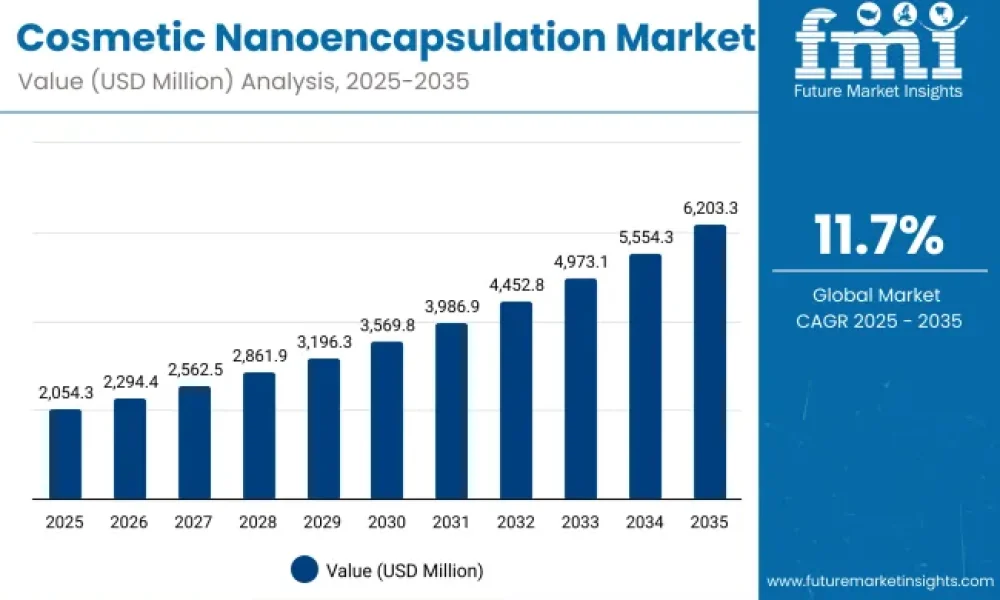
The global cosmetic nanoencapsulation market is entering a decade of accelerated expansion, with market value projected to rise from USD 2,054.3 million in 2025 to USD 6,203.3 million by 2035, according to newly updated industry estimates. This represents an absolute increase of USD 4,149.0 million and a cumulative growth of 193%, equivalent to a compound annual growth rate (CAGR) of 11.7%.
The forecast reflects growing adoption of nano-carrier technologies across skincare, suncare, haircare, and color cosmetics, driven by demand for more stable, high-performance, and dermatologically validated cosmetic formulations. Lipid nanoparticles remain the leading carrier system, accounting for 36.4% of global market value in 2025, while skincare dominates applications with a 55.6% share.
Explore comprehensive market trends, regional outlooks, and competitive intelligence – Get a Sample Copy Now
Market Context: From Premium Skincare to Mass-Market Formulation Platforms
- Cosmetic nanoencapsulation involves embedding active ingredients—such as retinoids, vitamins, UV filters, peptides, and brightening agents—inside nanoscale carriers to improve stability, penetration, and controlled release. The technology has moved from a niche innovation in dermocosmetics to a core formulation strategy for global beauty brands.
- Between 2020 and 2024, the market expanded from USD 1,240 million to USD 1,900 million, led primarily by skincare-centric adoption. Specialty ingredient manufacturers controlled nearly 60% of revenue during this period, with companies such as Lipotec (Lubrizol), Evonik, and Croda focusing on lipid- and polymer-based delivery platforms for anti-aging and sun protection products.
- By 2025, demand is expected to reach USD 2,054.3 million as polymeric nanocapsules and nanoemulsions grow to more than 50% combined share. Traditional lipid-based leaders are facing rising competition from biotech-driven and digital-first players offering AI-personalized skincare delivery and cloud-enabled formulation design.
Growth Outlook: Two-Phase Expansion Through 2035
From 2025 to 2030, the market is forecast to grow from USD 2,054.3 million to USD 3,569.8 million, adding USD 1,515.5 million and accounting for 36.5% of total decade growth. This phase is characterized by steady adoption in anti-aging skincare, suncare, and dermocosmetics, particularly for stable delivery of retinoids, vitamins, and UV filters. Lipid nanoparticles dominate this stage, serving more than 30% of encapsulation needs.
The second half of the decade, from 2030 to 2035, contributes USD 2,633.5 million, or 63.5% of total growth, as the market accelerates to USD 6,203.3 million. Growth is driven by wider deployment of nanoemulsions in haircare and color cosmetics, peptide-loaded polymeric nanocapsules, and AI-assisted personalization through smart beauty platforms. By the end of the period, UV filters and brightening agents together are expected to capture more than 40% of active-class demand.
Segment Highlights: Lipid Nanoparticles, UV Filters, and Skincare Lead
Lipid nanoparticles (SLN/NLC) are projected to contribute 36.4% of global revenue in 2025, maintaining leadership due to biocompatibility, skin safety, and strong EU regulatory acceptance. They are widely used to stabilize retinoids, enhance vitamin absorption, and disperse UV filters in skincare and suncare products.
UV filters account for 27.3% of the market in 2025, valued at approximately USD 560.3 million. Encapsulation improves photostability, reduces irritation, and extends protection, making it central to reformulated sunscreens and multifunctional skincare. The broader “other actives” category—including retinoids, vitamins, peptides, growth factors, and brightening agents—holds 72.7% share, driven by anti-aging and brightening serums.
Skincare remains the dominant application, with a 55.6% share, supported by encapsulation technologies that improve retinoid tolerance, vitamin stability, and long-lasting UV protection across serums, lotions, and essences.
Regional Dynamics: APAC Emerges as the Primary Growth Engine
Asia-Pacific is the fastest-growing region, led by India (19.6% CAGR) and China (17.4% CAGR) between 2025 and 2035. Growth is tied to rising middle-class demand, strong brightening culture, and early adoption of science-backed beauty claims. Japan follows with a 14.1% CAGR, supported by anti-aging and sun protection needs.
Mature markets show steadier growth. The United States expands at 7.3% CAGR, driven by dermocosmetics and encapsulated retinoids, vitamins, and UV filters. Germany (8.5%) and the UK (11.3%) remain key European markets, supported by regulatory compliance and luxury skincare demand.
Competitive Landscape and Industry Direction
The market is moderately fragmented. Lipotec (Lubrizol) holds 7.6% of global value share in 2025, with other major players including Evonik, BASF, Croda, Tagra Biotechnologies, Seppic, Gattefossé, Lucas Meyer Cosmetics, Nanophase Technologies, and Ashland.
Competitive differentiation is shifting from raw encapsulation technology toward ecosystem integration, including regulatory credibility, AI-assisted formulation, and personalization scalability. Recent developments include Lipotec’s nanoencapsulated retinol system launched in March 2024 and Tagra Biotechnologies’ patented encapsulated UV filter platform introduced in July 2024.
Why the Market Is Growing
Key drivers include rising demand for high-performance and stable cosmetic formulations, regulatory push toward EU-compliant nano-delivery systems, and rapid expansion of APAC beauty markets. Restraints include high production costs, scale-up challenges, regulatory ambiguity in some regions, and mixed consumer perceptions of nanotechnology.
Despite these challenges, cosmetic nanoencapsulation is becoming a foundational technology for next-generation beauty products. As personalization, dermocosmetics, and multifunctional formulations gain traction, nano-delivery systems are expected to remain central to innovation across the global cosmetics industry.
Have a specific Requirements and Need Assistant on Report Pricing or Limited Budget please contact us – [email protected]
About Future Market Insights (FMI)
Future Market Insights, Inc. (FMI) is an ESOMAR-certified, ISO 9001:2015 market research and consulting organization, trusted by Fortune 500 clients and global enterprises. With operations in the U.S., UK, India, and Dubai, FMI provides data-backed insights and strategic intelligence across 30+ industries and 1200 markets worldwide
Why Choose FMI: https://www.futuremarketinsights.com/why-fmi



