
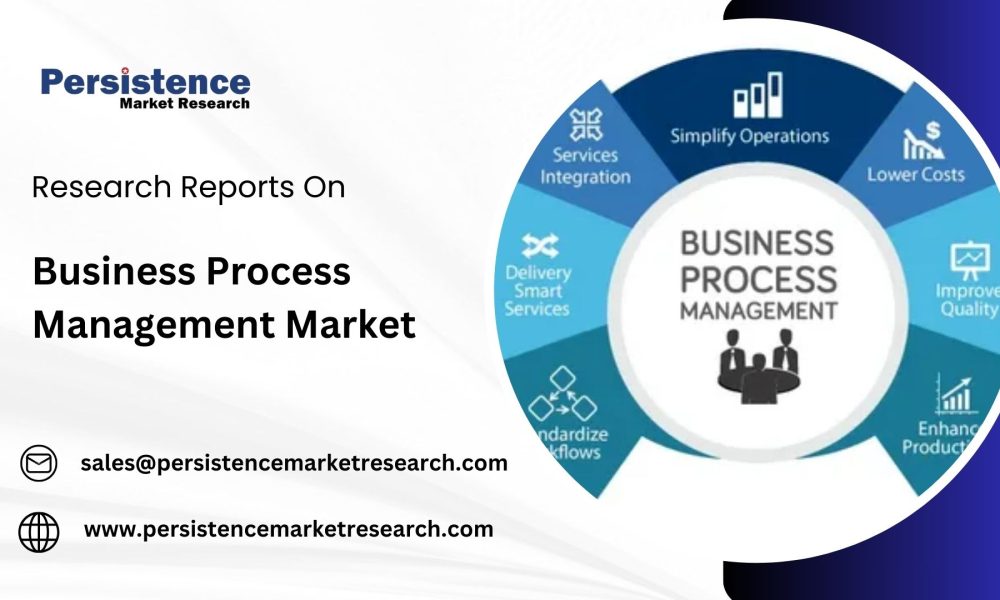
The global business process management (BPM) market is undergoing a transformative phase, driven by technological advancements and the growing need for operational efficiency. Valued at approximately US$ 20.7 billion in 2024, the market is projected to expand at a robust CAGR of 17.9%, reaching an estimated US$ 65.4 billion by 2031. This remarkable growth underscores the rising importance of BPM solutions in modern organizations and the increasing adoption of innovative technologies such as artificial intelligence (AI) and machine learning (ML) to optimize business processes.
Understanding Business Process Management
Business process management refers to the strategic approach organizations use to design, execute, monitor, and improve their processes. BPM solutions aim to streamline workflows, reduce redundancies, enhance efficiency, and ensure compliance with regulatory standards. Traditionally, BPM involved manual oversight and rule-based automation. However, the integration of AI and ML is redefining BPM capabilities, enabling organizations to leverage data-driven insights for smarter and faster decision-making.
AI and Machine Learning Driving BPM Evolution
The rise of AI and ML within BPM software is transforming how businesses approach process automation. Companies are increasingly relying on these technologies to optimize operations, reduce costs, and enhance customer experiences. AI integration allows BPM systems to go beyond simple task automation, enabling predictive analytics, process optimization, and intelligent decision-making.
According to recent estimates, 64% of organizations worldwide plan to deploy AI and ML tools in their BPM systems by 2026. This trend highlights a growing dependence on AI-driven tools for operational efficiency, competitive advantage, and agility in decision-making. By leveraging AI algorithms, businesses can analyze historical and real-time data to identify bottlenecks, predict outcomes, and recommend corrective actions.
Generative AI and BPM: Expanding the Horizons
One of the most significant technological advancements influencing BPM today is generative AI. Tools like GPT and other AI-driven content generation systems are being integrated into BPM platforms to enhance productivity and streamline routine tasks. Generative AI can assist in tasks such as:
- Summarization: Automatically generating concise reports from extensive data sets, enabling managers to make faster and more informed decisions.
- Conversational interactions: Facilitating natural language-based interfaces within BPM systems for seamless communication between employees and the software.
- Content drafting: Creating operational documents, emails, and process guidelines with minimal human intervention, saving time and resources.
Organizations that have implemented AI-integrated BPM solutions report a 30% improvement in process efficiency alongside a 25% reduction in operational costs. These figures reflect the tangible benefits of adopting intelligent process management systems.
Market Drivers and Growth Factors
Several factors are contributing to the rapid expansion of the BPM market:
- Digital Transformation Initiatives: Organizations across industries are embracing digital transformation, seeking to automate workflows and improve operational agility. BPM solutions are central to these initiatives, offering tools that enable process standardization and real-time monitoring.
- Demand for Operational Efficiency: Companies are constantly looking to reduce costs, eliminate redundancies, and enhance productivity. BPM software, particularly AI-enabled systems, provides actionable insights that help achieve these goals.
- Regulatory Compliance Needs: Businesses face increasingly complex regulatory environments. BPM platforms help ensure compliance through automated monitoring, reporting, and process documentation.
- Remote and Hybrid Work Models: The shift toward remote and hybrid work models has increased the demand for digital process management solutions. BPM tools enable teams to collaborate efficiently, track tasks, and maintain accountability, irrespective of location.
- Integration with Emerging Technologies: The synergy between BPM, AI, ML, robotic process automation (RPA), and data analytics is creating a new wave of intelligent process management solutions. This integration allows organizations to move from reactive to predictive and prescriptive process management.
Regional Market Insights
The BPM market is witnessing dynamic growth across various regions:
- North America remains a dominant player due to early adoption of technology, robust IT infrastructure, and a high concentration of BPM solution providers. The United States, in particular, leads in deploying AI-driven BPM systems across industries such as finance, healthcare, and manufacturing.
- Europe is experiencing steady growth fueled by stringent regulatory requirements, digitization of business processes, and the adoption of cloud-based BPM solutions.
- Asia-Pacific is emerging as a high-growth market, driven by rapid industrialization, increased IT investments, and growing awareness of the benefits of process automation in countries such as China, India, and Japan.
- Middle East & Africa and Latin America are gradually adopting BPM solutions, with cloud-based deployment models helping overcome infrastructure constraints.
Key Applications of BPM Solutions
BPM systems are versatile and can be applied across various business functions, including:
- Finance and Accounting: Automating invoice processing, payroll management, and financial reporting to improve accuracy and efficiency.
- Human Resources: Streamlining recruitment, onboarding, and employee performance management.
- Supply Chain Management: Enhancing inventory tracking, order processing, and logistics coordination.
- Customer Service: Improving response times and service quality through automated workflows and AI-driven insights.
- Compliance and Risk Management: Ensuring regulatory adherence, monitoring risk factors, and maintaining detailed audit trails.
The integration of AI and ML further enhances these applications by providing predictive insights, anomaly detection, and decision support tools that facilitate proactive management of operations.
Challenges in BPM Adoption
Despite the numerous advantages, organizations may face certain challenges in adopting BPM solutions:
- Implementation Complexity: Deploying BPM systems, especially AI-integrated platforms, can require significant resources, planning, and expertise.
- Data Privacy Concerns: With increased automation and AI analytics, safeguarding sensitive organizational data becomes critical.
- Change Management: Employees may resist process changes or automation initiatives, necessitating proper training and organizational alignment.
- Integration with Legacy Systems: Many organizations rely on legacy infrastructure, which may pose compatibility issues with modern BPM solutions.
Future Outlook
The future of the BPM market is closely tied to intelligent process automation. As organizations continue to prioritize efficiency and innovation, BPM platforms will evolve from traditional workflow management tools to AI-driven decision support systems. The integration of emerging technologies such as generative AI, RPA, blockchain, and IoT will further enhance process intelligence, agility, and scalability.
Moreover, the trend toward hyper-automation—a combination of BPM, AI, and RPA—is expected to redefine business operations, enabling companies to respond quickly to market changes and customer demands. By 2031, AI-integrated BPM solutions are projected to become the standard, driving significant productivity gains and cost reductions across industries.
Conclusion
The global business process management market is on a trajectory of rapid growth, fueled by technological innovation, digital transformation initiatives, and the increasing adoption of AI and machine learning. From streamlining workflows to enabling intelligent decision-making, BPM platforms are proving to be essential for modern organizations striving to stay competitive.
With an anticipated market value of US$ 65.4 billion by 2031, businesses that embrace AI-integrated BPM systems will gain a substantial advantage in efficiency, cost management, and operational agility. As generative AI, RPA, and predictive analytics continue to evolve, the BPM landscape will increasingly support data-driven, automated, and intelligent processes that redefine the way organizations operate.
Investing in BPM today is no longer optional—it is a strategic imperative for organizations aiming to thrive in an increasingly complex and competitive business environment. The future belongs to businesses that leverage intelligent process management to unlock innovation, accelerate decision-making, and achieve sustainable growth.
Related Reports:




