
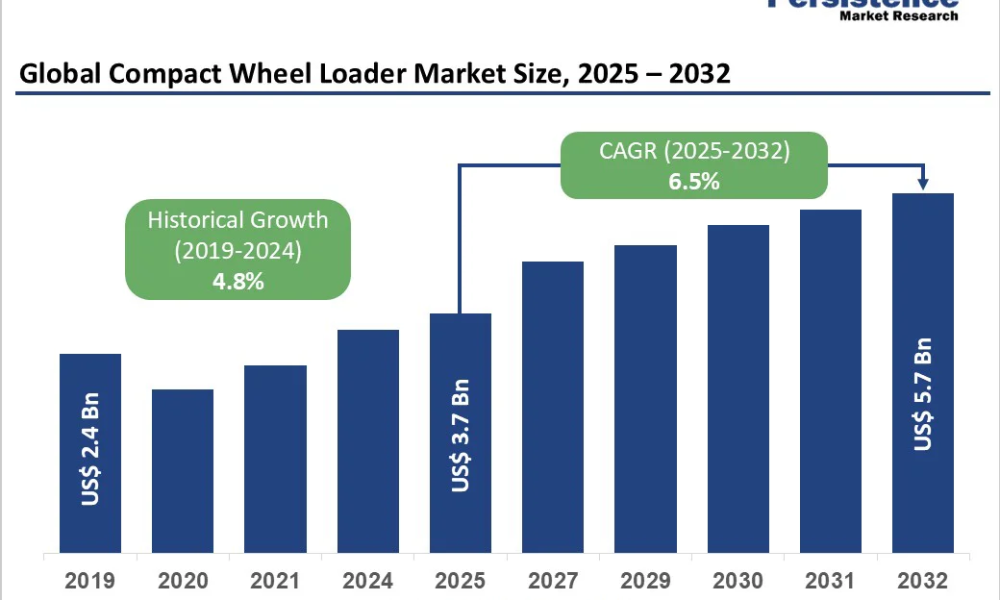
The global compact wheel loader market is projected to witness substantial growth over the next decade, driven by increasing construction activities, rapid urbanization, and expanding material handling requirements across industries. According to leading market research firms, the market size is estimated at US$ 3,713.0 million in 2025 and is expected to reach US$ 5,749.8 million by 2032, growing at a compound annual growth rate (CAGR) of 6.5% between 2025 and 2032.
Compact wheel loaders are heavy-duty machines equipped with front-mounted buckets operated by hydraulic arms. Their primary applications include loading, lifting, transporting, and dumping bulk materials such as soil, gravel, sand, construction debris, and agricultural products. In the construction sector, these machines are indispensable for earthmoving, site preparation, backfilling, and loading materials onto trucks. Similarly, in agricultural and industrial settings, they facilitate faster material handling, enhancing operational efficiency and reducing manual labor requirements.
Several factors are fueling the growth of the compact wheel loader market. Increasing infrastructure spending in emerging economies, expansion of urban development projects, and the rising need for efficient material handling solutions are key contributors. Furthermore, the growing adoption of technologically advanced wheel loaders, offering superior fuel efficiency, enhanced operator comfort, and intelligent automation features, is boosting demand across regions.
Get Your FREE Sample Report Instantly Click Now: https://www.persistencemarketresearch.com/samples/35396
Key Highlights from the Report
➤ The global compact wheel loader market is projected to grow from US$ 3,713.0 million in 2025 to US$ 5,749.8 million by 2032, reflecting a CAGR of 6.5% during the forecast period.
➤ Increasing urbanization and infrastructure development are driving higher demand in Asia Pacific and North America.
➤ The adoption of electric and hybrid compact wheel loaders is accelerating, driven by environmental regulations and cost-efficiency considerations.
➤ Technological integration, such as IoT-enabled fleet management and AI-driven operational optimization, is transforming machine productivity and maintenance.
➤ Rising demand from the agriculture sector, particularly for material handling of feed, fertilizer, and produce, is creating additional market opportunities.
➤ Strategic expansions by leading manufacturers through mergers, acquisitions, and regional partnerships are intensifying market competition.
Segmentation Analysis
By Type
The compact wheel loader market is primarily segmented by machine type, including standard compact wheel loaders, articulated loaders, and mini wheel loaders. Among these, standard compact wheel loaders dominate the market due to their versatility, higher load capacity, and widespread adoption across construction and industrial applications. Articulated loaders are witnessing rapid growth in urban construction and agricultural sectors, attributed to their maneuverability in confined spaces and superior turning radius. Meanwhile, mini wheel loaders are gaining traction in small-scale construction, landscaping, and municipal operations, where compact dimensions and fuel efficiency are critical considerations.
By Vehicle/Product/Service Type
Based on product offerings, the market is categorized into engine-powered loaders, electric loaders, and hybrid loaders. Traditional diesel-powered compact wheel loaders still account for the largest share due to established infrastructure and reliability. However, electric loaders are rapidly gaining adoption in environmentally sensitive projects and regions with stringent emission norms. Hybrid loaders offer the advantage of reduced fuel consumption and lower operational costs, appealing to contractors seeking sustainable solutions without compromising performance.
By Propulsion/Technology/Channel
Propulsion technology has become a differentiating factor in the market. Internal combustion engines remain prevalent, but electric and hybrid propulsion technologies are increasingly being integrated. Advanced hydraulic systems, telematics, and automated control mechanisms are enhancing operational precision, fuel efficiency, and safety. Additionally, manufacturers are leveraging connected platforms and IoT technology to offer predictive maintenance, remote diagnostics, and fleet management solutions. These innovations improve machine uptime, reduce maintenance costs, and optimize resource allocation across construction sites.
Regional Insights
Regionally, North America and Asia Pacific are the leading markets for compact wheel loaders. North America benefits from established construction infrastructure, high mechanization levels, and strong aftermarket support, while Asia Pacific is witnessing rapid urbanization and industrialization, driving robust demand for material handling equipment. Among emerging regions, Asia Pacific is anticipated to be the fastest-growing market, fueled by increasing government infrastructure initiatives, growing investments in transportation and logistics, and rising construction activities in countries such as China, India, and Southeast Asian nations.
Europe remains a significant market, with demand driven by strict emission regulations and sustainability mandates. The introduction of electric compact wheel loaders in the European market has accelerated adoption among environmentally conscious contractors. Latin America and the Middle East & Africa are witnessing steady growth, primarily driven by infrastructure development, mining operations, and agricultural mechanization.
Customize This Report for Your Exact Requirements: https://www.persistencemarketresearch.com/request-customization/35396
Unique Features and Innovations in the Market
Modern compact wheel loaders are no longer simple lifting machines; they incorporate advanced features that differentiate them from traditional models. Smart hydraulic systems allow operators to control load movement with precision, reducing spillage and improving efficiency. Telemetry and IoT-enabled connectivity enable remote monitoring of machine health, usage patterns, and predictive maintenance schedules. AI-powered software enhances operational decision-making by optimizing load cycles, fuel consumption, and route planning on construction sites.
Moreover, the integration of 5G technology in fleet management allows for real-time communication, seamless remote diagnostics, and faster troubleshooting. Safety features such as automated braking, collision avoidance systems, and operator fatigue monitoring have significantly improved workplace safety standards. These technological advancements collectively enhance productivity, minimize downtime, and reduce operational costs, thereby increasing market attractiveness.
Market Highlights
The adoption of compact wheel loaders is driven by multiple factors. Businesses prioritize operational efficiency, cost reduction, and adherence to environmental regulations. Compact wheel loaders reduce manual labor, increase material handling speed, and enhance project timelines. Sustainability considerations, including reduced fuel emissions and lower noise levels, are encouraging the adoption of electric and hybrid loaders. Additionally, regulatory incentives for green machinery adoption in Europe and North America have positively impacted market growth.
The construction, agriculture, and industrial sectors benefit from modular loader attachments that enable versatile operations, from material transport to earthmoving. Cost-effectiveness, fuel efficiency, and low maintenance requirements further support adoption. Contractors are increasingly deploying connected fleet solutions to monitor performance metrics and optimize resource allocation, driving demand for technologically advanced machines.
Key Players and Competitive Landscape
The global compact wheel loader market is highly competitive, dominated by established equipment manufacturers. Key players include:
✦ Caterpillar Inc. – A global leader in construction equipment, Caterpillar focuses on product innovation, expanding its electric and hybrid loader offerings, and strengthening its global distribution network.
✦ Komatsu Ltd. – Known for its high-performance machinery, Komatsu emphasizes smart hydraulic systems and AI integration to improve loader efficiency and reduce fuel consumption.
✦ Volvo Construction Equipment – Volvo leverages advanced telematics, electric propulsion, and operator safety technologies, enhancing productivity and sustainability.
✦ JCB – JCB has expanded its mini and compact wheel loader portfolio while introducing innovative hybrid models to meet emission norms and urban construction requirements.
✦ Bobcat Company – Bobcat is focused on compact loader versatility, offering a wide range of attachments, operator-friendly designs, and IoT-enabled fleet management solutions.
✦ Doosan Infracore – Doosan emphasizes product durability, fuel efficiency, and the integration of connected technologies to optimize machine utilization in construction and industrial sectors.
Recent Developments
- Introduction of fully electric compact wheel loaders by major manufacturers to comply with stringent environmental regulations and promote sustainable construction practices.
- Strategic acquisitions and partnerships to expand regional presence in Asia Pacific and North America, enabling companies to capture emerging market opportunities and enhance after-sales support networks.
Ready to Dive Deep? Buy Full Report Today: https://www.persistencemarketresearch.com/checkout/35396
Future Opportunities and Growth Prospects
The compact wheel loader market is expected to witness robust growth opportunities over the coming years. Increased adoption of electric and hybrid loaders in urban construction projects, coupled with government incentives for green machinery, will drive market expansion. Integration of AI, IoT, and 5G technologies will redefine fleet management and operational efficiency, further encouraging adoption.
The rise of smart city initiatives, growing demand for automation in construction and agriculture, and the expansion of mining and industrial operations provide substantial opportunities for manufacturers and service providers. Additionally, innovations in modular attachments, autonomous operation, and predictive maintenance solutions are expected to create a new wave of value-added offerings in the market.
Evolving regulations around emissions, safety, and sustainability will continue to shape product development and market strategies. Companies investing in R&D for energy-efficient propulsion systems, AI-based operational tools, and connected fleet solutions are likely to gain a competitive edge. The focus on minimizing operational costs while maximizing productivity will remain central to industry growth, ensuring that compact wheel loaders continue to be an essential component of modern construction and material handling operations.




