
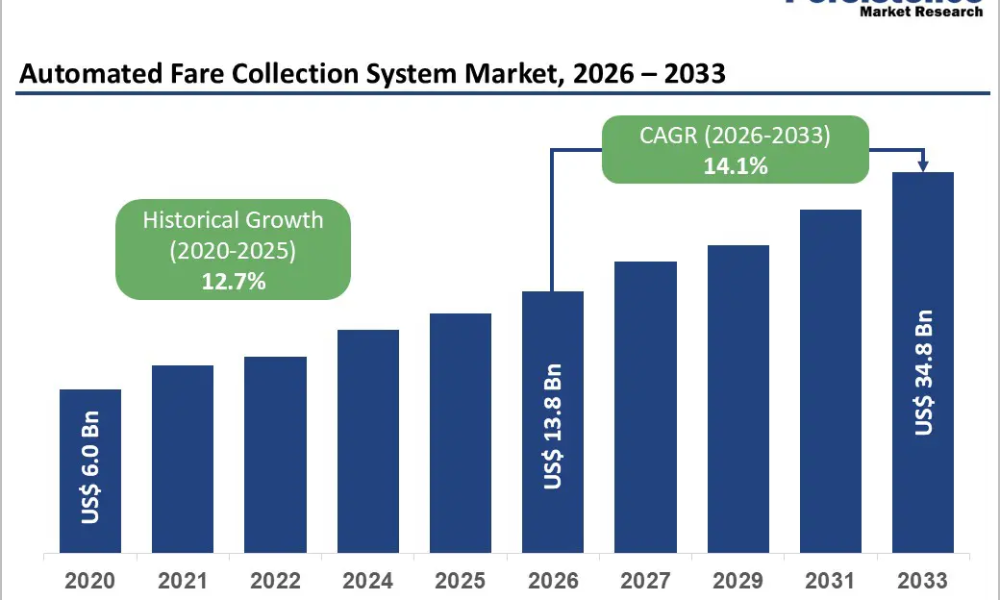
The global Automated Fare Collection (AFC) System Market is entering a period of accelerated growth, fueled by rapid urbanization, technological innovation, and increasing investment in public transportation infrastructure. According to recent industry analysis from leading market research firms, the global Automated Fare Collection System market size is projected to be valued at US$ 13.8 billion in 2026 and is forecast to reach US$ 34.8 billion by 2033, registering a strong compound annual growth rate (CAGR) of 14.1% during the forecast period.
Automated fare collection systems are integrated payment solutions designed to streamline ticketing, fare management, and passenger access control across public transportation networks. These systems utilize advanced technologies such as contactless smart cards, mobile payments, QR code ticketing, biometric authentication, and cloud-based fare management platforms. The rising demand for efficient transportation systems, coupled with the need for seamless commuter experiences, is significantly accelerating market adoption.
A key factor driving market expansion is the increasing rate of urbanization across emerging and developed economies. With urban populations growing rapidly, public transportation authorities are prioritizing automation to handle higher passenger volumes efficiently. Automated fare collection systems enable faster boarding, reduced queues, and enhanced operational efficiency, thereby improving overall system reliability and commuter satisfaction.
Get Your FREE Sample Report Instantly Click Now: https://www.persistencemarketresearch.com/samples/6457
Market Segmentation
Component
- Hardware
- Software
Technology
- Smart Card
- Magnetic Stripe
- Near-field Communication (NFC)
- Optical Character Recognition (OCR)
Application
- Railways & Transportation
- Parking
- Entertainment
- Others (Government, Retail)
Media
- Smart Cards
- Mobile Ticketing
- Wearables
By Region
- North America
- Europe
- East Asia
- South Asia and Oceania
- Latin America
- Middle East and Africa
Regional Insights
Asia-Pacific Leads Global Market Expansion
The Asia-Pacific region currently dominates the automated fare collection system market and is expected to maintain its leadership position throughout the forecast period. Countries such as China, India, Japan, and South Korea are investing heavily in metro rail, high-speed rail, and bus rapid transit systems.
Rapid urban population growth, expanding public transportation networks, and government-led smart city initiatives are key drivers supporting regional market growth. India, in particular, is witnessing extensive metro rail expansion across major cities, including Delhi, Mumbai, and Bangalore, driving demand for advanced fare collection technologies.
North America Maintains Strong Technological Leadership
North America remains a major market due to early adoption of advanced fare collection technologies and strong investment in transportation modernization. The United States and Canada have implemented account-based fare collection systems across major transit networks.
Public transportation authorities in North America are focusing on upgrading legacy systems to cloud-based platforms, enabling improved passenger analytics and operational efficiency.
Europe Demonstrates Steady Growth
Europe represents a mature and technologically advanced market. Countries such as Germany, United Kingdom, and France are investing in interoperable ticketing systems to enable seamless cross-border travel.
European transportation agencies are prioritizing sustainability and efficiency, encouraging adoption of automated systems that reduce operational costs and environmental impact.
Middle East and Latin America Emerging as Fastest-Growing Regions
The Middle East and Latin America are expected to witness the fastest growth rates due to expanding metro infrastructure and smart city development. Countries such as United Arab Emirates and Brazil are deploying advanced AFC solutions to support growing transportation demands.
Customize This Report for Your Exact Requirements: https://www.persistencemarketresearch.com/request-customization/6457
Unique Features and Innovations in the Market
Modern automated fare collection systems incorporate advanced digital technologies that significantly enhance efficiency, security, and passenger experience. Artificial intelligence (AI) is increasingly used to analyze passenger traffic patterns, predict demand fluctuations, and optimize fare pricing models. AI-driven analytics enable transportation agencies to improve operational planning and maximize revenue.
The integration of Internet of Things (IoT) technology allows real-time communication between fare collection devices, central servers, and transit infrastructure. IoT-enabled sensors provide valuable data on passenger movement, equipment performance, and system health, enabling predictive maintenance and reducing downtime.
The adoption of 5G connectivity is further enhancing AFC system performance. High-speed, low-latency communication enables faster transaction processing, real-time validation, and seamless integration with mobile devices and cloud platforms.
Cloud computing is transforming fare collection systems by enabling centralized data management and remote system monitoring. Cloud-based platforms provide scalability, flexibility, and cost efficiency, allowing transportation operators to manage complex networks effectively.
Biometric authentication technologies, including facial recognition and fingerprint scanning, are also emerging as innovative solutions. These systems improve security while eliminating the need for physical tickets or cards.
Market Highlights
Automated fare collection systems are increasingly being adopted across transportation networks due to their ability to improve operational efficiency and enhance passenger convenience. These systems reduce manual ticket handling, minimize human error, and improve revenue transparency.
Governments worldwide are supporting the adoption of automated fare systems through infrastructure investments and digital transformation initiatives. Smart city programs emphasize the integration of intelligent transportation systems, including automated fare collection solutions.
Cost reduction is another significant driver. Automated systems reduce labor costs associated with manual ticketing and improve revenue collection accuracy. Additionally, automated fare systems support environmental sustainability by reducing paper ticket usage and promoting digital transactions.
Transportation operators are leveraging AFC systems to enhance passenger satisfaction by providing faster, more convenient payment options. Seamless payment integration with smartphones and digital wallets is becoming a standard expectation among commuters.
Key Players and Competitive Landscape
The automated fare collection system market is highly competitive, with several global technology providers leading innovation and deployment. Major companies are focusing on strategic partnerships, product innovation, and geographic expansion to strengthen their market position.
✦ Thales Group is a global leader in transportation technology, offering advanced AFC solutions integrated with cybersecurity and cloud capabilities.
✦ Cubic Corporation provides comprehensive fare collection platforms widely used in metro and transit systems worldwide, focusing on account-based ticketing solutions.
✦ NEC Corporation specializes in biometric fare collection systems and AI-driven transportation analytics.
✦ Siemens Mobility delivers integrated fare collection solutions as part of its smart mobility portfolio, emphasizing digital transformation.
✦ Hitachi Rail offers cloud-based fare management platforms designed for scalable transit networks.
✦ Conduent Incorporated focuses on digital payment integration and automated fare processing technologies.
✦ Samsung SDS provides advanced fare collection systems integrated with blockchain and mobile technologies.
✦ LG CNS develops smart transportation solutions with cloud-based fare management platforms.
These companies are investing heavily in research and development to enhance system capabilities and maintain competitive advantages.
Recent Developments
- In 2025, Thales Group launched an advanced account-based ticketing platform designed to integrate multiple transportation modes, improving passenger convenience and operational efficiency.
- In 2024, Cubic Corporation expanded its contactless fare payment technology across major metropolitan transit networks, enabling seamless payment using mobile wallets and bank cards.
These developments highlight the industry’s focus on innovation, interoperability, and digital transformation.
Ready to Dive Deep? Buy Full Report Today: https://www.persistencemarketresearch.com/checkout/6457
Future Opportunities and Growth Prospects
The future of the automated fare collection system market remains highly promising, driven by ongoing technological advancements and expanding public transportation infrastructure. The increasing adoption of smart city initiatives worldwide will continue to create substantial growth opportunities for AFC system providers.
Emerging technologies such as AI, blockchain, and biometric authentication are expected to play a transformative role in shaping the future of fare collection systems. Blockchain technology offers enhanced security and transparency, reducing fraud and improving payment reliability.
The integration of AFC systems with mobility-as-a-service (MaaS) platforms represents another major growth opportunity. MaaS platforms enable commuters to access multiple transportation services through a single application, simplifying travel and improving convenience.
Government regulations promoting digital payments and smart infrastructure will further accelerate market adoption. Transportation authorities are increasingly mandating automated fare systems to improve efficiency and transparency.
In addition, the expansion of metro rail networks, high-speed rail systems, and bus rapid transit systems across emerging economies will significantly contribute to market growth.
As urban populations continue to grow and transportation systems become more complex, automated fare collection systems will play a critical role in enabling efficient, secure, and seamless public transportation worldwide. The combination of technological innovation, infrastructure investment, and regulatory support positions the automated fare collection system market for sustained long-term growth through 2033 and beyond.




